Monday, June 24, 2013

midsummer night’s dreaming


Across midsummer weekend (21–23 June) the Royal Shakespeare Company put on a unique performance of “Midsummer Night’s Dream” - directed by Artistic Director Gregory Doran and working in partnership with Google Creative Lab to provide a one-off theatre project in real time and viewable via the internet.
Hannah’s husband Felix was one of a number of actors invited back to the RSC to perform the play (with just a week’s rehearsal time!) and so Hannah, Ursula, Moira+I went to Stratford yesterday to watch some of the action. Felix played the part of “Snug” (one of the “Mechanicals”).
Obviously, much of the action took place out of doors and, this being midsummer in England, account needed to be taken of a certain amount of inclement weather! We attended some of yesterday afternoon’s rehearsals and “wedding events”.
A lovely, happy, relaxed atmosphere and a very enjoyable day.
Photo: Felix (the lion!) and some the other “Mechanicals” plus Google cameraman and props person… you can see other rehearsal images here (including one where the prompter is sheltering through the action under an umbrella!).
PS: as well as being able to watch the play “in real time” over the course of the weekend, hopefully, there will be an audio of the performance available in due course via this link.

Saturday, June 22, 2013

alice roberts at bristol’s big green week


As one or two of you may know, I think Alice Roberts is quite a talented broadcaster(!)… (ok, I mean, she can do no wrong in my book). I went along to the lunchtime lecture at the Arnolfini today to hear her talk about “Survivors of the Ice Age” (filling in the background to her recent BBC series, amongst other things). She spoke informatively and entertainingly for 50 minutes, without notes, before answering questions from the audience.
There’s something incredibly inspiring to hear someone talk with huge passion and knowledge about their subject.
She’s a brilliant communicator... and I want to be a scientist when I grow up.
Photo: après-lecture conversations.


Thursday, June 20, 2013

protest


Erdem Gunduz, pictured, has become a legend… just by standing completely still. He began to stand still, and silent, in Taksim Square, Istanbul last Monday at 6pm and remained there until 2am. In a matter of hours, his photograph was being shared globally.  
Dignified, powerful, passive resistance.
As someone who is frequently accused (in a friendly, light-hearted way) of ranting – via this blog or on facebook, perhaps I could learn something from Mr Gunduz!

Anyway, I’ve been reflecting on last week’s G8 Summit…
Although any solutions on Syria remain sadly far off, I’m relieved that the immediate prospect of arming the opposition to the Assad government has apparently been put on the back burner – at least for the time being. What WAS heartening, however, was that the G8 has made it clear that tax abuse is an issue of the highest priority and that tax evasion is within the G8 mandate and the requirement has been established to crack open the secrecy on tax havens.
Over the years, I’ve read several books by Peter Millar (former Warden of the Iona Community) and I’m currently reading “A Time To Mend: Reflections In Uncertain Times”. I’ve always found him a very wise man and someone well worth listening to… on a wide range of subjects. Whilst the G8 Summit’s intentions on tax are hardly mind-shatteringly new (or far-reaching), they do perhaps take account of the many protests that have taken place (especially over the past couple of years) about injustices surrounding what is sometimes termed as “predatory capitalism”.
This is an extract from one of Millar’s reflections (“Global Protest at Predatory Capitalism”):  
“Around the world people of all ages and of all faiths are saying that enough is enough in relation to our present-day pervasive predatory capitalism. We see this protest expressed in the Occupy London and Occupy Wall Street campaigns. These protests are opening up a long-needed debate about unbridled capitalism and about ethical bankruptcy which lies at the heart of many global financial institutions. This moral vacuum within financial structures has become clearer to the general public following the bailout by governments of major banks. It is also reflected in the growing divide between rich and poor…
There is a growing awareness and a legitimate anger about the unjust ways in which wealth is distributed. But there is more at stake. Many of those who believe in such protests also know that society needs a paradigm shift. As one protester put it: ‘We want to change minds and hearts’. To raise fresh questions in all our minds: Why cannot real change take place? Why are these institutions not more accountable for their behaviour? Is it inevitable that the gulf between rich and poor becomes wider year by year? The British journalist Madeleine Bunting described the aims of the protest in this way: ‘It is about seeding questions in thousands of minds, shaking certainties and orthodoxies so that there is space for new alternatives’”.
Perhaps people in authority have, at long last, started to realise the public, national and international strength of feeling when it comes to injustice and abuse of power? That might be too much to ask… but, perhaps we do all need to become Erdem Gunduzs.

Wednesday, June 19, 2013

much ado about nothing


Went along to the Watershed this afternoon to see Joss Whedon’s take on a Shakespeare play. It’s filmed in black+white and set in a Californian suburb in the 1970s(?). For me, it was an enjoyable film with some amusing touches (eg. Dogberry and his constables become NYPD tough guys), but no more than that. Good to watch on DVD on a wet Sunday afternoon perhaps, but nothing more. I thought Amy Acker made a pretty good Beatrice and, somewhat predictably, I fell in love with Hero (played by Jillian Morgese) – for the way she looked rather than her acting!
A pleasant afternoon in the cinema, but maybe I should have been out enjoying the sunshine?   

Saturday, June 15, 2013

drimnin+iona (1-12 June 2013)


I’ve been reflecting on a wonderful time that Moira+I have spent with great friends Bob+Christine at the Old Schoolhouse, Drimnin (thanks to Richard+Sarah’s generosity). The last time Moira+I were there was the summer of 2006, but this holiday echoed a time we spent here with B+C fifteen years ago. It’s a stunning location – situated some 11 miles west of Lochaline on the Scottish mainland, looking across the Sound of Mull towards Tobermory on Mull (near enough to make out the town’s colourful, harbour facades).
You do NOT venture into Scotland without being prepared for very wet (and cold?) weather and so, we duly armed ourselves with waterproofs, fleeces, thermals and plenty of jumpers. What we experienced was very, very different…
We had wonderful, warm, sustained SUNSHINE every single day (intermittent on the first day and mixed with some brief showers on our final day). Apart from one day (when we had an excellent lunch on the terrace at the Fish Café in Tobermory), we had a daily picnic lunch. We spent huge amounts of time sitting in the garden reading – or, from time to time for me, drawing.
We did plenty of walking – although I did feel somewhat restricted due to my hip/leg problems – towards Aluston Point, the Old Castle, Ardtornish House gardens, St Columba’s Chapel, beside Loch Arienas/Teacuis and Tobermory (as well as countless walks along the shoreline).
We also spent two lovely days on Iona – staying at The Argyll Hotel (at last!). Stunning sunshine, the beauty of the island and a chance to catch up with some very good friends (made during my time volunteering there last year). Again, picnic lunches consumed at the stunning Port Ban beach and at North End.
We’ve seen plenty of wildlife – including, THREE eagles (together, and between say 100-250m from Old Schoolhouse), several red/roe(?) deer (one relaxing in the garden for some TWO HOURS in the early morning of our last full day), a pine martin (again, in the garden… twice), a porpoise (well, almost certainly,… near Tobermory), a jay and at least a couple of common sandpipers… plus buzzards, herons, ravens etc!
I think the overriding memories – as well as very enjoyable times with very good friends – were a) the simply AMAZING number of bluebells, wild garlic and gorse, b) the sound of bees, birdsong and boats, c) the vibrant sunsets, d) meeting up with old friends on Iona and e) the incredible weather.
We feel very blessed.
Photo: trying to convey some of the good times with a bundle of holiday images.


Friday, June 14, 2013

may-june 2013 books


More book stuff:
A Visit of the Royal Physician (Per Olov Enquist): This is our latest book group book. It’s an historic novel based on Danish political turbulence and the enlightenment of the 1760s (power, sex and love feature strongly!). I appreciate that the book has been highly-acclaimed, but I’m afraid I frequently found it quite tedious and repetitive – I’ve just read a review which says: “Enquist writes in short, jerky sentences which often seem to repeat themselves. Although disconcerting at first, the technique works brilliantly”. Not for me it didn’t! I love history but, in truth, I’m not a great lover of historical fiction. No more than two stars from me… sorry!
Even the Dogs (Jon McGregor): This is just brilliant - DESPITE the unflinching desolation of the subject. It’s about homelessness, addiction, degradation and selfishness. It’s about people being caught up in a cycle of hopelessness and yet, it’s written with extraordinary tenderness and empathy and it’s also non-judgemental. It’s a powerful, unrelenting and grim book which offers some explanations of the plight (and people’s survival skills) but, at the same time, doesn’t offer excuses… and, perhaps most important of all, it’s simply beautifully written.
Levels of Life (Julian Barnes): I’m a great fan of Julian Barnes’s writing. This short book, written some four years after the death of his wife, Pat Kavanagh (they’d been married 30 years), is a mixture of history, fiction and memoir and is arranged in three sections: “The Sin of Height”, “On the Level” and “The Loss of Depth”. The opening paragraph establishes a theme: “You put together two things that have not been put together before. And the world is changed…”. Somewhat strangely (you might think), it begins on the subject of ballooning and photography (two wonders of the 19thy century), then deals with a fictionalised account of the relationship between one of the pioneering balloonists and Sarah Bernhadt, before concluding with Barnes's powerful account of/reflections on his wife’s death. I have no doubt that this is one of those books that I’ll re-read several times over future years. Beautiful.
Spies (Michael Frayn): This is a rather beautiful book. It’s a mystery/war story and a reflection on childhood from the perspective of old age. It’s set in England during WW2 and the title refers to two boys’ imagination of German agents within their quiet suburb. The actions of the boys brought back my own childhood memories of “secret clubs” and invented/unreal situations.
Sea Room (Adam Nicholson): This was my holiday book while we were in Scotland – and it just felt SO appropriate for our time there. Nicholson’s father bought the Shiants (three small,  isolated, craggy islands some 5 dangerous sea miles off Lewis, Scotland) for £1,400 over 70 years ago. Nicholson was given the islands by his father when he was 21 and will pass them on to his son Tom is 21. It’s an extraordinary and passionate book (“a love letter no one else could hope to write so well” according to a review in the Sunday Telegraph) and I loved it.

Thursday, June 13, 2013

"sea room" connections


The above image shows, on the left hand side, the cover of Adam Nicholson’s extraordinary book “Sea Room” – which represented part of my holiday reading while staying at the Old Schoolhouse, Drimnin. The image on the right is a photograph (not a particularly good one and taken on what was our only cloudy day!) from our holiday bedroom… overlooking the Sound of Mull.
It proved to be the perfect “holiday read”.
The book is the “story of one man, three islands and half a million puffins”. Adam Nicholson’s father had bought the Shiants (three small, inhospitable islands set five dangerous sea miles off Lewis in Scotland) over 70 years ago for £1,400. Adam Nicholson was given the islands by his father, Nigel, when he was 21 and subsequently passed them on to his son Tom when he turned 21 in 2005 (the book was written in 2002). It’s a beautiful, passionate book (“a love letter no one else could hope to write so well” according to a review in the Sunday Telegraph) and I loved it.
But the book cover and the view from our holiday bedroom window was just the first of a series of small coincidences…
2.    Initially, I hadn’t made the connection between Adam and his grandfather Harold Nicholson. I had read “The Harold Nicholson Diaries 1907-1963” (edited by Nigel Nicholson) in November 2011 – about his times as a diplomat and conservative MP. As I noted in my blog at the time: “despite his privileged background… and his smugness and snobbery (at times)”, I found the diaries gave a fascinating portrayal of British politics in the first half of the 20th century. Harold’s wife was poet/author/gardener, Vita Sackville-West. Adam Nicholson is married to Sarah Raven – gardener, writer, television presenter (you probably know all this… certainly, Moira did!).
3.    A good friend, Bob, lent me Nicholson’s book after a conversation (over red wine, I suspect) when I told him our (then) imminent holiday in the western isles. He decided that the book would make appropriate holiday reading… and how right he was!
4.    I think this was the fourth time we’d spent a holiday at Drimnin over the past 15 years but, in fact, we first had a holiday in this area 23 years ago (Easter 1990, blimey!) when we stayed in the Garden Flat at the impressive Ardtornish House, Lochaline (Jon Snow was a holiday neighbour and he and I spent many a happy hour chopping firewood together… well, a few minutes anyway!). The opportunity to stay at Ardtornish largely came about due to my architectural partner, Matthew, who had studied with the man who later became “factor” of the Ardtornish Estate. His name was Andrew Raven (he sadly died of cancer in 2005, aged 46).
5.    And, wait for it… Sarah Raven was Andrew Raven’s sister.
Well, I think they're slightly spooky connections/coincidences, anyway!

Saturday, May 25, 2013

festival of ideas: julia unwin


Moira+I went to hear Julia Unwin speak on “What Would Beveridge Say Now?” at the Watershed, as part of Bristol’s excellent “Festival of Ideas”. She’s Chief Executive of the remarkable Joseph Rowntree Trust. She warned of a “decade of destitution”. She spoke impressively for 30 minutes and then spent another half-an-hour answering questions from the audience (a full house) with huge knowledge and intelligence about depressing subjects like poverty, unemployment, housing, “marketisation” of the NHS and ageing with a clarity and optimism that we both found humbling and encouraging.   
She was truly inspirational.
If you can (it lasts for just 28 minutes), I would urge you to watch this recording of the same speech she’d previously given at Toynbee Hall.
She concluded her talk by saying that we needed an anti-poverty strategy for the 21st century and suggested the following five guidelines (I make no apology for repeating her thoughts in full below):
“1. It needs to recognise that poverty is dynamic – it changes and people change with it. Yesterday’s benefit recipient may pay tax tomorrow and require support again later. Movements into and out of poverty are part of the life cycle and in a good society the damage of poverty is minimised by reducing the amount of time that is spent being poor.
2. Poverty is experienced in a place, and geography is vital. The experience of being poor in Hartlepool, or Hampshire is entirely different. And so too will be the interventions. Geography matters, place matters, community matters. We know anecdotally about resilience in communities. We know a little about the ways in which families support and can offer help. And we are beginning to learn a lot about how rapidly those resources can be depleted. But unless we focus locally - on places, on communities we are doomed to failure.
3. And you cannot even begin this journey without thinking about women, those shadowy figures in the original Beveridge work – the widows and unmarried women. The biggest single change in our society has been the role of women. Our current labour market confines far too many women to the low status, poorly paid end of the market with obvious detrimental impacts on their lives and those of their children. Our current labour market does not allow the single breadwinner household to succeed, even where households choose it. Women and men need to be able to make a contribution to both the social and the real economy. Without that we are condemned to fail again.
4. A new contract will cost. The figures that the original Beveridge settlement demanded are enough to make any contemporary Chancellor look a little pale. In preparation for this lecture, I thought I would look back at the actual amount of real money Beveridge was talking about - For unemployment benefit, Beveridge suggested a move from 38shillings per week, which was means tested after 26 weeks, to 56s per week, without means testing. For old age a doubling of the payment to 40s per week. For people with a disability, a rise from 18s to 56s per week, unlimited in time, without means tests at any time.
It cost but it had huge popular support, it brought comfort at a time of need, and it injected money into a stuttering economy.
5. And finally no new settlement will ever work if it does not treat human beings with dignity and respect. If we are to end poverty we need to get real about understanding who is poor. Treating people who are poor as a homogenous group is not just ineffective, it is also wrong. But as I have pointed out tonight, it also makes it impossible for any of us to make progress. Let us be clear. People are poor because they are unlucky. A discourse that describes poor people as alternately bad, lazy, stupid, fraudulent, hopeless is inaccurate, and flies in the face of all evidence. But it also paralyses progress, prevents intelligent analysis, and ruins lives. Even more importantly, we need to treat people who are poor as effective agents in their own lives, able to shape their futures, with knowledge, wisdom and skill to inspire real change”.
We need lots more remarkable people like Julia Unwin!
PS: The John Rowntree Foundation website has some brilliant downloadable resources – definitely worth checking out.

Monday, May 20, 2013

southbank bristol arts trail


Our local arts trail is over for another year. This was the tenth consecutive year we’ve been participating.
We were very fortunate as far as the weather was concerned and so there were lots of people wandering around the streets of Southville+Bedminster over the course of the weekend. It’s always difficult to know just how many visitors come through our door but, some years ago, we tried to estimate numbers and came to the conclusion that it was probably in excess of 500. This year’s trail certainly produced a constant stream of people and it could well have been our best ever in terms of attendance.
Although people did purchase a lot of our art stuff (inevitably, some more “successful” than others due to the type of work), the weekend is NOT all about selling. For us, one of the huge attractions is that it offers a great opportunity for re-connecting with old friends and colleagues (and even potential clients in some cases!).
On the other hand, for most of us, the weekend does also provide a focus/deadline for putting together a body of work (as well as the discipline of an annual clear-out/tidy of the basement!) and it’s always good to receive words of encouragement/appreciation!
It’s also a wonderful opportunity for the local community to come together (over 130 artists/performers within a half-mile radius!) and celebrate something about the local neighbourhood.
Photo: mid-afternoon on day one in our basement.
PS: This year’s exhibiting artists at number40 were: Stuart Low, Jen Orme, Hannah Hickman, Sarah Duncan, Hannah Broadway, Ruth Broadway and me.

Sunday, May 05, 2013

catch-up


It’s been a very busy last few days catching up with lovely friends. Our somewhat chaotic weekend (chaotic in a very good way!) started with us meeting up with “old” friends Diane, Steve, Debby, Ken, Gail and Ian for an excellent lunch at River Cottage Canteen on Whiteladies Road, Bristol. Gail+Ian stayed with us overnight and we decided to start Saturday enjoying an excellent “light breakfast” at one of the fine cafes in St Nick’s market.
One of the many bonuses of the weekend was opening an email yesterday morning from lovely Dutch friends Dick+Dientje (who I first met on Iona in 2006) and then arranging an impromptu tea-coffee-cake-wine get-together around the harbourside… as you do!
Good times.
Photo (left to right): me, Moira, Dientje+ Dick (at the Watershed) and Moira, Ian, Gail+me (breakfasting at St Nick’s market).

Sunday, April 28, 2013

meeting up…


Life is full of coincidences. When I was volunteering with the Iona Community last summer, Becki Cox was the resident staff member “in charge” of all the volunteers (I think “staffing administrator” was her job title?). She’d noticed that I’d made reference to St Mary’s church, Thame in my application form. Her family had been church members there for a short time when she was “very young”(!) and so mentioned this in our first conversation on Iona. Well, of course, memories came rushing back… her parents, Sheila (singing group plus much, much more) and Stephen (star member of the church cricket team etc) and their twins, Andy and Chris (even smaller than Becki!).
At long last – and entirely due to Becki’s determination and organising capabilities - Moira+I met Sheila, Becki and Stephen for lunch at Bordeaux Quay, Bristol yesterday. We hadn’t seen Becki for 10 months, but it had been TWENTY years since we’d seen Sheila and Stephen!! And yet, strangely, thanks to the wonders of facebook (Stephen and Becki have been our FB friends since last summer – Sheila has decided to resist such social media temptations!), it didn’t seem like 20 years at all.
And the other (quite amazing) coincidence is that one of our old college friends, John Tremlett – he and I shared a house together for two years – is also a very good friend of the Cox family (he taught Becki to drive and his daughter and Becki were great school friends etc)… again, it was only through facebook that this fact “emerged”!
Anyway, Moira+I had an absolutely lovely time meeting up with them yesterday and, hopefully, it’ll be much less than twenty years before we get together again!
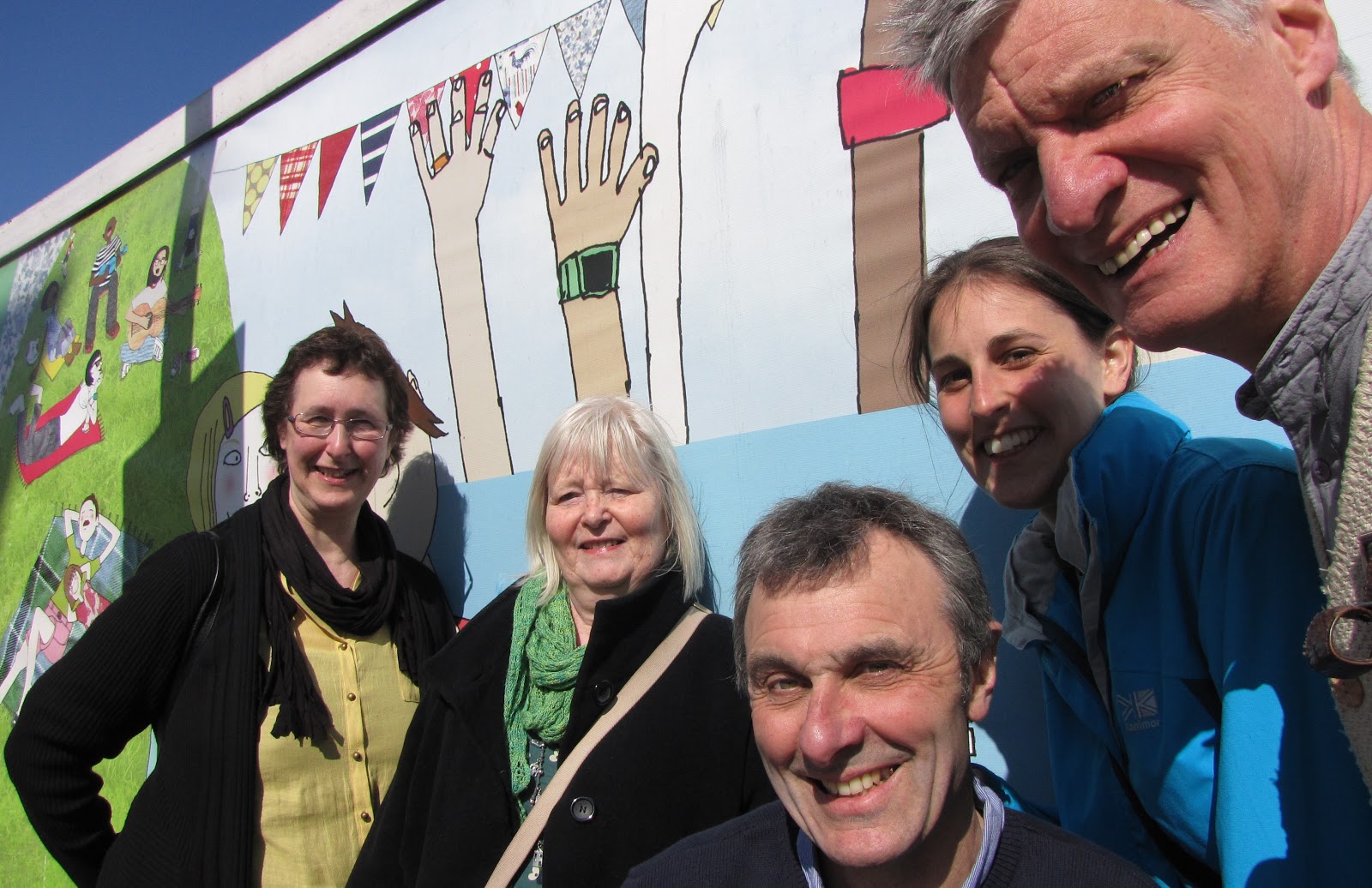
Photo: Sheila, Moira, Stephen, Becki and me in the Bristol sunshine (in front of Hannah’s harbourside banner).

Saturday, April 27, 2013

martin simpson at colston hall


Last night was my SECOND concert at Colston Hall in less than a week. Don’t worry, this doesn’t mark a new extravagant lifestyle or sudden wealth… simply how it turned out when I booked three concerts some months ago.
Martin Simpson IS an amazing musician – probably the best (non-classical) guitarist I’ve ever seen. I was sitting in the second row last night and became completely mesmerised by watching his right hand as he played the instrument (am I really that sad?)… he seemed to use ALL his fingers – and I don’t mean just “strumming”!
He played for a total of two hours in two sets. He’d lived in America (California and New Orleans) for a number of years and the first set included a fair amount of “American folk” (which isn’t really my cup-of-tea); the second set included much more familiar “traditional English” songs and was simply stunning.
A musical genius and a complete master of his craft.
PS: This might seem a slightly strange observation, but I noticed that probably 75% of the audience was male (much higher than normal, in my experience). Why was this, I wonder? Is guitar-playing a particularly “bloke” thing? Just asking!

Thursday, April 25, 2013

april 2013 books


More book stuff:
About Looking (John Berger): I bought this in the Tate St Ives bookshop. I’ve always been a firm believer in the need for us all to “learn to see” (ie. we often “look”, but don’t always “see”) and so this book seemed essential reading for me. Berger explores our role as observers to reveal new layers of meaning in what we see. They’re taken from various articles Berger wrote in the 1960s/70s; some of them remain rather obscure to me (despite Google’s help!), but I read others (eg. those relating to Millet, Lowry, Francis Bacon, Turner and Rodin) with absolute fascination and certainly saw lots of things afresh.
Stag’s Leap (Sharon Olds): I’ve been reading more poetry over recent years and opened the book on a whim on one of my pleasurable visits to Foyles bookshop. I was immediately struck by Olds’ writing style and the poignancy of her subject. It’s a book of 49 poems (I counted them!) after her husband of more than 30 years had “left her for another woman”. They’re incredibly honest reflections that extend well beyond “confessional”; they’re full of intimacy and sexual passion. The book was clearly written out of pain and as a way of counselling herself in coming to terms with her new situation. I was left with two overriding thoughts: a) her former husband will probably feel as if he’s being continually stalked and hung out to dry and b) that, surely, 49 poems is a bit excessive and she needs to move on! It is a quite stunning book though.   
A Book of Silence (Sara Maitland): After Maitland’s marriage ended in the 1990s, she took to living alone and, around the same time, began a long, growing, and intensely examined relationship with silence. She subsequently restored a tiny, dilapidated former-shepherd’s house into her own home in rural south-west Scotland. She tries to live in as much silence as is possible (which is more difficult than it might sound). It's not complete isolation - although she has no near neighbours, she has the internet and a car - but she is aiming for a prayerful life of "80% silence". It’s a fascinating journey and an honest, reflective and rather beautiful book.
The Revolt of the Pendulum: Essays 2005-2008 (Clive James): I absolutely love James’s writing – he has a wonderful, lyrical, snappy way with words; he’s articulate, intelligent and there’s an amazing breadth to his knowledge and interests (from poetry, art, literature and culture to films, music, politics and motor sports). He’s also very funny when he needs to be. This is a book of fairly recent essays. These reminded me, amongst other things, how much I had loved Denis Healey’s autobiography; how he hates poor grammar(!); what a fierce critic he can be when roused and, as morbid as this might sound, I particularly liked his obituaries (“Absent Friends”). According to recent newspaper reports, the irony is that he himself now doesn’t have long to live - he’s “losing his two-year struggle with leukaemia”. I for one will miss him dearly – thank goodness there’s so much of his writing that I’ve still to read.
The Box (Gunter Grass): I found this a very strange book. It’s essentially an autobiographical essay – although the book jacket refers to it as a “daring work of fiction”. Grass writes in the voices of his eight children as they recall memories (often contradictory) of their childhoods. “The Box” refers to an old-fashioned Agfa box camera used by Grass’s assistant, Marie (a long-time family friend, perhaps even a lover?), and its snapshots used to provide Grass with for ideas for his work. I found the book confusing, annoying and egoistic (and poorly translated?). Sorry!

Tuesday, April 23, 2013

king creosote: legless again (almost)…


The last time I saw King Creosote (+Jon Hopkins) perform was last May in the tiny library on Iona. It was a memorable “gig” – for the general hilarity, if not the precise musical accomplishment (they’d been drinking triple G+Ts in the Argyll Hotel all afternoon!). I went to see/hear him again last night at Colston Hall and he was almost legless again – this time, he walked on stage on crutches (he’d broken his ankle)!
Anyway, last night’s concert was absolutely excellent. I just love his voice and his (often) melancholic and lyrical song-writing… and he’s also very funny.
A full house and a great evening.
PS: he wasn’t “legless” at the Iona concert – just “very merry”… but, when I chatted to him last night, he admitted they’d got into a “bit of trouble” (with the hotel?) as a result!
PPS: last night he was drinking water…

Sunday, April 21, 2013

the count of monte cristo at the brewery theatre


Somewhat ridiculously, last night was the first time Moira+I had been to see a performance at the Brewery Theatre in North Street, Bristol (opened by the Tobacco Factory Theatre in 2009). On the face of it, the idea of a small travelling company of three actors rendering Alexandre Dumas’s famous book (all 117 chapters!) into a credible theatrical performance is ambitious, to put it mildly.
We need not have worried.
Andy Burden’s production (he transcribed, edited and adapted the book and directed the play) proved to be a complete delight. The three talented actors (Alex Dunbar, Kali Hughes and Dan Winter) play seventeen parts between them - utilising simple props and costumes - and are excellent. There’s something incredibly exciting about theatre being performed in a small, intimate space – where the audience is taken on a fast-moving journey and where imagination, directness and honesty are conveyed with such appealing, believable conviction.
I loved it!

Saturday, April 20, 2013

another stunning, new education policy…


Michael Gove’s been at it again (surely not?)…
This time it’s about “longer school day and shorter holidays”.
Apparently, according to education guru Gove, our schools need to adopt this approach because it’s the way they do it in south-east Asia.
Sadly, I think the real reasons he wants to introduce this policy are that, magically, a) they mirror the long-hours culture of the workplace (oh, excellent!); b) they keep children at school (or should that be “child-minding” centre?) for longer and this will be less inconvenient for busy working parents; and c) he doesn’t like teachers.
Perhaps he should introduce compulsory boarding school for ALL children instead?
I find his “thinking” SO wrong that it’s almost funny – except that he’s dealing with children’s and families’ lives here.
It would be very easy (ie. about as easy as Gove finds introducing education policies?) to provide a lengthy list of objections to the education secretary’s latest “initiative”. I’m not even going to try, but I would offer the following brief thoughts:
1.       The concept of “quality family time” has clearly been kicked into touch by Gove (where would families find the time for this, given Gove’s new timetable?).
2.       After-school clubs are a very important way for children to get to enjoy important “non-lesson” activities outside the curriculum… and these include sports, music, language, science, IT, technology, art, drama, dance (actually, the list is HUGE). If you extended the school day, all these would be lost. How else would school theatrical productions, sports matches, concerts and the like happen? Answer: they wouldn’t – because there wouldn’t be time available.
3.       Everyone knows that teachers have it INCREDIBLY easy (of course!) and have far too much time on their hands. Clearly, they don’t need to prepare any of their lessons in advance or mark homework or meet parents… and, on top of all that, they just love dealing with badly misbehaving children – so a couple of extra lessons will come as a godsend. Actually, come to think of it, lots of the behavioural problems can be put down to poor parenting so, if children spend LESS time with their parents, and more time at school, then things are bound to improve massively!
Gosh, that Mr Gove is a very, very clever man… quite brilliant.
I could go on…

Thursday, April 18, 2013

two gentlemen of verona


For the first time in a long time, I came away from a performance at the wonderful Tobacco Factory Theatre feeling a little disappointed. Maybe it was because it’s not one of Shakespeare’s best plays? Maybe I’d been spoilt by seeing so many RSC productions? Maybe it was my mood on the night?
I really don’t know.
Moira+I think we’ve only seen this play performed once before… in Edinburgh, several years ago – and so, perhaps, the play’s comparative unfamiliarity (to me) was partly to “blame”?
Don’t get me wrong… the acting, the costumes, the design and the music were all good. But, sadly, no aspect of last night’s performance struck me as being outstanding… I was well entertained, but I wasn’t transformed by any theatrical “magic” – as I so often am.
However, it seems that I might be in a minority… The Independent has given the play a 4-star review!

Wednesday, April 10, 2013

a late quartet


Another cheap Wednesday afternoon’s cinema at the Watershed!
This time, it was to see Yaron Zilberman’s directing debut in “A Late Quartet” featuring four wonderful, highly-talented actors: Christopher Walken, Catherine Keener, Mark Ivanir and Philip Seymour Hoffman.
The film features the Fugue String Quartet, an internationally acclaimed musical group based in New York, who have been playing around the world for past 25 years. Their founder, brilliantly played by Christopher Walken (cellist) is diagnosed with the early signs of Parkinson’s disease (I’m not really giving the game away here, I promise) and this throws the quartet into a somewhat confused self-questioning group, with an uncertain future. That’s when the film starts to explore them as individuals as well as part of a celebrated group of musicians.
It’s a beautiful, subtle, moving and intelligent film (and the music is rather good too!) AND New York looks stunning in the winter snow. Although the actors are clearly not professional musicians, the film was apparently made without “hand doubles” for the vast majority of “takes” – I have to say, it’s all pretty convincing to my untutored eyes.
I loved the film and would highly recommend it.
PS: Please note: this is NOT Dustin Hoffman’s film “Quartet:, this IS “A Late Quartet” starring (amongst others) Philip Seymour Hoffman! Confused? Don’t worry, rest assured, THIS is the one you should definitely see!…

Tuesday, April 09, 2013

legacy


I’ve been trying to avoid all the wall-to-wall media frenzy following Lady Thatcher’s death.
It’s obviously impossible to do so… but, don’t worry, I’m NOT going to list all my pet grievances (or even one or two positives) about the woman!
However, I have been reflecting on the hugely differing political legacies that war provided for both Margaret Thatcher and Tony Blair.
Mrs T decided to embark on the Falkland’s War in 1982 when her popularity was at an all-time low. I opposed the war. To this day, I maintain that it was nothing more than jingoistic opportunity to re-assert illusions of the “old empire”. Despite the problems of fighting a war such a long way from home (and the strong opposition from the US), there was never any real chance of Britain “losing”. I absolutely hated the whole affair.
Sadly, I was in a minority.
Incredibly (to me), the public at large lapped it up. Mrs T’s popularity soared and she went on to win a resounding victory at the next general Election in 1983. I personally found the entire business completely sickening but, for many people, the “Falkland’s Factor” was the political making of Mrs Thatcher.
In contrast, Blair’s legacy of the Iraq War in 2003 (alongside Bush junior) is almost entirely negative - certainly from a UK viewpoint at least. The comparatively slow build-up - with Saddam being given warnings about all those “Weapons of Mass Destruction” - gave the British public time to voice their opinions (eg. a million people, including me, took to London’s streets in the largest political demonstration in the city’s history). Although he went on to win a third general election victory in 2005, his majority was much-reduced majority and he was severely tainted.
People never quite trusted the man after that (and I don't really blame them).   
With arrangements being made for Lady Thatcher’s “ceremonial” funeral – with full military honours, would you believe(!) – next Wednesday, I think the Tories will be loving all the attention their beloved former leader will have given them over the next week or so: parliament is being recalled (ridiculously in my opinion – although one might question why they’re in recess at all?) so it can “show its respect”; on the day of her funeral, streets will be cleared of traffic and the coffin processed from Westminster to St Paul’s Cathedral.
It’ll be rather like a non-stop party political broadcast for them.
Call me when it's all over!

Wednesday, April 03, 2013

in the house


Went with Alan+Gareth to see this psychological Francois Ozon film yesterday afternoon. At times, it felt like watching a Woody Allen movie. High school teacher Germain (very well played by Fabrice Luchini) is bored by his job and depressed by the lack of imagination (and effort!) shown by his French literature students… but encouraged by the creative-writing assignments of one talented 16-year-old pupil who writes about his attempts to wheedle his way into the middle-class home of a classmate. It becomes a matter of rather uncomfortable classroom voyeurism (with comic elements)… the boy’s fascination with his classmates beautiful mother (Esther, played by Emmanuelle Seigner)… and, ultimately, affects Germain’s own job and marriage (he’s married to Kirsten Scott Thomas!).
In the end, I really didn’t know what to make of it… and came away feeling ultimately disappointed.