Showing posts with label religion. Show all posts

Tuesday, December 12, 2023

nothing changes…

As part of my Advent ‘ponderings’, I‘ve been reading Rowan Williams’s Christmas sermons from his time in office as Archbishop of Canterbury, 2002-2012 (”Choose Life”). I’ve always found him a wise and thought-provoking man…
The following words from Christmas 2008 are a poignant reminder of how little has changed in the Middle East:
“This year, as every year, we remember in our prayers the crises and sufferings of the peoples of the Holy Land: how tempting it is to think that somehow there will be a ‘saviour’ here – a new US president with a fresh vision, an election in Israel or Palestine that will deliver some new negotiating strategy. It’s perfectly proper to go on praying for a visionary leadership in all those contexts; but meanwhile, the ‘saving’ work is already under way, not delayed until there is a comprehensive settlement.
This last year, one of the calendars in my study… has been the one issued by by Families for Peace – a network of people from both communities in the Holy Land who have lost children or relatives in the continuing conflict; people who expose themselves to the risk of meeting the family of someone who killed their son or daughter, the risk of being asked to sympathise with someone whose son or daughter was killed by activists promoting what you regard as a just cause. The Parents Circle and Families Forum organised by this network are labouring to bring hope into a situation of terrible struggle simply by making the issues ‘flesh’, making them about individuals with faces and stories. When I have met these people, I have been overwhelmed by their courage; but also left with no illusions about how hard it is, and how they are made to feel again and again that they come to their own and their own refuse to know them. Yet if I had to identify where you might begin to speak of witnesses to ‘salvation’ in the Holy Land, I should unhesitatingly point to them.”
Fifteen years on, nothing changes… and the prayers remain the same. 


Wednesday, September 18, 2019

referendition... my 'poem' for resonate

Referendition…

 Let’s ask their permission
Consult the population
Pose them a question
Call it democratisation
Powers of persuasion
Lies and distortion
Blame immigration
Avoid any retraction
Keep raising the tension
Use manipulation

 
 Art of discretion
Another edition
Evil collusion
Special adviser’s deception
He’s no relation
Self-gratification
Don’t stop for reflection
Congratulation
Lack any compassion
Stand to attention

 
 Shun all contrition
Do you want an election
Face annihilation
No constitution
No negotiation
No retraction
Don’t even mention
Prorogation
Don’t tell the nation
Slow realisation

 
 Abject depression
Hopeless position
Utter dejection
Bring revolution
Time for some action
Ignore apprehension
Discover restitution
Seek reconciliation
Achieve restoration
Let’s find a solution


Friday, November 30, 2018

back to berlin…

I went along to the Watershed this afternoon to see Catherine Lurie’s thoughtful, sobering documentary “Back In Berlin”. It follows eleven Jewish bikers travelling from Israel to Berlin for the Maccabiah Games (often referred to as the ‘Jewish Olympics’).
In 1930, a group of Jewish bikers travelled to all corners of Europe to find participants for the first Maccabiah Games. In 2015, to commemorate this heroic journey, 11 Jewish bikers set off from Israel once again to re-trace their ancestors' footsteps and carry the Maccabiah torch to the site of the infamous 1936 Berlin Olympics for the first games held on German soil. Travelling 4500km across 7 countries in just 24 days, together they explore their dark genocidal past and discover how they or they families survived the Holocaust.
Given the populist movements from both the left and right rising again today, “Back to Berlin” provides an essential connection between the past and present. It’s a cautionary tale but also a story of defiance, survival and people overcoming the worst from others to restate our common humanity – and with the games themselves being a kind of redemption. Or, as the Guardian film critic, Peter Bradshaw, aptly describes it: “an Olympic flame of hope burning defiantly in the presence of moral darkness”.
It’s a beautiful, evocative and poignant documentary that reflects on anti-semitism in Europe and very much worth seeing.
PS: There were just me and five others in the audience, but I did strike up an interesting conversation with a fascinating, highly intelligent, 83 year-old man (a former nuclear scientist)… and, for some reason(!), we found ourselves talking about Trump and Brexit (he started it!!)(note: he was very much ‘a man after my own heart’!) and bemoaning how on earth we’d come to find ourselves in the current mess. At the end of the film, he turned to me, wiping tears from his eyes, and simply said: “an emotional journey”. He was absolutely right.

Saturday, July 08, 2017

racing demon at the theatre royal bath…

Moira and I went along to the Theatre Royal Bath last night to see a revival of David Hare’s play “Racing Demon”, first performed at the National Theatre in 1990.
We’d previously been to see a production at the Theatre Royal, but there’d been a BIT of gap between yesterday evening and the last time we were there… just a FORTY-FOUR YEAR gap!!
On the face of it, the idea of going to see a play about the Church of England (the establishment church?), society, politics, morality and such like might not seem like the best way to enjoy a Friday evening… but that was far from the case. David Hare was a playwright who emerged from the left-wing theatre movement of the 1960s and 70s… someone who was clearly angered by the injustices, as he saw it, of the capitalist system and wanting to see a ‘fairer society’.  
Yes, whilst the play was inevitably ‘dated’ on some matters (eg. regarding the ordination of female bishops and references to the poll tax), it felt very much a play of ‘our time’ – touching on such secular matters as (in addition to the spiritual): austerity; the ‘haves and have-nots’ of society; justice; morality; domestic violence; listening to and supporting people who feel they have no voice… and at a time when many still question the relevance of the Church in today’s world.
When he wrote the play, in the late 1980s, Hare felt that the Anglican Church provided subject matter that was archetypically English and, at worst, represented an old-fashioned institution, stuck in its dogmatic ways and struggling to adapt to ‘modern life’. From the programme notes, it appears that Hare respected many of the clergy he met in his researches, but was conscious of the best of them being “up against a bureaucratic system that worked in opposition to their talents”… with the Church appearing to have become increasingly irrelevant, “debating arcane matters of doctrine instead of looking outwards to fulfil the community’s spiritual needs”.
The play proved to be provocative, challenging, thought-provoking and, as far as we were concerned, still highly relevant today.

One of the prime reasons for going last night was to watch our lovely actor friend Sam Alexander perform…. and he didn’t disappoint (in his role playing Revd Donald ‘Streaky’ Bacon!).
Indeed, the whole cast were excellent… with David Haig quite brilliant as Revd Lionel Espy and Paapa Essiedu very impressive as the curate, Revd Tony Ferris.
A really excellent evening.
Photo: Paapa Essiedu as Revd Tony Ferris.

Thursday, June 15, 2017

bristol pilgrimage 2017…

If you’re ever on the beautiful island of Iona, the weekly pilgrimage walk around the island is an experience not to be missed.
During the course of my 8-week stay there as a volunteer with the Iona Community in 2012, I bought Jane Bentley+Neil Paynter’s really excellent book “Around A Thin Place” (an Iona pilgrimage guide) and, as well as using it when I was on Iona, I have used it as a resource for my own Bristol pilgrimage version on three previous occasions (undertaken in September 2012, March 2014 and June 2015).
Yesterday, I decided to undertake a fourth ‘pilgrimage’ journey around Bristol (strangely, I thought I’d done more than this… but the blog never lies!).

This time, I broke up my route into eight sections or stops… pausing for reflections taken from the book, together with my own deliberations. Each time I’ve done this, I’ve used a completely different set of locations and, as on my previous walks, the weather was perfect.
As before, I related my stopping points with pilgrimage stops on Iona:
St Martin’s Cross/setting out on the road was Gaol Ferry Bridge; The Crossroads was the Cumberland Piazza (essentially land under the flyovers by Cumberland Basin); Dun I/High Point was the Clifton Suspension Bridge; The Hermit’s Cell was, perhaps a little incongruously, Clifton Cathedral (the Roman Catholic cathedral); St Columba’s Bay was the Harbour/Harbourside; The Machair was Queen Square; The Jetty was Temple Meads station;
and St Oran’s Chapel/Reilig Odhrain was God’s Garden (a grassed area beside the Cut).


I’ve been chatting to quite a few of Bristol’s homeless people over recent months and I found my final stop at God’s Garden particularly poignant. On Iona, St Oran’s Chapel was the place that the bodies of numerous kings were sent for burial – the end of the journey (literally)… the homecoming, as it were. God’s Garden was my final stop before arriving back at home, just up the road. But, for many of the homeless, God’s Garden IS home. Small, rough tents, belonging to these otherwise homeless people, have appeared over recent months. As you might imagine, it’s far from ideal but it does represent the nearest thing to home for many of them. It’s a very tough existence – made all the worse because of the frequent thefts of their ‘belongings’ or people causing deliberate damage to their tents… or even the risk of flooding (from the adjacent tidal Cut). Life is tough… everyone needs their dignity.
Within two minutes of leaving God’s Garden, I passed a roadsign declaring “Home Zone ENDS” (Home Zones are small local residential areas where traffic and pedestrians are mixed together – no pavements). In the circumstances, it seemed a particularly ironic, sad statement.
The day proved to be another challenging and thought-provoking time… and something that I will no doubt repeat in Bristol over the coming years.
This Celtic blessing, from the book, seemed to sum up my day rather nicely:
May God’s goodness be yours,
and well, and seven times well, may you spend your lives:
may you be an isle in the sea,
may you be a hill on the shore,
may you be a star in the darkness,
may you be a staff to the weak;
and may the power of the Spirit
pour on you, richly and generously,
today, and in the days to come.
Photos: just a few photographs from my day.

Saturday, April 01, 2017

question mark at bristol cathedral…

This morning, I went along to Bristol cathedral to see/hear Stefan Smart perform/recite St Mark’s Gospel. I hadn’t heard anything about this until my good friend Stuart (from our old days in Thame) sent me a facebook message.
Who’s Stefan Smart? Well, sadly, I’d never heard of him before Stuart contacted me… he’s a Christian, but he’s also an English teacher who works alongside Stuart (a Language teacher).
Stefan performed in the cathedral Nave in front of a good-sized audience (and to the amazement of some of the ‘usual’ cathedral visitors as they shuffled down the side aisles!).
It was a stunningly good morning.

I know St Mark’s Gospel pretty well, but I found the experience completely captivating… almost mesmerising (it lasted just over 90 minutes). The cathedral acoustics were perfect for Stefan’s rich tones and I found his ‘performance’ perfectly pitched – very well dramatised, but not over-acted (as I slightly feared!) and with imaginative, simple use of the single ‘prop’ (a set of steps) and the space available. A really impressive, stimulating and thought-provoking performance.
A pretty amazing feat and a wonderfully effective and appropriate prologue to Holy Week. So pleased I went!
PS: Although Stuart had sent me a message letting me know that Stefan was happy for me to take photographs of the performance, the cathedral has a large notice forbidding people to take photographs within the cathedral… at any time (which I think is absolutely barmy). In the circumstances, I didn’t want to cause any disruption, so decided to leave my camera in my bag. However, I did do a few VERY rapid scribbled sketchbook doodles (not really looking at the paper at all) – so, I’m afraid, that’s the best I can offer (see above)!!
PPS: On my way home, I was reflecting on Stefan Smart’s incredible achievement of memorising the entire Gospel of St Mark… and then remembered being in a nativity play at St Mary’s church, Thame (I had ‘volunteered’ to play one of the Kings and Stuart’s wife, Mary, somewhat predictably played the part of Mary)… I had six lines to learn (or was it four? I can’t remember!). My moment duly came and I began: “Oh Mary”… this was followed by one of the longest dramatic pauses in the entire history of nativity plays (possibly more than 30 seconds?) as I desperately tried to remember what came next…
Oh, how we laughed (eventually)! Needless to say, Stefan didn’t have ANY such moments. Oh the irony!

Friday, January 06, 2017

silence...

I went along to the Watershed this afternoon to see Martin Scorsese’s lengthy film “Silence” (some 2hrs 40 mins long!), based on Shusaku Endo’s book of the same name (published in 1966). Strange as this may seem to cinema-lovers, but I think I’ve only watched a couple of Scorsese films in my life! Endo’s profound, disturbing, harrowing novel - about a 17th century Portuguese priest in Japan at the time of great persecution of the small Christian community - was one of our Book Group books in 2014. Scorsese first read the book in 1989 and, over the past 25 years, the possibility of turning it into a film became one of his true passion projects.
Like the book, I found the film utterly compelling… tragic, challenging and unrelenting. Christians in Japan are dealt with viciously… this is a world where Christians are asked to spit on the cross or to stamp on an image of Christ to prove they have renounced their faith (if they demur, they or their families will be cruelly tortured and killed). You certainly don’t need to be a Christian (or to have any other religious beliefs) to appreciate the film, but it’s very definitely a film that makes you question one’s own faith and the very nature of God. Will God remain silent in the face of such unimaginable suffering?
It’s all about the struggle for the very essence of faith.
Tough, but a brilliant film.
PS: Our Resonate group went to see the film last Tuesday, but I was unable to make it… but, after nearly 3 hours of film, I probably wouldn’t have been much good for any après-film discussion! No doubt there will be other opportunities to compare notes…

Monday, May 30, 2016

occupied territories...

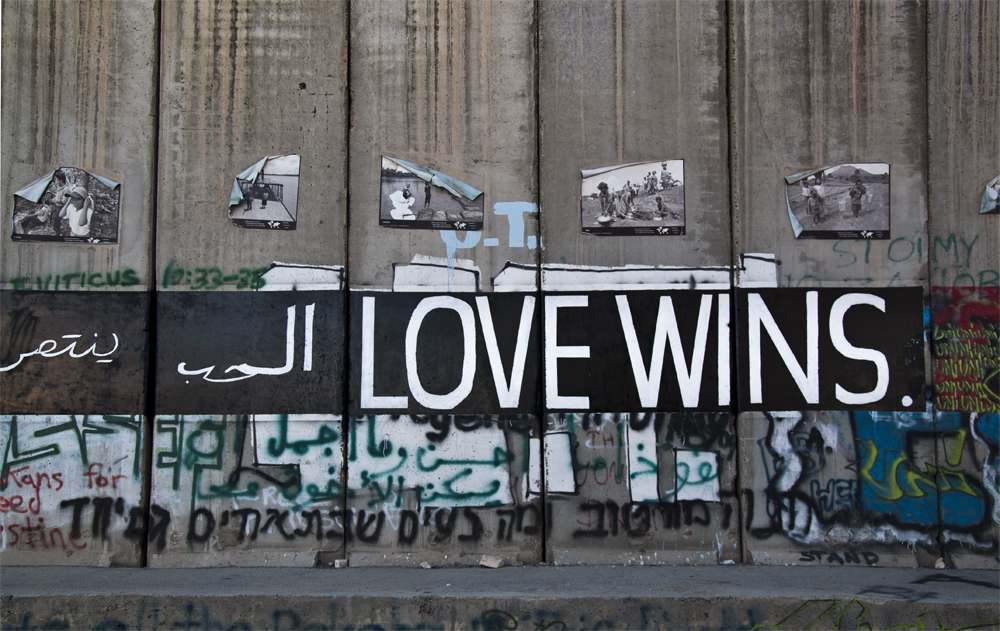
This is the name of a book* written by Garth Hewitt (the founder of the Amos Trust: “a small, creative Christian human rights agency that works with vibrant grassroots partners around the world”). I briefly acted as one of its volunteers at Greenbelt perhaps 10 years ago and again met Garth and his wife Gill on Iona in 2012 when they attended a conference to discuss the division of the West Bank, the encroachment of Israeli settlements and the impact on the lives of Palestinians.
It's a powerful, profound, thought-provoking book and one that I think deserves to be read by anyone who cares about peace, dignity and justice in this brutal, greedy world we live in.
Again and again, I found myself underlining passages from the book (frequently quotes from prominent academics, politicians or church leaders), so I’ve collected just SOME of them together – as a reminder for me and, perhaps, to provide others with food for thought. In no particular order (I hope Garth doesn't mind me quoting from his book - believe me there are LOTS more extracts I could have included!):

“If you are neutral in situations of injustice, you have chosen the side of the oppressor”.
Archbishop Desmond Tutu.

“We need to create a new reality in the Holy land, a new structure where every person that lives here – that was born here, Israeli, Palestinian, Jew, Christian and Muslim, is honoured for who they are so their history and their past is respected”.
Sami Awad, executive director of Holy Land Trust, 2013.

“But this is the frontline. The wall and its offspring road are here and growing, the beautiful valley is being ripped in two. And then there is the ‘tunnel house’. A family has the ‘right’ papers to prove they belong to this land but they (the Israeli army) put them on the ‘wrong side of the line’. The ‘solution’ is to literally wall them in to their own private prison at a cost of $1million. It is obscene. It is obscene that these people in this village are being brutally shown by the wall, the settlements, the demolition orders, the soldiers and the bottomless budget that we want what is yours but we do not want you. We will dehumanise and humiliate you and make simple things so difficult. We will make your life so intolerable that you will leave… How can the world stand by and let this happen?”
Nive Hall, Amos Trust’s operations Manager at the Cremisan monastery.

“It involves difficult decisions and tough choices. However, the choice is not the support for Palestine against Isael or vice versa. Rather:
·         It is a choice for justice, against oppression; for human and political rights, against dispossession.
·         It is a choice for freedom, against an occupation that denies freedom.
·         It is a choice for equal human dignity, against racism and discrimination.
·         It is a choice for non-violent resistance, against the violence that perpetuates a cycle of hatred and recrimination”
“Time for Action”, Kairos Britain – following “The Iona Call” conference, 2012.

“I wonder… if having financial services and arms manufacturing at the core of your country… corrupts you morally?”
Alexei Sayle, The Metro, April 2013.

“As I write this, the richest people in the world are meeting in Davos, Switzerland. Of this meeting Aditya Chakrabortty says ‘More than 2,500 business executives and bankers will converge on the highest town in Europe for the annual World Economic Forum. For the next five days Davos will, it is safe to say, boast more millionaires per square foot than anywhere else on the planet’. He points out there is a basic membership and entrance price tag of £45,000 (approx. $74,000), but then adds: ‘The real business lies in private sessions with industry peers and amenable politicians and access to those start at around £98,500 ($161,600). And this is what makes Davos so fascinating: it is the most perfect case study of how practitioners of free market, globalised capitalism give the public one explanation for what they are doing and why, while privately pursuing the complete opposite. On the one hand there is an event attended by Sharon Stone, Bono and a slew of tame academics (14 Nobel laureates this week alone) the message being, “we are open to anyone”. On the other hand, there are those secret meetings off limits to anyone not in the £100K club… From its inception, the whole point of Davos has been to promulgate the gospel of free market fundamentalism. Earlier generations would have known what to call Davos set of wealth extractors and rip-off merchants’”.
Garth Hewitt, “Occupied Territories”. Aditya Chakrabortty: “An Action-Packed Thriller Is About To Unfold In Davos, Switzerland”, The Guardian, 21 January 2013.

“The greatest threat to world peace is not from nuclear weapons and their possible proliferation, it is from drones and their certain proliferation… Drones are now sweeping the global arms market. There are some 10,000 said to be in service, of which a thousand are armed and mostly American. Some reports say they have killed more non-combatant civilians than died in 9/11. I have not read one independent study of the current drone wars in Afghanistan, Pakistan and the Horn of Africa to suggest these weapons serve any strategic purpose. Their ‘success’ is expressed solely in body count, the number of so-called ‘al-Qaeda linked commanders’ killed… Neither the legality nor the ethics of drone attacks bear examination… It is hard to imagine a greater danger to world peace”.
Simon Jenkins, “Drones Are Fool’s Gold: They Prolong Wars we Can’t Win”, The Guardian, 10 January 2013. 

“The world must urgently set goals to tackle extreme inequality and extreme wealth. It is now widely accepted that rapidly growing extreme wealth and inequality are harmful to human progress, and that something needs to be done. Already we hear the World Economic Forum’s Global Risk Report rated inequality as one of the top global risks of 2013. The IMF and The Economist agree. Around the world, the Occupy protest demonstrated the increasing public anger and feeling that inequality has gone too far.
In the last decade, the focus has been exclusively on one half of the inequality equation – ending extreme poverty. Inequality and the extreme wealth that contributes to it were seen as either not relevant, or a prerequisite for the growth that would help the poorest, as the wealth created trickled down to benefit everyone. There has been great progress in the fight against extreme poverty… (But) we cannot end poverty unless we end inequality rapidly.
That is why we are calling for a new global goal, to end extreme wealth by 2025 and reverse the rapid increase in inequality seen in the majority of countries in the last twenty years”.
Oxfam: “The Cost Of Inequality: How Wealth And Income Extremes Hurt Us All”, 18 January 2013

“Every gun that is made, every warship launched, every rocket fired signifies, in the final sense, a theft from those who hunger and are not fed, those who are cold and are not clothed. The world in arms is not spending money alone. It is spending the sweat of its labourers, the genius of its scientists, the hopes of its children… This is not a way of life at all, in any true sense. Under the cloud of threatening war, it is humanity hanging from a cross of iron”.
US President Dwight D Eisenhower: “The Chance For Peace” speech, 16 April 1953.
Note*: “Occupied Territories” (Garth Hewitt), published by IVP Books, 2013.
Photo: part of the wall surrounding Bethlehem.

Saturday, November 07, 2015

he named me malala

I went along to the Watershed yesterday afternoon to see Davis Guggenheim’s film. Yes, we all know that Malala Yousafzai is a truly inspirational figure - a teenager who won the Nobel Peace Prize while still studying for her GCSEs in Birmingham. I knew the film would make an impressive documentary… but I was somewhat taken aback by its effect on me. Yes, I know I’m a bit of an old softie (“The Railway Children” gets me every time), but I found myself surreptitiously trying to dry my moistened eyes through large tracts of the film!
It was good to be reminded that, as a 15 year-old (before she was shot in the head), she had already been a powerful campaigner for the rights of girls to be educated (in fact, she was a campaigner for girls’ education from the age of just 11!). The story of her grotesque shooting on the school bus, her survival, her remarkable recovery, her articulation and her continuing, global campaigning are truly staggering… and she’s still only 18.
Maybe it’s because I’m the father of three wonderful daughters but, for me, one of the most powerful aspects of the film was Malala’s relationship with her father, Ziauddin Yousafzai – a wonderful, gentle and wise man (who, amongst many other things, set up his own school… and, despite his stammer, has been a passionate, articulate speaker against the Taliban’s radical, ideological version of the Islamic faith)(the film includes lots of footage of him speaking at various rallies in north-west Pakistan). Malala’s father has not been the person pushing her to take a stand on issues, he has simply been someone whose passions and concerns about the world have inspired her.
Malala’s father named her after the Afghan folk heroine Malalai – a Joan of Arc figure who rallied Pashtun fighters against the British in 1880. The same moral courage and heroism is alive well today, thanks to Malala Yousafzai.
It’s a wonderful, moving, inspiring film about the strength of the human spirit and about having the bravery and courage to do something about it.
As she has said: “One child, one teacher, one book, one pen can change the world”.
Amen to that.
PS: another film that I/we had wanted to see was “Suffragette”, but the nearest cinema (within easy walking distance) was charging £13.40* for the privilege of watching it in their “Director’s Hall” (with a free drink and popcorn!)… so £4.50 at the Watershed felt like a bit of a bargain! Actually, the main reason for posting this note is that the Cinema De Lux DID do special rates for oldies like us - £13.20, instead of the full £13.40 price. A WHOLE 20p saving!! Whoop, whoop!
We’ll no doubt end up getting the DVD.