Showing posts with label finance. Show all posts

Wednesday, February 22, 2023

citizen ethics in a time of crisis…

While searching through what we laughingly refer to as our filing system (somewhat predictably, I was unable to trace the actual document I was seeking!), I came across a quite brilliant supplement entitled ‘Citizen Ethics in a Time of Crisis’. It was published in 2010, exactly 13 years ago this week, by the Guardian newspaper (in conjunction with Citizens Ethics Network, Barrow Cadbury and the Joseph Rowntree Charitable Trust). In it, a number of prominent thinkers – philosophers, politicians, economists, theologians and writers – considered how the financial and political events of the previous year (ie. the sense of outrage following such matters as the Banking crisis, Bankers’ bonuses and the MPs’ expenses scandal) had given rise to a crisis of ethics… although it’s interesting that the document relates to “Citizen Ethics” (not politicians’ ethics).
I was so taken by the document that I’d sent away for a copy of 60-page bound version.
 
I’ve been re-reading much of it this morning and it makes for fascinating reflection… especially at this time of a ‘Cost of Living Crisis’, an ‘Energy Crisis’, attitudes towards migration (and refugees) – not to mention (but I will) the dishonesty/lack of integrity of some senior politicians; allegations of sexual misconduct against dozens of MPs; allegations of ‘irregular’ PPE funding during the pandemic, Brexit, Climate Crisis… actually, the list goes on and on).
It speaks about how self-interest and calculation have derailed our values.
 
The document’s articles asked some crucial questions (dozens and dozens of them) – that are JUST as relevant today as they were 13 years ago. Here are just a few examples:
  • Do we leave it to the market to distribute riches or must the state intervene to ensure more justice than market mechanisms have achieved over the last 25 years?
  • We have looked into the abyss where individualism is concerned and we know it won’t do.
  • We have lacked a language to respond. How are we to articulate our misgivings? How can we regain our ability to reason ethically?
  • It is not a manifesto, it is an argument we have left derelict, a crucial public concern.
  • We need a public life with a purpose.
  • A promising measure would be to grant all adults a basic income, leaving it to them to decide how to work. This would make part-time work viable for many.
  • Shareholder value is shorthand for doing whatever it takes to pump up the stock price.
  • What human beings most desire is not material wealth, but social recognition.
  • That the economy should meet human needs means we have to focus on needs, not wants.
  • London and Westminster, the twin epicentres of power, feel as rotten as Rome under Caligula.
  • Politics must come from the people.
  • The ethical human being has a need for meaning in order to sustain a sense of aspiration.
How little has changed in the past 13 years… and, sadly, I suspect things won’t change in my lifetime.
Note: https://www.theguardian.com/commentisfree/series/citizen-ethics

Monday, January 23, 2023

two-tier health...

This summer, the NHS will be celebrating its 75th birthday.
I was one of the first individuals who benefitted from the service and it’s something I’ve treasured throughout my life.
Increasingly, there’s talk that the Tories are wanting to introduce a privatised version of the NHS (and they’ve been pushing such policies over the past 10 years or more)… making people pay for doctors’ appointments; encouraging people to ‘go private’ in order to jump the lengthy waiting times for operations; making things so bad that they maintain that introducing a privatised system is the only solution to health service needs.
Frankly, I’ve long argued that higher taxation is the only appropriate (and essential) way to ensure that our public services are maintained and developed. By contrast, the Tories constantly talk about cutting taxes.
 
I am hugely fearful that we’re becoming a two-tier society… the haves and the have-nots. The rich who can afford to pay and the poor who can’t. Those families who don’t have sufficient resources to maintain a decent standard of living and who, in these days of cost-of-living and energy crises, are being forced into making desperately difficult decisions (eg. heat or eat). By the same token, if people are forced into making decisions about their (or their family’s) health based on whether or not they can afford to do so, I genuinely fear for the society we would have become.
It doesn’t take much to imagine a situation where a family member is in need of health treatment, but is forced to opt out for reasons of cost… parents who understandably focus on their children (or perhaps elderly relatives) because they feel unable to justify being treated themselves. People with special needs or disabilities struggling because the appropriate services have been ‘run down’ due to lack of finance/political decisions. What are they expected to do if they can’t afford to pay for a replacement?
 
I genuinely fear for what lies ahead if the current political mindset doesn’t change. Yes, of course, our NHS is far from perfect but, frankly, from what I’ve heard of several people’s experiences, neither is the privatised version.
I think that the time has come when we have to take a stand for certain important principles… but time is running out. 

Saturday, August 31, 2019

magic money tree?

Mr Johnson has just announced that schools in England are to be given over £7 billion more in spending over the next three years. That’s brilliant news. Many of us have been pressing for extra funding for education over recent years and, suddenly, it’s actually going to happen.

Mr Johnson has also pledged nearly £2 billion for hospitals.
Mr Johnson has also indicated that over £1 billion will be allocated to provide extra police officers.
Mr Johnson has also promised some £2.5 billion for extra prison places.
Mr Johnson has also pledged funds for “fantastic new road and rail infrastructure and full-fibre broadband” (the cost for these is somewhat vague – figures of up to £40 billion have been cited).
Mr Johnson has pledged £300m of new funding for the expansion of Growth Deals across Scotland, Wales and Northern Ireland.
Mr Johnson has allocated an extra £2.1 billion in the event of a no-deal Brexit (on top of the £4.2 billion already ‘set aside’).
Mr Johnson is also going to REDUCE taxes (by raising income tax thresholds).

Do you get a nagging feeling that Mr Johnson might be preparing for a General Election?
Call me politically and financially naïve (and I’d be the first to accept that this might well be the case!), but how is all of this going to be paid for?
Is there a Magic Money Tree?
Or is Mr Johnson simply relying on squirming out of paying the £39 billion EU divorce bill previously agreed and accepted by Mrs May’s government… because he doesn’t think this would apply in the event of a no-deal Brexit?
Asking for a friend…
Photo: BBC.com

Monday, July 09, 2018

redeeming capitalism...

My great friend, Ken Barnes (he’s an ordained minister who has conducted business on six continents as a senior executive; he also holds the Mockler-Phillips Chair in Workplace Theology and Business Ethics at Gordon-Conwell Theological Seminary, Boston, USA), has written a remarkable book which explores the history and workings of capitalism in a business world that, these days, frequently seems devoid of any core principles or ethical constraints.
It’s a truly fascinating, well-researched, intelligent book (and it’s very readable too). It deals with a highly complex subject in a way which is both comprehensible and hugely thought-provoking.  The book begins with the spectacular collapse of the New York investment bank Lehman Brothers in September 2008 (28,000 employees and nearly $700billion of managed assets). It outlines the financial mess the bank got itself into and describes the cheating, immoral ways in which it tried to cover its tracks. It also reminds us that, despite the catalogue of errors and deceptions, none of the senior executives of Lehman Brothers went to gaol or even faced criminal charges – because the prosecutors concluded that they hadn’t actually broken the law! As Ken puts it: “the motive for deception was strong, not because the penalty for failure was severe… but because the financial reward for success was extreme”.
Ken goes on to list several other instances of individual and corporate fraud and financial deception. He also provides an enlightening mini-history of economics and capitalism – taking in the likes of Adam Smith, Karl Marx and Max Weber – before moving on to ‘postmodern capitalism’ (which he described as “capitalism that is devoid of a moral compass and resistant, if not impervious to ethical restraint”).
I found myself constantly scribbling in the margins or highlighting fact after fact (not something I usually do with books, believe me) – SO many snippets of information and detail eg. growing wage gap between corporate CEOs and the people who work for them; 1% of Americans today have an annual income 38 times greater than 90% of their fellow Americans; 78% of the US economy is now in the service sector, including financial services; (I could go on for several pages like this!).

Perhaps not surprisingly, given his background at Gordon-Conwell , Ken is a great advocate for the need for a different kind of capitalism to emerge – one that begins to change the social, political, ethical AND religious drivers that have formed our economic system from the onset. He calls this “virtuous capitalism” and puts forward a compelling argument which re-imagines capitalism within a faith-based ethic. He maintains that “there lies in every breast of every human being a shrouded yet indelible knowledge of God and both an ability and a desire to reflect the goodness of God, which explains the fact that the overwhelming majority of people in the world (84%) still profess faith in God”. Although, as a Christian myself, I love the concept of “virtuous capitalism”, I’m afraid that I don’t quite share Ken’s optimism in people’s spiritual attitudes. Indeed (and I know one can quote research paper after research paper), a recent survey that indicates that more than half the population here in the UK has “no religion”.
Nevertheless, I absolutely DO agree with Ken that it is entirely possible to build a business ethic that is universally applicable and which incorporates such features as morality, mission, common good, openness, trust, fairness, thrift and mutuality (I think my own architectural practice was built on such a platform). There needs to be a change away from greedy, uncaring corporations towards business such as Danish company Novo Nordisk (where the CEO is paid a fraction of what similar ranked executives would make in the US; where the accounting focus incorporates environmental and social concerns; where economic performance is measured a 20-25 year view in mind).
There are far too many aspects of the book that I COULD refer to (eg. The Occupy Movement; the theology of wealth; tax avoidance; United Global Compact/the Religious Freedom+Business Foundation; the third world; world politics; rich and poor etc etc)… but you really do need to read this book for yourself!

Nearly two years ago, I read an equally fascinating book on capitalism by Paul Mason, entitled “Postcapitalism”… and, although written from very different perspectives and backgrounds, there are lots of similarities – even if their respective ‘solutions’ were fundamentally different. Much food for thought!
One of the passages in Ken’s book related to what he called “The Geography of Virtuous Capitalism”, namely: “Economics is indeed a global concern, and not just in our current postmodern context, but in all future contexts as well. The resistance of nationalists and those who gnash their teeth over the corruption and inefficiencies of both corporate and government pan-national organisations notwithstanding, railing against globilisation is akin to howling at the moon. The world is small and through interconnectedness getting smaller every day. The challenge facing our economies, political structures, and environment are becoming ever more complex and intertwined. To become a force for good in the world, virtuous capitalism cannot be based on a beggar my neighbour mentality or the weaponisation of economic policies designed to give one country an advantage over others. It must be based on a think-globally-act-locally mentality and an ethos of shared responsibility for each other and for the planet we call home”.

This struck a chord with me very locally (although perhaps not quite in the way Ken envisaged). Here in Bristol, we’ve taken an initiative to introduce what we call the ‘Bristol Pound’. It was introduced in 2012 and we have our own printed money (and it’s also accessible digitally via smart phones) to trade in Bristol, localising supply chains and keeping money circulating in our city. It’s a movement, an idea, a hope, a better way of doing money… and it works! Two years ago (this is just one example), an enlightened developer decided to construct a scheme next to the harbourside (Wapping Wharf/Gaol Ferry Steps) consisting of a mixed-use scheme of apartments and cafés/bars/shops/restaurants. The developer took great care to select those he felt would complement each other and, crucially, ensure that they were all independent, local businesses. It’s been a phenomenal success… it’s become the go-to place in Bristol (and many of the traders have also opted to use Bristol Pounds). The traders are happy and the developer plays his part by ensuring that the area is kept clean and that the development continues to ‘look the business’ (the scheme won a prestigious heritage design award last year). As a result, a real sense of community has developed – the traders all know each other and seem to get on wonderfully well. So, on the back of this success, the developer put forward ideas for further shops, a yoga/massage unit and other eating places – housed in converted shipping container units. Again, the result has been wonderfully successful… and the sense of community has continued to develop. The developer is now seeking permission to build a number of small, independent office/studio units (plus café/bar) at the opposite end of the site (again using converted shipping containers) – a hotel is planned within the heart of the development on the site of the old gaol. In normal circumstances, the developer might have struggled to obtain permission for this latest proposal but, because he has a) now developed a very successful track record, b) prospective occupiers are keen to be associated with a development which they know will enhance the area and its community and c) has the firm support from people who use the facilities, I have absolutely no doubt that this latest phase of the scheme will prove equally successful. Relatively small beginnings; a determination to do things as well as possible (from design, environmental and organisational perspectives); being prepared to engage with end-users AND the local community; the city council is delighted by its success (which ‘rubs off’ on them, so they look good too!)… Think globally, act locally? A model for the future perhaps… on a VERY small scale?

Returning to the book, I have to say I was both encouraged and delighted by what it had to say and how it said it. I’m one of those people who have really struggled to come to terms with the implications of the 2008 financial crisis (and beyond!). I’m not easily reconciled about such matters, and yet, I finished this book feeling hopeful and even optimistic(!) that redeeming capitalism IS possible – given time, commitment, faith, perseverance, a sense of serving the common good and an acceptance of the need to engage with fellow stakeholders.
I think it’s a brilliant book and, even though you might not think so, one that you should definitely read.

Monday, November 06, 2017

tax avoidance, off-shore tax havens and the like…

Today, in newspapers and websites, we read about a huge leak of financial documents which reveal how the powerful and ultra-wealthy (including the Queen’s private estate) secretly invest vast amounts of cash in offshore tax havens… Many of the stories focus on how politicians, multinationals, celebrities and ‘high-net-worth’ individuals (including people who are significant donors to political parties) use complex structures of trusts, foundations and shell companies to protect their cash from tax officials or hide their dealings behind a veil of secrecy.
Oh, what a surprise!
And, of course, to complicate things a little further, we keep hearing reports that our own government is considering making the UK some form of tax haven to offset lost revenue in the light of Brexit. Last March, for example, it appeared that the Prime Minister and the Chancellor were warning the EU that (according to a report in the Guardian) if they don’t like the Brexit deal, they could turn the UK into a tax haven”. Not In My Name!

The trouble is (and, clearly, I’m no financial expert)(slight understatement!) that, over the years, we’ve consistently been told (by both major UK political parties) that there would crackdowns on tax avoidance, offshore tax havens, unacceptable banking practices and the like… and, consistently, over the years, nothing really seems to change.
At the end of last month, for example (I posted a link via facebook at the time), there was a report that five offshore PFI companies (Private Finance Initiatives) had paid little or no corporation tax over the past five years, despite making profits of nearly £2billion. Education and health projects, including schools and hospitals, account for two-thirds of the purchases by offshore companies. So, while our taxes are paying for our schools and hospitals, the PFI companies are clearly profiting and paying no UK tax!
I’ve just spent a few minutes checking back on finance-related stuff that I’d posted on this blog and (I won’t bore you with the details) and this is something I’ve consistently moaned about. For example:
Meltdown (Sep 2008); Financial speculation (Oct 2008); Poverty (Oct 2008); Financial crisis (Nov 2011); Greed (Nov 2011); Public Sector (Nov 2011); Bankers (Feb 2012); Greed, incompetence+dishonesty (June 2012); Banks (July 2012); Libor (July 2012); Protest (Jun 2013)… I could go on (and on!).
Nothing ever seems to change.
It all seems to be about greed; about influence; about the haves and the have-nots; about ‘clever’ people doing things with their money to make yet more money (and often, completely legally); about vested interest; about political lobbyists; about ‘me’ not ‘us’; about political ideology.
I’m about to read a book by my great friend, Ian Adams, entitled “Some Small Heaven(Seeking Light in Winter)”… it’s a book for Advent, Christmas and Epiphany. The introduction talks about the winter testing our hope and our resolve. He talks about ‘feeling’ the encroaching darkness of winter and about his stability being tested… and about yearning for a light to come. In a strange way, it seems to be a metaphor for how I’m feeling when I come across things like this depressing report of leaked financial documents.
I need to seek the light amongst this darkness… but I think it’ll continue to be a very difficult and depressing journey.

Sunday, September 18, 2016

a guide to our future?...

Essentially, this is an extended review of Paul Mason’s book “Postcapitalism”. Reading it was a bit like reading a PhD thesis (actually, I’ve never read one… but this is how I imagine the experience might feel!). He paints a picture of capitalism today (as well as charting its chequered history over the past 200 years or so) and reckons that its long-term prospects are extremely bleak.
He contends that the series impacts of climate change, demographic ageing and population growth kick in around the year 2050… and that “if we can’t create a sustainable global order and restore economic dynamism, the decades after 2050 will be chaos”.

Mason, born in Leigh, Lancashire in 1960, is an articulate, intelligent and fascinating bloke. He graduated from the University of Sheffield with a degree in music and politics in 1981 and went on to work as a music teacher and lecturer in music at Loughborough University. He became a freelance journalist in 1991 and went on to join BBC2’s Newsnight as Business Editor in 2001. In 2013, he became Channel 4 News’s culture and digital editor and later became the programme’s Economics Editor. He left Channel 4 in February 2016 in order to be able to engage more fully in debates on the political left without the constraints of impartiality placed on UK broadcasters. He’s a supporter of Jeremy Corbyn and describes himself as “radical social democrat”.

I found the book absolutely absorbing… and decided that I should jot my thoughts on it in a little more length than my usual one paragraph book review summary. In the book, Mason describes capitalism as a “complex, adaptive system which has reached the limits of its capacity to adapt”. He looks back on the growth of capitalism over the past 200 years or so… and refers to a whole host of key players who he sees as being influential in the development and understanding of the subject – the likes of Piketty, Kondratieff, Nachimson, Slutsky, Schumpeter, Luxemburg, Hilferding, Bukharin and Varga (no, I’d never heard of them either!).
Even though I struggled to understand some of the financial complexities, it was all fascinating stuff!

I stopped scribbling in my books a very long time ago(!), but I KEPT on coming across interesting/depressing/startling/powerful/frightening extracts and, so, my copy has become absolutely covered in pencil underlining and notes! These are just a few “tasters” to give you a (somewhat random) flavour – look, I know this makes it a pretty lengthy blog post(!)… but I think he makes several important points:

“Neoliberalism is the doctrine of uncontrolled markets: it says that the best route to prosperity is individuals pursuing their own self-interest, and the market is the only way to express that self-interest. It says the state should be small…; that financial speculation is good; that the natural state of humankind is to be a bunch of ruthless individuals, competing with each other”.

“…The long-term prospects for capitalism are bleak. According to the OECD, growth in the developed world will be ‘weak’ for the next fifty years. Inequality will rise by 40%. Even in developing countries, the current dynamism will be exhausted by 2060”.  

“The main contradiction today is between the possibility of free, abundant goods and information and a system of monopolies, banks and governments trying to keep things private, scarce and commercial. Everything comes down to the struggle between the network and the hierarchy, between old forms of society moulded around capitalism and new forms of society that prefigure what comes next”.

“The elite and their supporters are lined up to defend the same core principles: high finance, low wages, secrecy, militarism, intellectual property and energy based on carbon. The bad news is that they control nearly every government in the world. The good news is that in most countries they enjoy very little consent or popularity among ordinary people”.

“…Then, through austerity programmes, they transferred the pain away from people who’d invested money stupidly, punishing instead welfare recipients, public sector workers, pensioners and, above all, future generations. In the worst-hit countries, the pension system has been destroyed, the retirement age is being hiked so that those currently leaving university will retire at seventy, and education is being privatized so that graduates will face a lifetime of high debt. Services are being dismantled and infrastructure projects put on hold”.

Mason frequently refers to the 2008 financial crisis (note: according to the New York Times, only ONE top banker has ever been imprisoned in connection with the financial crisis!). The following quote refers to a Lehman executive running the ‘infamous Repo 105’ tactic in an email:
“The tactic involved hiding debts away from Lehman’s balance sheet by temporarily ‘selling’ them and then buying them back once the bank’s quarterly report had been submitted. Another Lehman exec is asked: is the tactic legal, do other banks do it, and is it disguising holes in our balance sheet? He emails back: ‘Yes, no and yes’ :)”.

“We have to try to learn what’s urgent, and what’s important, and that sometimes they do not coincide. If it were not for the external shocks facing us over the next fifty years, we could afford to take things slowly: the state, in a benign transition, would act as the main facilitator of change through regulation. But the enormity of the external shocks means some of the actions we take will have to be immediate, centralized and drastic”.

“In this book, I’ve avoided ‘building in’ the climate change crisis until now… Industrial capitalism has, in the space of 200 years, made the climate 0.8 degrees Celsius hotter, and is certain to push it two degrees higher than the pre-industrial average by 2050… Either we react in time and confront it in a relatively orderly way, or we don’t – and disaster follows”.

“The lesson is: a market-led strategy on climate change is utopian thinking. What are the obstacles to a non-market-led strategy? … Between 2003-2010, climate-denial lobby groups received $558million from donors in the USA. ExxonMobil and the ultra-conservative Koch Industries were major donors until 2007, when there was a tangible shift to funds channelled through anonymous third parties, under pressure of journalistic scrutiny. The outcome? The world spends an estimated $544billion on subsidizing the fossil fuel industry”.

“There is, in short, a rational case for panic about climate change – and it is compounded when you consider the interrelatedness of climate and the other great uncontrolled variant: population… demographic ageing is set to make state finances unsustainable all across the developed world… analysts predict that by 2050, even with a pension cuts, 60% of all countries in the world will have credit ratings below investment grade: it will be suicidal for anybody who does not want to risk losing their money to lend to them”.

“We have not yet considered the impact of migration… By 2050, there will be 1.2billion more people of working age in the world than today… the population of Niger will have grown from its current 18million to 69million. Chad… will see its population treble to 33million. Afghanistan… will rise from 30 to 56million”.

I could go on… and on!
I think Mason is very good in his analysis of what’s “gone before” and in his assessment of the future alarming dangers we face. Looking into the future and pointing the way forward represents a truly massive challenge and he’s brave in his assertions. But, trying to outline these in a mere 30 pages (out of a book some 300 pages long) is perhaps a little over-ambitious. Having said that, he does at least TRY and, although I don’t pretend to understand all the intricacies of his arguments(!), he has thought things through in impressive detail.
To give you just a flavour, these are the sub-headings of his concluding chapter, entitled “Project Zero” (each of these really needs a few lines of explanation… but you’ve probably already lost the will to live!): Five Principles of Transition; Top-Level Goals; Model First, Act Later; The Wiki-State; Expand Collaborative Work; Suppress or Socialize Monopolies; Let Market Forces Disappear; Socialize the Finance System; Pay Everyone a Basic Income; The Network Unleashed; Is This For Real?; and Liberate the One Per Cent.

Whatever your thoughts about Mason’s left-leaning political stance, this is a powerful, thought-provoking book. I’m sure a right-wing political thinker could provide an altogether different view, but I think Gillian Tett (from the Financial Times) sums things up perfectly:
“Even if you love the current capitalist system, it would be a mistake to ignore this book… Politicians of all stripes should take note. And so should the people who vote for them”.
A brilliant, brave book in my view.

Thursday, August 25, 2016

metrobus: bus rapid transit system…

I’m all for improving public transport links… especially in Bristol (which must rank as one of the worst cities for road traffic chaos in the country?).
The answer, we’ve been told, is MetroBus.
According to its website, “MetroBus is a new express bus service that’s coming to the West of England region. It is a joint project between Bristol City Council, North Somerset Council and South Gloucestershire Council. MetroBus is a form of high capacity rapid public transport found in urban areas. It’s a smarter way of travelling that uses a combination of segregated busways and bus lanes”… and, of course, it will (again, according to the website):
·         reduce carbon emissions,
·         support sustainable economic growth,
·         promote accessibility,
·         contribute to better safety, security and health,
·         improve quality of life and create a healthy natural environment”.
The trouble is (well, ONE of the troubles) that it’s going to cost an AWFUL lot of money!
In these austere times, the project is due to cost £200million (which includes just £34million from Central Government)(actually, there are SO many figures banded about that it’s all very confusing – probably intentionally!). I’m unsure about the latest cost estimates, but delays have no doubt already caused a sizeable increase.
Oh, and just last week, as a result of central government massively reducing funding to local councils (which, according to the Green Party "make it impossible for local councils to deliver essential basic services"), Bristol City Council has announced that it will have to axe 1,000 jobs to keep up with budget cuts! Aaargh!!
In December 2014, “The Bristol Post” reckoned the Bristol work was due to start in early February 2015 - with the aim of opening the Long Ashton-Temple Meads route in summer 2016 (yeh, right!!). Other construction work was programmed, thus:
Phase1: Docks+Hippodrome area = Oct15-Apr16
Phase2: Road closures and associated works = Mar16-Oct16
Phase3: finishing works = Sep16-Mar17
Well, let’s just say that the programme has slipped somewhat!

At this stage, for many Bristolians, MetroBus simply means yet another way of disrupting the city by roadworks. On 9 August, “The Bristol Post” reported that there about 40,000 sets of roadworks being carried out on the city’s road network every year… and, believe me, this year is going to be a bumper year!! The trouble is that the MetroBus work seems to be being undertaken in an incredibly haphazard way… LOTS of things are started but never, it seems, completed. The zone between Baldwin Street and St Augustine’s Parade is a perfect illustration (see above photograph): a large area has been closed off by hoardings for virtually a year (causing inconvenience and disruption), BUT virtually no construction has actually been carried out (its principal use appears to be as a massive parking area for digging machinery). Sightings of actual construction workers are somewhat rare! I COULD provide countless examples of areas where work has been commenced, but then “stalled”!  
Mastermind’s famous phrase of “I’ve started, so I’ll finish” could never be applied to the MetroBus roadways!
From the onset, campaigners questioned the scheme’s viability (not to mention its impact on the green belt etc). And now, just this month, it’s been reported that the scheme – “due to be running in Bristol by 2017” (note that they’ve stopped predicting a month!) - still has no operator and may need public funds “to entice firms on board”. Brilliant!
You just couldn’t make it up!

Wednesday, June 08, 2016

EU referendum: where is the labour party?

I posted this on facebook about a month ago:
“I don’t know about you, but I’m completely fed up with the EU Referendum “debate”… (and we’ve still got 14 days to go!)… and I know I shouldn’t say this, but I also have great reservations about the electorate’s ability to understand (or care about?) the key issues… and, if they do vote, not to make decisions based purely on narrow prejudice”.
I reckon that more than 90% of my facebook friends favour staying in the EU. But, as we know from last year’s General Election, there’s clearly another facebook world out there that thinks entirely differently! The polls don’t all agree, but it really does seem that the referendum result is “too close to call” at this stage (but, hey, do we trust the polls?!).

It’s clear that, for the Tory Party, the EU Referendum marks, in part, an excuse for a leadership battle (which, in turn, would lead to the government moving still further to the right). However, given that less than 25% of registered voters actually voted Tory, then you’d think that, with Labour Party and the Scottish Nationalists backing the “Remain” option, the polls would be predicting a relatively large majority for a "yes" vote.

I don’t happen to think that Messrs Cameron and Osborne have been particularly convincing in the EU Referendum debate (just don’t get me started on Boris, Gove and IDS!), but why has the Labour Party NOT been at the forefront of the “Remain” campaign too? The situation demands a powerful Labour voice but, sadly, I don’t think that Labour has been pulling its weight. Too many Labour politicians – and that includes Jeremy Corbyn and senior members of the Party - seem too ready to sit on their hands so far. Alan Johnson (a bit of a political hero of mine) has been leading “Labour In For Britain” campaign – and I feel sure he’s been arguing the case at public meetings throughout the land - but how often have I seen him being interviewed on television interviews or news programmes or in extensive newspaper articles and the like? Not enough for my liking. I cannot understand this… when SO much is at stake.

This article in The Telegraph (7 June) gave an interesting, albeit somewhat depressing, picture. Amongst its findings were:
·         73 per cent of those aged between 18-29 want to remain in the EU, while 63 per cent of those aged over 60 want to leave.
·         Guardian and Times readers are “yes”, while Mirror, Telegraph, Sun, Mail and Express are “no”.
·         Northern Ireland, Scotland, London, Wales and North-East England are “yes”, while the rest of England is “no” (with East Midlands, West Midlands, East Anglia and Yorkshire+Humberside apparently leading the “no” vote).
·         University-educated people are more likely to be “yes”.

Clearly, it seems that Immigration is one of the key issues… and, for me, Polly Toynbee (writing in The Guardian on 7 June) summed up the situation pretty well:
“Immigration is Brexit’s winner. The bottom 10% do lose out by importing unskilled labour, according to the Bank of England. For them, that’s a real effect all governments have failed to remedy. But the focus on migrants conveniently displaces deeper causes of discontent about the loss of good jobs, as a third of people are left behind, never to be property owners. It wasn’t always that way: the late 1970s were the most equal time in our history, when boardrooms dared not pay themselves obscene sums and unions stopped pay falling back. But since Margaret Thatcher took the lid off “aspiration” for the top few, inequality soared and never recovered. Labour redistributed with tax credits and invested in public services – but that’s been swept away. Brexit would reap whirlwinds for the inequality sowed over the past 35 years.
The right has used immigration and a diet of lies about the EU to distract from austerity-stricken public services, most damaging to those whose living standards have stagnated for over a decade. University education has expanded, leaving little for the other school leavers but shoddy false apprenticeships and stripped-down further education colleges. Social mobility has fossilised. There would be an awful justice if that lack of education finally did the country in.
Economists, including the governor of the Bank of England, warn that inequality is the great economic risk. Capitalism eats itself when too many get left too far behind to consume its products. Insane investment in over-inflated house prices instead of job-creating production devours the nation’s wealth. If the dispossessed up-end the economy with a leave vote, it may serve the country right – though as ever, the poorest would lose most.
Out on the doorstep over the last weeks, the class divide jumps off the canvass forms as lower income Labour voters go Brexit, and Labour MPs turn ashen-faced. Yet when confronted with what a Johnson/Gove/Farage government meant, I found many did change their mind. Will enough Labour people get out there, making the case? Jeremy Corbyn’s contribution has been more saboteur than saviour, dismissing the remain case as ‘histrionic’, ‘myth-making’, ‘prophecies of doom’. But Labour canvassers talking to their own side are good persuaders – and there is still time”.
As a nation, we’re not used to holding a referendum. For me, one of the problems about the EU Referendum is that it’s NOT really about the EU… it’s become a fight for the leadership of Tory Party.
The trouble is that, yes, in 2020 there’ll be another General Election and, if we want to, we can vote out the current government… but, once we opt out of the EU, there won't be a chance for us to simply opt back in if we feel like changing our minds.

Photo: it's from Emma Chapman's facebook page... and I think it's VERY good!

Monday, May 30, 2016

occupied territories...

This is the name of a book* written by Garth Hewitt (the founder of the Amos Trust: “a small, creative Christian human rights agency that works with vibrant grassroots partners around the world”). I briefly acted as one of its volunteers at Greenbelt perhaps 10 years ago and again met Garth and his wife Gill on Iona in 2012 when they attended a conference to discuss the division of the West Bank, the encroachment of Israeli settlements and the impact on the lives of Palestinians.
It's a powerful, profound, thought-provoking book and one that I think deserves to be read by anyone who cares about peace, dignity and justice in this brutal, greedy world we live in.
Again and again, I found myself underlining passages from the book (frequently quotes from prominent academics, politicians or church leaders), so I’ve collected just SOME of them together – as a reminder for me and, perhaps, to provide others with food for thought. In no particular order (I hope Garth doesn't mind me quoting from his book - believe me there are LOTS more extracts I could have included!):

“If you are neutral in situations of injustice, you have chosen the side of the oppressor”.
Archbishop Desmond Tutu.

“We need to create a new reality in the Holy land, a new structure where every person that lives here – that was born here, Israeli, Palestinian, Jew, Christian and Muslim, is honoured for who they are so their history and their past is respected”.
Sami Awad, executive director of Holy Land Trust, 2013.

“But this is the frontline. The wall and its offspring road are here and growing, the beautiful valley is being ripped in two. And then there is the ‘tunnel house’. A family has the ‘right’ papers to prove they belong to this land but they (the Israeli army) put them on the ‘wrong side of the line’. The ‘solution’ is to literally wall them in to their own private prison at a cost of $1million. It is obscene. It is obscene that these people in this village are being brutally shown by the wall, the settlements, the demolition orders, the soldiers and the bottomless budget that we want what is yours but we do not want you. We will dehumanise and humiliate you and make simple things so difficult. We will make your life so intolerable that you will leave… How can the world stand by and let this happen?”
Nive Hall, Amos Trust’s operations Manager at the Cremisan monastery.

“It involves difficult decisions and tough choices. However, the choice is not the support for Palestine against Isael or vice versa. Rather:
·         It is a choice for justice, against oppression; for human and political rights, against dispossession.
·         It is a choice for freedom, against an occupation that denies freedom.
·         It is a choice for equal human dignity, against racism and discrimination.
·         It is a choice for non-violent resistance, against the violence that perpetuates a cycle of hatred and recrimination”
“Time for Action”, Kairos Britain – following “The Iona Call” conference, 2012.

“I wonder… if having financial services and arms manufacturing at the core of your country… corrupts you morally?”
Alexei Sayle, The Metro, April 2013.

“As I write this, the richest people in the world are meeting in Davos, Switzerland. Of this meeting Aditya Chakrabortty says ‘More than 2,500 business executives and bankers will converge on the highest town in Europe for the annual World Economic Forum. For the next five days Davos will, it is safe to say, boast more millionaires per square foot than anywhere else on the planet’. He points out there is a basic membership and entrance price tag of £45,000 (approx. $74,000), but then adds: ‘The real business lies in private sessions with industry peers and amenable politicians and access to those start at around £98,500 ($161,600). And this is what makes Davos so fascinating: it is the most perfect case study of how practitioners of free market, globalised capitalism give the public one explanation for what they are doing and why, while privately pursuing the complete opposite. On the one hand there is an event attended by Sharon Stone, Bono and a slew of tame academics (14 Nobel laureates this week alone) the message being, “we are open to anyone”. On the other hand, there are those secret meetings off limits to anyone not in the £100K club… From its inception, the whole point of Davos has been to promulgate the gospel of free market fundamentalism. Earlier generations would have known what to call Davos set of wealth extractors and rip-off merchants’”.
Garth Hewitt, “Occupied Territories”. Aditya Chakrabortty: “An Action-Packed Thriller Is About To Unfold In Davos, Switzerland”, The Guardian, 21 January 2013.

“The greatest threat to world peace is not from nuclear weapons and their possible proliferation, it is from drones and their certain proliferation… Drones are now sweeping the global arms market. There are some 10,000 said to be in service, of which a thousand are armed and mostly American. Some reports say they have killed more non-combatant civilians than died in 9/11. I have not read one independent study of the current drone wars in Afghanistan, Pakistan and the Horn of Africa to suggest these weapons serve any strategic purpose. Their ‘success’ is expressed solely in body count, the number of so-called ‘al-Qaeda linked commanders’ killed… Neither the legality nor the ethics of drone attacks bear examination… It is hard to imagine a greater danger to world peace”.
Simon Jenkins, “Drones Are Fool’s Gold: They Prolong Wars we Can’t Win”, The Guardian, 10 January 2013. 

“The world must urgently set goals to tackle extreme inequality and extreme wealth. It is now widely accepted that rapidly growing extreme wealth and inequality are harmful to human progress, and that something needs to be done. Already we hear the World Economic Forum’s Global Risk Report rated inequality as one of the top global risks of 2013. The IMF and The Economist agree. Around the world, the Occupy protest demonstrated the increasing public anger and feeling that inequality has gone too far.
In the last decade, the focus has been exclusively on one half of the inequality equation – ending extreme poverty. Inequality and the extreme wealth that contributes to it were seen as either not relevant, or a prerequisite for the growth that would help the poorest, as the wealth created trickled down to benefit everyone. There has been great progress in the fight against extreme poverty… (But) we cannot end poverty unless we end inequality rapidly.
That is why we are calling for a new global goal, to end extreme wealth by 2025 and reverse the rapid increase in inequality seen in the majority of countries in the last twenty years”.
Oxfam: “The Cost Of Inequality: How Wealth And Income Extremes Hurt Us All”, 18 January 2013

“Every gun that is made, every warship launched, every rocket fired signifies, in the final sense, a theft from those who hunger and are not fed, those who are cold and are not clothed. The world in arms is not spending money alone. It is spending the sweat of its labourers, the genius of its scientists, the hopes of its children… This is not a way of life at all, in any true sense. Under the cloud of threatening war, it is humanity hanging from a cross of iron”.
US President Dwight D Eisenhower: “The Chance For Peace” speech, 16 April 1953.
Note*: “Occupied Territories” (Garth Hewitt), published by IVP Books, 2013.
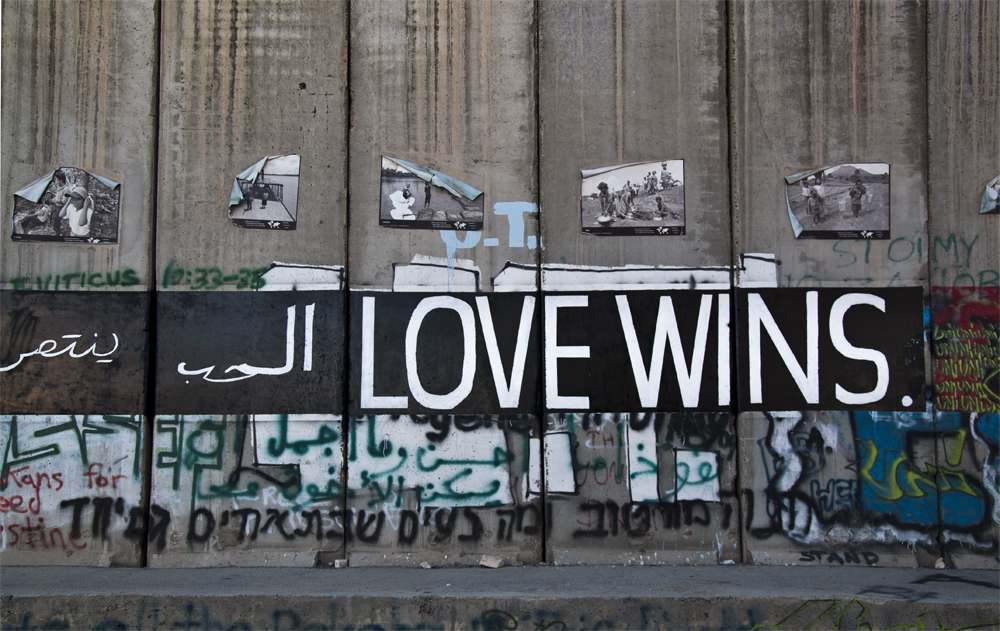
Photo: part of the wall surrounding Bethlehem.

Sunday, March 20, 2016

academy schools…

The government’s latest education “initiative”, to make ALL schools in England Academy schools by 2020, fills me with absolute horror.
Be under no illusions, the government’s plans for academies represent a disaster for our education system – a system that has already suffered devastating, damaging and potentially irreversible revisions since 2010.
Some years ago, I worked in a secondary school which took on Academy status. I certainly felt that the decision to change was taken quickly, with minimum meaningful consultation, and implemented without the full implications being explained to either staff or parents. Essentially, it appeared that the powers-that-be at the school were ‘told’ by the government that, if they wanted extra money for their budget, then Academy status was their only realistic option.
Of course, Academy status was being ‘sold’ to schools in a flagrantly sugar-coated way (schools would be able to “take control of our own futures”, “achieve confidence and independence”; achieve “innovation and creativity” and schools would be “free from the shackles of bureaucracy”!)…
The government has also been promoting Academy Schools as a way to improve standards in education. It endeavours puts a positive spin on its Academy status policy – but academic analysis has simply refuted much of its key assertions.
Academy status will mean (amongst other things): schools not having to employ qualified teachers; an end to parent governors (in future, professionals with the ‘right skills’ will replace the parents with a multitude of skills!); and removing schools out of LEA control. All academy chains and academies will effectively be able to operate in secret, avoiding any accountability to anyone, let alone society as a whole.
Ron Glatter, Emeritus professor of educational administration and management at the Open University, describes the government’s current policy as appearing “to be based on a combination of ideological zeal and extraordinary organisational naivety” (eg. “1,000 trusts, each responsible for at least 10 academies, will be required by 2020. As of last July, there were just 39 trusts with more than 10 academies. Each new trust will need a chief executive, and the heads of some of the largest chains now have salaries in the range £150,000 to £225,000”).

I STRONGLY recommend that you watch this excellent 55 minute documentary, made by parents and teachers from Downhills School in Tottenham in their battle to stop Education secretary, Michael Gove, forcing them to become an Academy School in 2013.
As you might imagine (and no doubt read some yourself), there have also been lots of worthy words written about Academy Schools, following the Chancellor’s Budget announcement last week (nothing about such a policy in the Tory general election manifesto, of course!). You might to check out some of the following:
1.    An article in the TES by a Hampshire headteacher.
2.    Another article in the TES by a Suffolk headteacher.
3.    Reaction from the teaching profession in The Independent newspaper.
4.    Letters to The Guardian newspaper.
5.    An article in The Guardian on former education secretary David Blunkett’s reactions to the policy.
Hey, but these are just a few! No doubt, you’ll have your own examples…

Peter Bunyan, in a recent letter to The Guardian, maintains that “'executive' heads of multi-academy trusts… will have to be creative, and that is finding ways to cut costs and save money, as the supply from central government is reduced. The obvious way is to employ fewer teachers on lower salaries and employ more poorly paid teaching assistants. Another is to extend the school day, but add time saved on to extra holidays so that less money has to be spent on cleaning, general maintenance, office staff and providing meals. That is, cut down on hourly paid workers, the poorest in society. It will be interesting to see, over the coming years, what other ‘creative’ strategies will be adopted as all schools become small businesses, competing with each other for that valued ‘client’, the child”.

Apologies for all my negativity!
I read one anguished comment on facebook a couple of days ago, about the government’s latest education initiative, from a worn-down, disillusioned and angry teacher. She said: “Thank goodness that I’ll be retiring in a couple of years… I can’t stand much more of this” (or words to that effect).
I can only sympathise with her sentiments.
Sadly, it’s today’s children and tomorrow’s children (and society in general) who will have to suffer the consequences of the government’s ideology.
PS: Oh, and just in case you thought university education was all hunky dory, you might like to check out this article in The Observer newspaper: "a government adviser and crossbench peer has warned there could be an 'American-style catastrophe' in English higher education if ministers push ahead with plans to expand opportunities for private providers to become universities".