Thursday, November 17, 2011

remembering my father


I’ve just been reading Blake Morrison’s book “And When Did You Last See Your Father?”. It’s a poignant reflection of his larger-than-life GP father (infuriating memories of him jumping traffic queues; “I may not be right, but I’m never wrong” motto etc) as he approached death. Although my own father wasn’t a “larger-than-life” character (or a GP!), Morrison’s reflections on his father’s final days instantly brought back memories of my Dad’s death (lots of similarities: I think Morrison’s father died the same year as mine – 1992; they both died from cancer that had been diagnosed too late; Morrison and I are similar ages – he’s a year younger; we were both at our fathers’ bedsides when they died).
My father died within six months of diagnosis. I remember my mother telling me “it was serious”, but my father never really accepted this. He refused to talk about it. He seemed to be in complete denial. I recall numerous times when I tried to get him to talk about his life, his family, his childhood - but all to no avail. During his final months (when he was still fit enough to do so), I wanted to drive him to places he loved and for which we had particular memories – like the regular family picnic spot by the river at Aston Cantlow, near Henley-in-Arden, or the Flagpole (or “Tadpole” as younger family members called it!) on Cannock Chase or Llanrhaeadr, near Oswestry, or Bispham, near Blackpool, where we spent so many family holidays. But he just wasn’t interested. Looking back, I think I was trying to prepare myself for grieving him and now feel somewhat guilty that I had pressed him on such matters.
Amazingly, it’s coming up to 20 years since his death and, in many ways (like Blake Morrison), I wish I had written stuff down at the time – so many things have become very hazy, half-remembered recollections.
My Dad, Ron, was a printer for most his working life (compositor and reader). He was a proud and practical man, very organised, quite shy, conscientious and very reliable. He was born and brought up Handsworth, Birmingham (his father worked in the jewelry trade – starting out as a “jeweler errand boy”) and continued to live there for the rest of his life. He was quite an intelligent man who, I think, was very conscious of his working class background. As I grew older, I felt he was almost embarrassed by what he felt was a lack of education (although, of course, he would never have admitted this) - he used to challenge himself to learn new words/meanings on a daily basis via the “Reader’s Digest”. He was very fond of words (but hardly ever read any books, from what I remember?). Whenever he wrote a letter, they frequently “read” overly-formal/flowery and regularly contained words which weren’t quite used correctly – he regularly wrote letters of complaint to the Council or of appreciation to Hollywood stars.
He was a strict disciplinarian. He kept a riding whip hanging over one of the door architraves and used to use it quite frequently – never on me as it happens (was I really such a “good boy”?), but certainly on my brother Alan! He was pretty obstinate at times (surely not something I’ve inherited from him?) and his favourite family saying was: “If I say ‘black’s white’, black’s white”!
I still find it amazing that he used to come home to lunch every day – despite the fact that he worked in Birmingham (Dams+Lock). He had an hour for lunch and, with military precision, this was taken up by a 20-minute bus ride and walk home; 20 minutes to eat lunch; 20-minute walk and bus ride back to work (it’s a very good job the buses were so reliable!)… bearing in mind that it took him 5-10 minutes to walk to the bus stop from home.
He was embarrassingly colour-prejudiced (perhaps this was a result of what he saw as all the changes, for the worse, that had taken place in Handsworth during his lifetime?) and, as I grew older, my only coping-mechanism was to avoid the subject at all costs.
He was a great tinkerer – he could just sit and read a book. I well remember him “digging over” a flower bed at our house in Oxford just a/ few days after Moira had carefully sewn seeds! He and Mary came down to house-sit when we were away on holiday one year; unfortunately (when we lived in Thame), our cat died while we were away and he took it upon himself to get the vet to “get rid of it” – much to the dismay of our girls when we returned – they didn’t even have a body to bury and were completely distraught. I remember us returning home after a few days away and finding that he’d been down to the house and left me a list of things that I “needed to do” on the house!
He was a quite a deep- thinker and quite a creative person in some ways – he always claimed that he invented cellophane wrappings for food, for example (but, obviously, only in theory!)(he’d have a lot to answer for in these eco-conscious days).
Despite his relative shyness, he was quite gregarious in family situations (organising the games at Christmas, for example). Having said that, although he very much loved his family, he seemed to have an awkwardness when it came to dealing with his grandchildren (and his daughters-in-law!).
I think my most treasured memories are our occasional chats in the pub when they came down to Oxford/Thame on a Sunday. That was the time when I think we were closest. These were probably the only occasions that he “let his guard down” a little. He wasn’t a man to tell his sons that he loved them (well, certainly not in so many words!) and was frequently critical of both Alan and me – but, over our pints of beer, I came to appreciate that he was very proud of us both. This sounds awful but, whenever Mary accompanied us to the pub, it was never the same – he would clam up (and so would I!).
Apologies for rabbiting on, but I sense that if I don’t write down some of my recollections now, I may end up forgetting altogether!
He died from lung cancer when he was just 70. He was a thoroughly good man and he’d be incredibly proud of his sons, daughters-in-law, grandchildren and great-grandchildren if he were alive today.
Photo: My mother and father (late 1991? and 1947, Ilfracombe).

Tuesday, November 15, 2011

golfing and green fingers


In an ideal world, I’ve sometimes thought it would be rather nice to have “green fingers”. Clearly, in the real world, I don’t. That was until yesterday. As you might be able to see from the photograph (yes, it’s my ancient-looking hand), I now really do have green fingers!
I went back to my former golf club (Studley Wood near Oxford) yesterday to participate in the annual Bob Head Classic Golf Tournament – to celebrate Bob’s birthday. Last year, at about this time, the golf greens were apparently suffering from some fungal disease. So this year, as a precaution, they decided to spray all the greens with a green dye (which apparently contains fertilizer and some magic potion)(really?). It makes the course look as if it’s trying to impress passing helicopters, for some reason. It also means that your golf balls end up being covered in the stuff… and, of course, so do your hands (well, at least your non-golf glove hand).
It’s now getting on for 24 hours since I played and I must have washed my hands more than 20 times since I finished the round… and, as the photograph hopefully illustrates, my hand is STILL green! I have to say, I’m not very impressed.
Actually, it was a really good day. There were more than 20 of us playing and it was great meeting up with some old friends again (school terms have meant that I’ve missed the past six “tournaments”).
PS: Hardly playing these days means that my golf is somewhat unpredictable in terms of quality. This was well illustrated by my exploits at the first hole (par 4) yesterday: without having hit any practice balls, I played two superb shots to put myself some 10feet from the hole and ended up four-putting!

Monday, November 14, 2011

the awakening


Catherine, Gareth, Alan and I went to see Nick Murphy’s “The Awakening” at the Watershed yesterday afternoon (Moira was sorting out her vast collection of knitting needles – true!). I’m not really a horror-/ghost story-lover but I did “enjoy” this film. It’s set in England shortly after the end of the Great War and Rebecca Hall (acknowledged ghost-buster or, rather, ghost-debunker) is summoned to a remote boys’ school to investigate some creepy incidents. Beautifully filmed and containing some suitably scary moments (I may not be prepared to play with our granddaughters’ dolls house in future!). Not sure that I was at all convinced about the ending, but… I did fall for Rebecca Hall!

Sunday, November 13, 2011

the dreaded eleven-plus and other stuff…


I’ve just finished reading a book about the “Middle Classes” (I know this seems a strange book choice, but I picked it up in a bookshop and became intrigued after reading a few pages). I think we’ve largely left the differentiations between the classes behind, thank goodness, but I did find one of the book’s conclusions worrying: “All the relevant indicators suggest that British society became more unequal and less open in the later 20th century. For example, the poorest 10% of Britons were 13% worse off in 1997 than in 1979; by the 1990s the gap between highest and lowest paid was the widest since records began; and there is clear evidence of declining social mobility among the poorest third of society”.
The book also highlighted the dreaded Eleven-Plus examination – introduced by Tory Minister Rab Butler through the 1944 Education Act. The system was based on the idea of different types of education for different children (ie. differentiation by academic ability rather than by class) - yet hopes that the “secondary modern” would, by virtue of its more practical education, gain a prestige equal to that of the grammar school were never to be fulfilled.
The awful thing was that this creamed off a small minority into the grammar schools while the vast majority were labelled as “failures” (many for the rest of their lives) – just on the strength of one, single, flawed examination.
It made me reflect on my own childhood in the 1950s/60s. My family was very much a loving and supportive one, but definitely “working class”. I did have a very good Grammar school education (although my parents were only informed that I’d passed the eleven-plus the day AFTER everybody else due to the letter having been delivered to the wrong address!), but my brother – who I feel was just as “bright” as me – failed the exam. This wasn’t at all surprising however. As a child, he suffered terribly with chronic asthma and he ended up spending time at an “open air school” in the years before sitting the exam (which clearly had a detrimental effect on his education)… I just LOVE the rather bizarre idea that Birmingham should be considered a suitable location for an “open air school”!
The awful thing is that, while my brother went through secondary school education and left school at 15, I ended up being fast-forwarded to take my O-Level exams a year in advance (despite my father insisting on seeing the headmaster to plead that I shouldn’t be allowed to do so… the headmaster fortunately persuaded him otherwise!). Happily, by the time brother was 20, at his own insistence, he began to study at night-school in order to obtain some qualifications and, amazingly despite all the odds, ended up going to university and obtaining a Surveying degree (but he did so only by continuing to work full time/study in his spare time – it took him something like 10 years). He really is an amazing bloke.
Not many people, in similar circumstances, would have had his guts, determination and sheer endurance (or opportunity?) to battle through such an educational background.
For a variety of reasons (including my brother’s experiences), we took the decision that our own children should be educated under the comprehensive system – deciding to remain in Oxfordshire, rather than Buckinghamshire (where my architectural practice had its offices).
We don’t regret it.

PS: The “Middle Classes” book was fascinating in all sorts of ways. This was just one of the ridiculous things I discovered: “Until the Test and Corporation Acts of 1828, holders of public office had to receive Anglican communion and to reject the Catholic doctrine of transubstantiation, thus preventing non-Anglicans of any kind from becoming members of parliament. Even then, the same barrier still prevented anyone who was not a member of the established church from taking a degree at Oxford or Cambridge until 1856 or teaching there before Gladstone abolished the University Religious Tests in 1871”. Genius!
Photo: extract from Handsworth Grammar School photograph dated May 1963 (I’m third row from the top, third from the right)(yes, this was just pre-Beatles and I’d just started experimenting with Brycreem!).

Friday, November 11, 2011

what new financial crisis?


I trust you’re keeping up with the various downs and downs on the current financial crisis? After Greece, it’s now Italy’s turn to come under the intense spotlight (and who’s next? Spain? Portugal? France?... perhaps then the UK?). There’s even talk of a two-tier eurozone. On Tuesday, Mr Berlusconi said that he planned to resign after failing to win an absolute majority in the lower house of parliament in a vote on the budget. On Wednesday, Italy's cost of borrowing touched a new record (if Italy now tried to borrow money, payable in 10 years, it would have to pay an interest rate of more than 7%). Robert Preston, BBC Economics Correspondent, commented: “When the implicit interest rate rises to that kind of level, investors know that a country with big debts can't afford to repay what it owes”. An Italian financier sadly acknowledged on the BBC’s Six O’Clock News that: “The markets go after the weakest”. Jon Snow, from Channel4 News, gloomily warned: “Make no mistake this is one of the biggest news stories of our generation, one of the most alarming and all-enveloping fogs of uncertainty since the build up of the second world war”.
I’ve just finished reading a book entitled “Middle Classes”. In it is a section about “The City” and the Stock Exchange in days gone by. These are some fascinating extracts:
George Verey (in the 1940s): “It was a gentler world; it was less grabbing. In my day no one picked up a million; five thousand a year was considered good money. The income mostly went on living – the upkeep of the family, holidays, school fees. There were virtually no “perks”. If you knew someone to be greedy, you saw as little as possible of them”.
…. and this (the book was published in 2002):
“The City remained curiously wedded to custom and tradition even by middle-class standards, so that when changes occurred they appeared especially striking. As with other sectors of the British economy, change began to be felt in the City in the early 1970s with the onset of recession. In 1972-3 the stock market crashed as a result of banks over-lending with insufficient liquidity to compensate. As deputy chairman of the Stock Exchange, James Dundas Hamilton recalled, ‘We used to go to visit the governor of the Bank of England every Wednesday and listen to the appalling news of one bank after another closing its doors. The Stock Exchange had a very tough time in that period’. Still more profound in the long term were the effects of the deregulation of the international money markets following the collapse in 1971 of the Bretton Woods agreement, which had underpinned and controlled the international monetary system since the Second World War. Exchange rates had previously been fixed internationally in relation to the US dollar, but from the early 1970s the system broke down and there was nothing to stop large flows of money going from one country to another. Boosted by petrodollars from the profits of the world’s oil-producing countries and by the exchange controls by national governments, new money flooded onto the financial markets over the next decade, largely independent of either world trade or government intervention. These developments had major and lasting effects…. But while these trends augmented the importance of the City of London within both the national and the international economy, they also rapidly destroyed the old-fashioned work practices and culture”.
So, we’ve seen it all before (well, almost)… except that the markets now seem to control everything in these times of GLOBAL economics, while governments appear powerless and are just left tinkering on the sidelines (or am I being terribly unfair?).
Photo: is the sun setting on the eurozone?

Thursday, November 10, 2011

the day of the nasturtiums….


Triffid-like, the nasturtiums in our small back garden have taken over everything and have been threatening to swamp the whole of Southville. They’d re-seeded themselves from last year.
Well, yesterday was the day that they met their match (well, until they pop up uninvited next year); I spent an hour or so hunting them down (not difficult, they’re everywhere), stuffing them into sacks, taking them down to the local re-cycling place and waving them goodbye. In an ideal world, despite its small size, we’d like to grow some food in our garden. A couple of years ago, thanks to our GrowZone friends, we made an initial effort to get things rolling… not particularly successfully (some strawberries, chard, lettuce, tiny potatoes, small green tomatoes and the odd squash), but at least it was a start. THIS year has been pretty disastrous: we decided to grow fruit and planted (last year) gooseberry and blackcurrant bushes, rhubarb and an espaliered(?) apple tree; plus tomatoes, potatoes, chard, chives, beans and garlic. All we seem to have produced from this is the odd tiny green tomato, more small potatoes (even for perhaps three meals?) plus some chard, chives and some small garlic specimens (and nasturtiums, of course!). If ONLY we’d decided to concentrate on cultivating slugs and snails, we’d have been quids in, but unfortunately we didn’t.
This coming year, we’re going to try again. After our previous disasters, we’re setting our sights pretty low. But I promise to be make daily slug+snail dawn patrols and I will endeavour to water stuff regularly as necessary.
Other suggestions gratefully received!
Photo: the view from our kitchen window (before!).
PS: yes, I know you can eat nasturtium flowers, but….

Wednesday, November 09, 2011

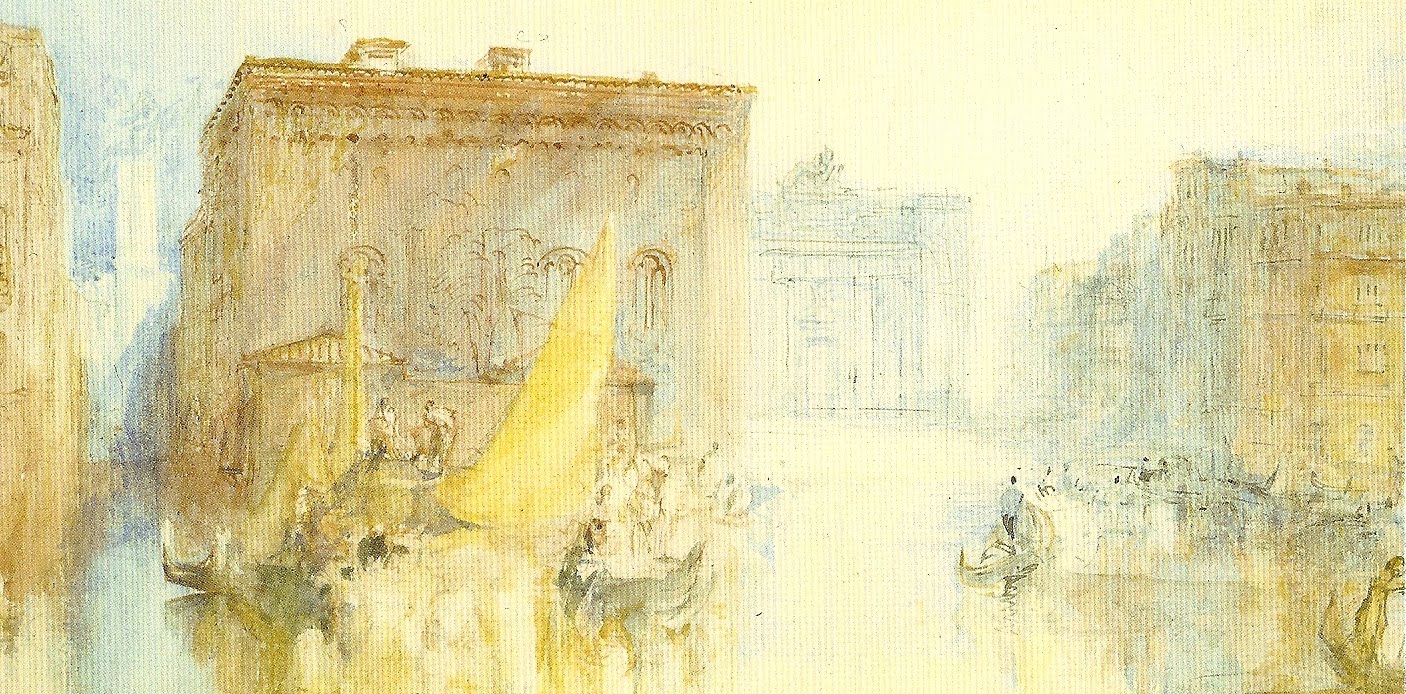
touching turner's treasures


I’ve been fascinated by Joseph Mallord William Turner (1775-1851) ever since attending an exhibition of his work at the Tate Gallery, London in early 1975. My memory is somewhat vague about precisely how it came about but, shortly after that time, I was given the chance to look at some Turner watercolours (normally kept hidden away) at the Ashmolean Museum, Oxford. Simply wonderful.
Well, following this experience, I vowed that I’d repeat this experience one day. Now that I live a life of leisure(?), I decided that that time had come and so I e-mailed the Western Art Print Room one evening last week and asked if there was a chance of me seeing some of Turner’s watercolours – including three of his Venetian studies. By 10am the following morning, I’d received a really helpful reply (together with a very useful web-link which allowed me to select some additional pieces from their archive) and, as a result, made arrangements to meet one of the print room assistants yesterday morning.
So, Moira and I spent nearly an hour poring over about 50 of Turner’s watercolours – wonderful actually being allowed to handle these works of art (presented with large boxes of mounted watercolours, small desk easel and, of course, white cotton gloves!).
A huge privilege and a truly magical, memorable experience.
PS: The Print Room at the Ashmolean is open to “members of the public, students and visiting scholars alike for the study and enjoyment of drawings and prints from the collection” (quote from the print room brochure)… and it’s free.
PPS: Thankfully, when I went to the Tate exhibition in 1975, I’d decided to buy the accompanying exhibition catalogue and have been looking through it again over recent days. It made me query how many drawings, sketches or paintings I had undertaken in my life (so far!). 500? Perhaps 1,000? I suspect it’s far closer to 500 - even including those undertaken during my architectural career. This pales into utter insignificance when compared to Turner. He left over 19,000 sketches and watercolours in the “Turner Bequest”, hundreds of finished watercolours and well over 500 oil paintings. How on earth did he find the time (he virtually produced a sketch EVERY day of his adult life – and this doesn’t allow for his “finished” paintings!)?
My catalogue gives a pointer: “A true professional, he never stopped observing, recording. Over 250 sketchbooks at the British Museum bear witness to this. Not for him the busy private life: his social life was confined to professional functions at the Royal Academy and basic, safety-valve affairs with his housekeepers”. Brilliant quote!
PPS: The Ashmolean also has drawings and prints by Michelangelo and Raphael (amongst others) – so I’ll be making a return visit in the not-too-distant future!!
Photo: this is one of the watercolours I actually handled yesterday: “Venice: The Accademia, 1840” (this was Turner’s fourth, and last, visit to Venice).

Monday, November 07, 2011

the ides of march


Well, it wasn’t like this on West Wing!
Moira, Gareth+Alan+I went to see this George Clooney-directed political thriller at the Watershed yesterday. It focuses on the last frantic days of a closely-contested presidential primary - just two Democrats left in the fight for the presidency and the brilliant up-and-coming press secretary (convincingly played by Ryan Gosling) of one of the candidates (played by Clooney himself) suddenly finds himself involved in a complicated political scandal which threatens to sink his “camp”…..
Loyalty? Trust? Betrayal?
All I’ll say is that it’s an impressive and worryingly convincing film (apart from a couple of issues perhaps?) and definitely worth seeing.

Saturday, November 05, 2011

G20, bill gates, bill nighy, rowan williams and the robin hood tax


French President Nicolas Sarkozy commissioned Bill Gates to produce a Report for this week’s G20 Summit. In the event, Gates has given a boost to supporters of a Robin Hood Tax by telling the summit that such a levy on financial transactions was "clearly technically feasible". He maintains that it was "critical" that a portion of the money raised from any Financial Transaction Tax (FTT) should be used to help the developing world, rather than simply to shore up ailing First World economies. An FTT - which this week won the backing of the Archbishop of Canterbury was one of a range of measures which Mr Gates said could bring the number of the world's poor states down to "zero".
As things stand, Britain and the USA governments are reluctant to sign up to a levy.
Bill Nighy, an ambassador for Oxfam and a strong supporter of the Robin Hood Tax, has also been in Cannes this week (and he was very impressive on BBC Breakfast earlier this week too - I’ve just watched
this recording).
Thursday’s Guardian newspaper included some interesting
comments from Nighy:
"I find increasingly any resistance to the idea harder and harder to swallow. It is mysterious. Resistance is becoming less and less easy. The reasons given are suspicious. There is not only support from serious moral people like Archbishop of Canterbury, and the pope, but there are 1,000 economists in support. Both the IMF and EU have done feasibility studies that are very supportive.
"It is very popular because no one is going to have to pay any more tax directly. The value of the derivatives market is now somewhere between $605 and $620tn [£377 and £387tn] – the world economy is only $60tn – and the $620tn is currently untaxed. The 50 pence tax on every £1,000 is all that is being asked for."

When questioned about the world-wide “Occupy” protesters (against accusations that they were “rebels without a cause”), Nighy responded: "The Robin Hood tax expresses in real terms what they are about. The protests around the world are directly linked to the Robin Hood tax matters and I find it very moving. The dignity restraint and powers of these protests is very impressive."
I’ve just added Bill Nighy to my “Dream Team”/“World Eleven” (these two old blogs of mine refer!).
PS: I’ll post an updated version of my latest “Dream Team”/“World Eleven” in due course!

Friday, November 04, 2011

october-november books


Latest books:
Theft: A Love Story (Peter Carey): The story is told by two Australian brothers in alternating chapters – Michael, an artist whose career appears to have peaked and Hugh, his “damaged” brother (for whom Michael acts as guardian/caretaker). It starts with Michael fresh out of jail for robbing his ex-wife of his own paintings and proceeds – with the help of a mysterious woman - into an art world tainted with concerns about validation and authenticity…. and potential fortunes. It’s a very funny (and somewhat grumpy and crude!) book and I thoroughly enjoyed it.
The Harold Nicholson Diaries 1907-1963(edited by Nigel Nicholson): I REALLY enjoyed this book. It draws on diary entries and letters (essentially between Nicholson and his poet/author/gardener wife, Vita Sackville-West)(they had a very happy, but very unconventional marriage). He rightly has a reputation for being one of the great political diarists. He was a diplomat, Conservative MP - he flirted with Labour after WW2 - an extensive author and also worked in the Foreign Office (he attended the Paris Peace Conference in 1919). I found the political background to both World Wars historically illuminating. He never achieved high office, but his diaries are simply littered with accounts of his meetings with “the great and the good” of the time. Despite his privileged background (he describes himself as “upper class”) and his smugness and snobbery (at times), I found Nicholson’s book to be a beautifully written, insightful and completely fascinating portrayal of British politics in the first half of the 2oth century.
Thinking Out Loud (John L Bell): This is a book of his “Thought for the Day” recordings for Radio4’s Today Programme (which we’re discussing at our weekly Ithaca sessions). The only trouble with a batch of these bound up in a single volume is that they become somewhat predictable in style. However, I’m a big fan of John Bell and did find his observations both thought-provoking and challenging.
The Betrayal (Helen Dunmore): This is our Book Group’s latest study book. It tells the story of a Russian family in the early 1950s – a time when the country was dominated by Stalin, the secret police and when everyone mistrusted almost everyone. It’s an intelligent, thoughtful novel – I read it very quickly, almost as if it was “thriller”. It reminded me of the time I read Solzhenitsyn’s “One Day in the Life of Ivan Denisovich” and had felt somewhat guilty of life’s simplest pleasures (family, friendship, warmth, food, sleep, comfort, home, fresh air, freedom and the like). It’s a very impressive book and brilliantly captures a sense of hopelessness and fear and yet, at the same time, acknowledges the massive strength of the human spirit.
Much Obliged, Jeeves (PG Wodeshouse): It’s been an awful long time since I last read any PG Wodehouse, but I did enjoy this. There’s something rather reassuring about Jeeves+Wooster books – the humour; ridiculous snobbery; language; bizarre characters and the excruciating predictability. Effortless, light reading.

Thursday, November 03, 2011

occupy bristol camp


I dropped in to the “Occupy Bristol” camp yesterday morning on College Green and chatted to a group of protesters. They seemed in very good spirits and determined to continue the occupation for as long as possible. They appeared to be very organized – they’d just finished one of their daily “open meetings” and scribbles on their white board certainly seemed to have identified a number of key issues/responsibilities and assigned particular individuals as coordinators. I’ve been impressed by the way they’re trying to communicate with the public at large – via signs and messages placed around the site (explaining what they’re doing and that their protest is entirely peaceful and non-confrontational) and also the “drop-in” gazebo(?) where one or two members of the camp can answer any queries from members of the public. I also noticed that they’d put together a schedule of “campsite rules”, which they displayed around the site so that members of the public (and prospective protesters?) were aware. The ten or so rules seemed entirely sensible and appropriate to me (and I think that the today’s open meeting also took a decision to ban alcohol from the site).
I had a long chat to “Greg”. He told me that the camp members had been encouraged at St Paul’s by the changed attitude of the church authorities (and the City of London Corporation) to back away from the enforced eviction actions (and with the ongoing dialogue). He said that, here in Bristol, the relationships with City Council and cathedral authorities was good and that he understood that they were under no immediate threat of eviction. I told him that the Archbishop of Canterbury had written an article in today’s Financial Times indicating his support for the Robin Hood Tax – Greg hadn’t been aware of this prior to our conversation. I asked him how people were able to afford to devote their time to the demonstration and he told me that some people had given up their holidays, some were spending all their “non-work” time at the camp and some simply didn’t have jobs to go to. He said that the most encouraging aspect of the occupation had been the real sense of community that the protesters had experienced. For example: local businesses and individuals had been donating money+food and members of the public had also been turning up and cooking meals for them. He accepted that the protesters didn’t have any “specific” demands – it was simply their intention to raise awareness and basically to say “enough is enough”!
Photo: part of the Occupy Bristol campsite (note: I decided it was best to avoid taking any group pictures!).
PS: This ended up feeling as if I SHOULD have ended it with the words: “Steve Broadway, News At Ten, Bristol”. Apologies!

Wednesday, November 02, 2011

june tabor and the oysterband


Moira and I went to see a remarkable concert last night at St George’s, Bristol. The Oysterband and June Tabor were back on stage touring for the first time for some 17 years. I love June Tabor’s voice and had the booked tickets purely on this basis. I’m sorry to have to admit that I knew very little about the Oysterband and went along very much thinking they’d be her “backing band”. How wrong I was! The Oysterband’s John Jones has a wonderful voice too and the combination of Tabor, him and the highly-gifted band was simply beautiful. They interacted with such ease that it seemed as if they’d be touring together on a weekly basis for ever! June Tabor has an amazing, brooding voice (and she’s even older than me!). Among the highlights for me were covers of Joy Division’s “Love Will Tear Us Apart”, Jefferson Airplane’s “White Rabbit” and PJ Harvey’s “That Was My Veil”… with a wonderful version of the Oysterband’s “Put Out The Lights” to finish (click here to get a sense of the finale – but ours was better!).
My retirement commitment to attend more concerts is a great success… but now I need to book some more dates in my diary!
Photo: Yes, I know the band members are missing (no photography allowed in the concert) - but we had seats in the front of the balcony immediately above the band and I wanted to capture this for posterity!

Tuesday, November 01, 2011

I'm afraid I'm at a loss....


Last week, eurozone leaders agreed a second Greek bailout worth 130bn euros as well as banks agreeing to take 50% losses on their holdings of Greek debt. It was meant to remove uncertainty and to help provide longer-term stability in the world financial markets. But now that deal is up in the air again. The Greek Prime Minister, in response to an increasingly bitter electorate, has now announced a referendum on the bailout deal. No doubt, this will take a little time to organise and, in the meantime, worldwide financial uncertainty (or maybe even panic?) will be back on the agenda (with 60% of Greeks apparently against the austerity measures, it seems likely that they will end up leaving the eurozone altogether).
Political leaders from the EU and beyond had hoped that last week’s measures would end (to some extent at least) speculation on the financial markets…. but surely, this was only ever likely to be short-term relief and that Italy, Spain, perhaps the UK and who-knows-who would be next in line? I don’t blame the Greek people at all – they are having to pay for poor government decisions/policies that probably go back an entire generation.
When it comes to finance on a personal level, I REALLY don’t have a good track record (Equitable Life investor, endowment mortgage etc etc!). However, what seems clear to even financially-naive people like me, is that our own individual efforts count for nothing. We work hard all our lives; we obey the rules; we trust our respective governments to take sensible decisions for the greater good; we strive to make the world a better place…. but, actually, we don’t stand a chance. It seems that the world is about greed; about power in the hands of CEOs, shareholders, bankers, city speculators; about profit and more profit; about dog-eat-dog and ignore the consequences…. and, rather like “The Sorcerer’s Apprentice”, things have got completely out of hand and no one seems to know how to stop the depressing cycle.
This is background for the Occupy Wall Street demonstrations in New York that started in September and have now extended to over 900 cities worldwide – including the “Occupy London Stock Exchange” (OLSX) outside St Paul’s in London. They’ve been protesting about "social justice, real democracy and challenging the unsustainable financial system that punishes the many and privileges the few".
Where’s Superman when you need him (and I’m definitely NOT referring to George Gideon Oliver Osborne)?

Monday, October 31, 2011

protest camp at st paul’s: what would jesus do?


Questions, questions, (typical) questions….
How on earth can these people find the time to camp out indefinitely? Haven’t they got jobs?
What do they hope to achieve? They haven’t got any specific demands, have they?

Well, all I know is that I’m glad that these protesters in cities throughout the world ARE making a stand. I’ve signed countless petitions; I’ve written to my MP a number of times; I’ve blogged about all the unfairness and the greed…. but, apparently, all to no avail. These people ARE doing something and it nags away at the powers-that-be and they’re helping to keep the media’s attention on the issues.
They’re acting as MY conscience (why don’t I camp out with them – afterall, I’ve got the time/opportunity – is it because I just couldn’t be bothered?). I want them still to be protesting as we come up to Christmas and we start hearing about the bonuses being paid out to all and sundry in the banking/stock exchange/CEO world – even though it’s ordinary people like us that are actually paying the ENORMOUS price for their mistakes/mismanagement/greed.
Much has been written over the past few days about the decision of the cathedral authorities (and the City of London Corporation) to begin the legal process to evict the protesters currently camping outside St Paul’s. I have to say that I just cannot comprehend the Church’s stance on this. You will recall that Dr Giles Fraser resigned from his post as canon chancellor last Thursday. It was Canon Fraser who told police to allow the protesters to set up camp outside the cathedral on 15 October after they had been prevented from camping by the London Stock Exchange in privately-owned Paternoster Square near St Paul's. What actual harm are the protestors causing as far as the church is concerned? I’m convinced that they would be able to come to agreement to ensure that the cathedral remains open at all times. Archbishop of Canterbury, Rowan Williams, has spoken out about the greed of bankers, financial markets and the “rich” over recent years on several occasions and this was surely an opportunity for the church to stand alongside the protesters.
There was a very good
article (in my view) in The Guardian on 29 October entitled “Occupy London could be protected by Christian ring of prayer”. I think the following extracts sum up the feelings of a lot of us:
“Christian groups that have publicly sided with the protesters include one of the oldest Christian charities, the Fellowship of Reconciliation, and the oldest national student organisation, the Student Christian Movement, Christianity Uncut, the Zacchaeus 2000 Trust and the Christian magazine Third Way. In addition, London Catholic Worker, the Society of Sacramental Socialists and Quaker groups have offered their support.
“A statement by the groups said: ‘As Christians, we stand alongside people of all religions who are resisting economic injustice with active nonviolence. The global economic system perpetuates the wealth of the few at the expense of the many. It is based on idolatrous subservience to markets. We cannot worship both God and money.’
“Director of the influential religious think-tank Ekklesia, Jonathan Bartley said: "There are some very unhappy people within the Church of England. The protesters seem to articulate many of the issues that the church has paid lip-service to. Many people are disillusioned with the position St Paul's has adopted. To evict rather than offer sanctuary is contrary to what many people think the church is all about. The whole thing has been a car crash."

A car crash indeed!

Saturday, October 29, 2011

we need to talk about kevin


Blimey! A stunning, unrelenting film, directed by Lynne Ramsay, based on Lionel Shriver’s novel. You know from the start (and I’m not really giving anything away here as the publicity – plus the book - makes it pretty clear!) that the son goes on a high school killing spree. The film flashes back and forth as the mother (superbly played by Tilda Swinton) fruitlessly tries to find out the reasons why. Some brilliant scenes – including the opening sequence at the tomatina festival in Bunol, Spain! Powerful, horrific and haunting - but completely absorbing. Moira+I walked home from the Watershed somewhat subdued (and thankful we only had daughters?).
After writing this, I’ve just read Peter Bradshaw’s excellent review in The Guardian. This is its final paragraph: “My only worry is that some hapless cinemas might schedule this as one of their special "parent-child" screenings. Bad idea”. Agreed!
You must see this film (and Tilda Swinton for an Oscar, surely?).

Friday, October 28, 2011

sunrise at glastonbury


I had an inkling that it was going to be a bright, but misty, morning first thing and, when I awoke and peered through the curtains (it was still very dark!), it gave every impression that that was indeed going to be case. So I jumped in the car and headed for the Somerset Levels (as you do). En route - having established that it WAS going to be a beautiful “bright, but misty, morning” – I decided to drive on to Glastonbury. I’m really pleased I did because it was absolutely stunning. Once I’d climbed up the Tor (just as the sun was rising), there were the most amazing views across the Levels – which were completely shrouded in low cotton-wool clouds. Perhaps not surprisingly, there were just three other people on the Tor…. we just smiled at each other and acknowledged that we’d been privileged to be there.
Simply magical.
Photo: as you will note, one of the other people on the Tor was a “proper” photographer!!
PS: you can see some of my photographs by clicking
here (not compulsory!).

Thursday, October 27, 2011

chris wood at colston hall


Moira+I spent a weekend with lovely friends Bruce+Sara in May. I was looking through their CD collection (as you do!) and Sara suggested that I play an album by Chris Wood. Frankly, I’d never heard of him before, but followed her advice and was hugely impressed (so much so that I later bought the CD – “The Lark Descending”).
One of my “retirement resolutions” was to attend some more concerts and so, when I discovered (a few weeks ago) that CW was coming to the Colston Hall in Bristol, I booked a couple of tickets. Ruth+I duly went along to the concert last Friday and it proved to be a brilliant evening. Just Chris Wood and his guitar. He performed some stunningly beautiful songs for nearly 90 minutes and entertained everyone with his straightforward, gentle chat and humour. I’ve since purchased his “Handmade Life” CD – which is excellent and I thoroughly recommend it.
Nothing beats live performance (and thanks Bruce+Sara)!

Wednesday, October 26, 2011

dismissive


A leaked government report, prepared by a venture capitalist/Conservative Party donor, argues that “unproductive workers” should lose their right to claim unfair dismissal. I think this could set a really dangerous precedent.
Clearly, there ARE cases of slackers (or whatever you might call them) but, as someone who employed people for nearly 30 years, I am well aware of the need to ensure that all employees are “on board” as far as the company/organisation is concerned. In my view, trying to ensure that you employ the “right” people in the first place and, crucially, communication are the key factors. In all my time as an employer, I think we only made one “mistake” – and it wasn’t anything to do with the member of staff being “unproductive”, it was the person’s negative attitude towards his work and his colleagues (I didn’t have to sack him, he left after 3 years, but he was definitely a “bad apple”!).
A number of general observations:
1. How do they propose to define an “unproductive worker”?
2. Good personnel management and “fairness” (working both ways) are crucial.
3. Setting a meaningful probationary period (perhaps up to 12 months?), with regular reviews, must make sense?
4. What about poor employers or line managers?
5. Might this just be another case of the government “leaking” a proposal so it can unveil a watered-down version in a few months’ time which doesn't create the same level of negative reaction?
Unfortunately, I can actually see a time when virtually all employees are on fixed-term contracts – with no guarantee of re-employment and people to apply for their own jobs at the end of the term (as/if appropriate).
I feel this could run and run…

Saturday, October 22, 2011

family time


Grandparenthood is a beautiful thing!
Moira+I have just returned from a few days in Lancashire with Alice+Dave (and Mikey+Dan+Jemima). Although we’re in the very fortunate position of being able to see our other grandchildren, Iris+Rosa (and their parents!), on a very regular basis, we don’t get to meet up with the Leyland branch anything like as often as we’d like. As a result (often with several months between visits) , we don’t see the day-to-day changes that happen as M+D+J’s respective characters develop. However, such occasional snapshots do highlight their physical changes/growth and magnify their evolving sensitivities/sense of humour/likes/dislikes/passions/skills.
Thankfully, it doesn’t take them long to adjust/remember their long-lost grandparents and so we seem to spend an awful lot of our time together laughing and enjoying each other’s company.
It was also (obviously!) LOVELY to see Alice+Dave again. They are amazing parents. I have say that this parenting stuff is definitely for young people – at least for Moira and me in our “advanced” years, we can sit back and relax after two or three days “intensive” effort/activity…. parents, of course, don’t have such luxuries!
Photo: Mikey, Dan+Jemima.

Monday, October 17, 2011

it’s probably just me, but…..


Last Saturday morning, as I tended our market stall at the harbourside, I saw two things that have been haunting me since that time.
The first involved what I took to be three young men and their three sons(?). The men were all in their early 30’s, I suppose, and the boys were perhaps 8-10 years of age. Nothing particularly memorable or disturbing about this, of course, and on the positive side, it’s good for fathers and sons to be spending some time together. The problem, for me, was that each of the men was drinking from a can of beer as they passed me; they were loud-mouthed, fairly aggressive in their manner and definitely appeared to be “strutting their stuff” (as if in warning to anyone who might get in their way). Apart from the fact that it was only mid-morning, nothing particularly usual about this you might think. What I found particularly sad was that the three boys were walking directly behind them and, in many ways, were mirroring their fathers’ actions – they each had the same “cocky” gait; they weren’t just talking to each other (and anyone else who might have been interested), they were shouting. In short, they were emulating their fathers – who, sadly and depressingly, were clearly their role-models.
The second incident involved four girls (each perhaps 12 years of age?). I watched them “play” on the cascading steps – running up and down and splashing each other as they did so. Then I saw one of the girls pick up a discarded, polystyrene food container (still half-full of food) and gleefully throw it at one of her friends who was about 5metres away from her – accompanied by much shrieking and shouting. Food was scattered everywhere (but ALL of it in the waters of the cascading steps). It was disgusting. Not a single onlooker seemed to bat an eyelid. The girls thought it was hilarious and soon moved on (to cause havoc elsewhere?). Although I was some 50metres away, I now regret not running along the harbourside myself and confronting the girl in question.
What is to become of us (and them)?