Thursday, April 21, 2022

march-april 2022 books…

The Village Of Eight Graves (Seishi Yokomizo): This was my third Yokomizo murder mystery (first published in 1971)… and probably my favourite of the three. As always, the plot is quite complicated (but clever and intriguing) – with more murders than ‘Midsomer Murders’ – and involves a young man arriving in hamlet nestling in the mountains of Japan (named ‘Eight Graves’ after a centuries-old massacre) to claim a mysterious inheritance. There are a series of gruesome poisonings but, with the help of the famous Kosuke Kindaichi (the book’s equivalent of Christie’s Poirot), the mystery is eventually solved (despite all the various red herrings and dubious alibis. It’s typical, classic, crime fiction with all the dots duly joined up by way of explanation at the end of the book.
Clothes, Clothes, Clothes… (Viv Albertine): This was Albertine’s first book (published in 2014). I’d previously read her follow-up ‘To Throw Away Unopened’ (published in 2018) and had been vaguely familiar with the punk band “The Slits” and, by association, knew that Viv Albertine had been a guitarist in the band. She’s a really excellent writer (and I heard her at a book launch 3 years ago and was very impressed). As the title suggests, this memoir is about her ‘obsession’ (my description) about clothes, music and boys. From a poor, working-class background and largely brought up by her mother, the book is a breathtakingly honest, often quite shocking story about her life in the band, her subsequent health and family struggles and her re-connection with music in her mid-fifties. She describes herself as being somewhat shy (I’m not sure I’d agree – ‘bossy and selfish’ might be closer to the mark?). She’s certainly a determined, rebellious, uncompromising woman (we wouldn’t have ‘got on’!). Nevertheless, the book is incredibly readable and entertaining (400+ pages which I read in 3 days).
A Black Boy At Eton (Dillibe Onyeama): The book was first published in 1972 and re-published, fifty years later, after being selected by Bernardine Evaristo as one of a series of ‘rediscovered’ books about Black Britain. Nigerian Onyeama (son of a Supreme Court Judge) is a couple of years younger than me, but interesting nevertheless to compare our respective school experiences – not that Handsworth Grammar quite compares with Eton!). In 1969, he became the first black person to finish their studies at Eton College. He wrote the book about his experiences of racism at Eton, “Nigger at Eton” (but subsequently re-titled). It’s a shocking story of the cruel racial prejudice and racism he endured during his time at the school. It’s a very frank book - frequently exposing his own inappropriate behaviour on occasions – written, in my view, in a style of awkward formality (and reflecting a somewhat naïve attitude to life and, in Evaristo’s words, “still maturing into adulthood”). By his own admission, he wasn’t a particularly impressive pupil (arrogant and a self-confessed snob)(probably a common Etonian trait!); he was unpopular with many of his fellow students and taunted/verbally abused by many of them; he comes across as someone who was self-centred, insensitive and unaware of how his own actions and comments might be interpreted; he was also not averse to using violence against his aggressors. Despite its occasional humour, it’s a dehumanising and shameful book - reflecting much of the sickening colour prejudice of the time in society (much of which sadly continues today).
Being Mortal (Atul Gawande): This is a book about what it’s like to get old and die and how we manage our mortality… and I thought it was rather wonderful. It might seem a little morbid reading about such a subject, but this eloquent, moving book is something of a manifesto that could radically improve the lives of the aged and the terminally ill. Gawande is a surgeon and a professor at Harvard Medical School and the book includes accounts of a number of people’s ‘last days’. It opens a door to discussions with close relatives about how people wish to spend their final days – not necessarily about extending life, but more about living with dignity and joy until the end of it (ie. not so much a medical problem but a human one). It’s beautifully and engagingly written and I highly recommend it.
Grey Bees (Andrey Kurkov): This is our Storysmith bookgroup’s next book and to say that it’s pertinent to what’s going in Ukraine at the present time would be something of an understatement! First published in 2018, the book relates to “Putin’s failed attempt to tear Ukraine away from Europe” (Kurkov describes in the book’s Foreword) in 2013 – although Russia did manage to capture the Ukrainian peninsula of Crimea in 2014 and also sent officers and activists to the south and east Ukraine. The strip of land between the resulting front line between Ukrainian troops and pro-Russian separatists is referred to as the “grey zone”. Most of the inhabitants have left this zone but, here and there, some stubborn residents refused to budge. This novel is the story of the only two villagers who remain: a 49 year-old, retired safety inspector turned beekeeper and an old ‘enemy’ from his schooldays. As spring approaches, under the ever-present threat of bombardment the beekeeper knows he needs to take his bees far from the Grey Zone so they can collect their pollen in peace. This ‘simple mission’ on their behalf introduces him to combatants and civilians on both sides of the battle lines - uncooperative border guards and officialdom, generous and/or suspicious civilians. The sense of war’s futility is one of the novel’s constant themes. He is brought into contact with two families, who represent other lives and other cultures, but whose kindness and consideration are touching. Despite the ever-present threat of bombardment, there’s a gentle, almost childlike simplicity to the book and to its main character that makes it an endearing read. 

Tuesday, April 19, 2022

response to partygate excuses…

Keir Starmer is not my idea of a hugely effective Leader of the Opposition…
However, I think his response to Mr Johnson’s ‘apology’ this afternoon is probably his most powerful speech in the Commons to date. 

This is what he said: 
“What a joke. Even now as the latest mealy-mouthed apology stumbles out of one side of his mouth, a new set of deflections and distortions pour from the other.
But the damage is already done.
The public have made up their mind.
They don’t believe a word the Prime Minister says.
They know what he is.
As ever with this Prime Minister those close to him find themselves ruined and the institutions he vows to protect damaged.
Good ministers forced to walk away from public service.
The Chancellor’s career up in flames.
And the Leader of the Scottish Conservatives rendered pathetic.
For all those unfamiliar with this Prime Minister’s career.
This isn’t some fixable glitch in the system.
It’s the whole point.
It’s what he does.
It’s who he is.
He knows he’s dishonest and incapable of changing.
So he drags everybody else down with him.
The more people debase themselves, parroting his absurd defences, the more the public will believe all politicians are the same.
All as bad as each other.
And that suits this Prime Minister just fine.
Some members opposite seem oblivious to the Prime Minister’s game.
Some know what he’s up to but are too weak to act.
But others are gleefully playing the part the Prime Minister cast for them.
A minister on the radio this morning saying it’s the same as a speeding ticket.
No it’s not.
No one has ever broken down in tears because they couldn’t drive faster than 20mph outside a school.
Don’t insult the public with this nonsense.
But Mr Speaker, as it happens the last Minister who got a speeding ticket and then lied about it ended up in prison and I know because I prosecuted him.
And last week we were treated to a grotesque spectacle.
One of the Prime Minister’s loyal supporters accusing teachers and nurses of drinking in the staff room through lockdown.
Members opposite can associate themselves with that if they want.
But those of us who take pride in our NHS workers, our teachers and every other key worker who got us through those dark days will never forget their contempt.
Plenty didn’t agree with every rule the Prime Minister wrote.
But they followed them nonetheless because in this country we respect others, we put the greater good above narrow self-interest and we understand that the rules apply to all of us.
This morning, I spoke to John Robinson, a constituent for the Member for Lichfield, I want to tell his story.
When his wife died of Covid, John and his family obeyed the Prime Minister’s rules.
He didn’t see her in hospital, he didn’t hold her hand as she died.
Their daughters and grandchildren drove 100 miles up the motorway, clutching a letter from the funeral director in case they were questioned by the police.
They didn’t have a service in the church, John’s son-in-law stayed away because he would have been the forbidden seventh mourner.
Doesn’t the Prime Minister realise that John would have given the world to hold his dying wife’s hand, even if it was just for nine minutes?
But he didn’t.
Because he followed the Prime Minister’s rules.
Rules that we now know the Prime Minister blithely, repeatedly and deliberately ignored.
After months of insulting excuses, today’s half-hearted apology will never be enough for John Robinson.
If the Prime Minister had any respect for John and the millions like him who sacrificed everything to follow the rules he’d resign.
But he won’t.
Because he doesn’t respect John.
He doesn’t respect the sacrifice of the British public.
He is a man without shame.
Looking past the Member for Lichfield and the nodding dogs in the cabinet.
There are many decent, honourable members on the benches opposite.
Who do respect John Robinson.
Who do respect the British public.
They know the damage the Prime Minister is doing.
They know things can’t go on as they are.
And they know it is their responsibility to bring an end to this shameful chapter.
Today I urge them once again.
Don’t follow in the slipstream of an out of touch, out of control Prime Minister.
Put their conscience first, put their country first, put John Robinson first and remove the Prime Minister from office.
Bring decency, honesty and integrity back into our politics.
And stop the denigration of everything that this country stands for”. 

Sunday, March 27, 2022

march 2022 books…

The Inugami Curse (Seishi Yokomizo): This is the second Yokomizo detective mystery I’ve read. First published in 1972, the story is set in 1940s Japan and the wealthy head of the Inugami Clan has died and his family eagerly await the reading of his will. Strange details emerge about forbidden liaisons, monstrous cruelty and hidden identities which, in turn, lead to a series of bizarre and gruesome murders. Yokomizo’s notorious detective Kindaichi tries to unravel matters… The book is clearly one of those ‘Golden Age of Classic Crime Fiction’ mysteries (with Kindaichi acting the equivalent role of a sort of Hercule Poirot character) – ridiculously intricate, frequently funny but far-fetched plot (albeit a clever one) – culminating in the customary detailed explanation of what had taken place (again, think Agatha Christie novels!). Entertaining and enjoyable. 
The Fell (Sarah Moss): Published in 2021, this novel is set in the Peak District in November 2020 – 7 months or so into the pandemic. A 40-something single mother (furloughed from her waitressing job and feeling the strain financially) is having to isolate for 14 days with her 16-year old son. 10 days in, she finally snaps and decides to abandon her house and garden (and her son) – and despite the illegality of it all - to get back into the landscape just beyond their garden gate… with its varied terrain, ever-changing weather and potential dangers. It proves to be an ill-fated mission. It’s a compelling story told through the minds and lives of four characters (the mother; son; their older, shielding, neighbour; and the divorced mountain-rescuer)… which brings back thoughts of our own attitudes and fears about ‘dealing’ (and still dealing) with the pandemic (lots of “when this is all over” promises to ourselves etc). An unsettling, impressive novel.
My Fathers’ Daughter (Hannah-Azieb Pool): This is our Storysmith bookgroup’s latest book (theme: Black British writing). Pool was born in Eritrea and had been adopted, aged 6 months, by a white couple and grew up in England thinking both her parents were dead until. While she studying at Liverpool University, she received a letter from her brother revealing that her father was alive. Her mother had died in childbirth (hers), but it turned out she had three brothers, a sister and one parent (and countless aunts) that she never knew she had. It took her nearly 10 years before she felt she could face up to the challenge of tracing her biological family and travel to Africa in search of roots. It proved to be a fascinating (at times guilt-ridden and angry about her feelings relating to her adoption) journey of discovery as she comes to acknowledge how different her life would have been if she had stayed in her homeland. The contrasts are enormous: a middle-class, high-profile journalist living in liberal, secular Britain with her own small London apartment and enjoying 3 foreign holidays a year compared with a patriarchal society in Eritrea where women are expected to get married in their teens, produce children and, often, forgo career opportunities. A compelling, candid and enjoyable book.
Silverview (John Le Carré): This was Le Carré’s was final full-length book (he died last December). As everyone knows, he was a brilliant writer of spy stories and this one is predictably clever, complicated and intriguing – with cold war references; hints of communist Poland; the breakup of Yugoslavia; and the struggle in Palestine. My problem is that Le Carré frequently leaves me feeling intellectually inadequate with his own in-depth knowledge and experience of motives and consequences of British foreign policy. I also often found myself constantly needing to trawl back to be reminded of the who’s who of the novel’s principal characters and their frequently complex relationships. It took me some time to ‘get into the story’ but, once in, I found it quite compelling – even if I find the idea of going through life never being able to trust anyone repellent!
The Word Detective (John Simpson): This is our next “Bloke’s Books” book selection. Simpson is the former editor of the Oxford English Dictionary (OED). He joined the editorial staff of the OED in 1976 to work on the Supplement to the OED and was appointed Chief Editor in 1993, a position he held until his retirement in October 2013. As Chief Editor, he led the first comprehensive revision of the OED and oversaw the introduction of its online version. Simpson’s book provides an evocative history of the painstakingly-slow work in producing and subsequently editing and updating the OED and it wasn’t until 1989 that the OED was published “from a computer database”, which enabled dissemination of text as a searchable CD. The very thought of compiling and constantly updating a dictionary without a database - or subsequently the internet - is somewhat overwhelming. I loved Simpson’s humorous, somewhat self-deprecating style of writing and his tenacious eye for detail. He also writes beautifully about his family – his wise wife, and his two daughters (one of whom has a mystifying disability which, poignantly and with a cruel irony, has resulted in her existence in a “wordless world”). It’s a low-key, wise, fascinating and charming book. 

Friday, March 25, 2022

the worst person in the world…

Renate Reinsve is my new favourite actor!
I went along to the Watershed this afternoon to see Norwegian director Joachim Trier’s latest film “The Worst Person in the World”.
 
Despite the fact that Reinsve plays a young woman (Julie) in her late 20s who dumps two men, cheats on and lies to the second, and is fearful of the irreversibility of life decisions, it’s a powerfully life-affirming film.
To say that Julie doesn’t know what she wants to do with her life is something of an understatement – she starts off as a medical student, changes course to psychology and then decides she wants to go into photography. Her first featured relationship is with a comic-book artist - who’s gaining quite reputation for himself (while she’s still working in a bookshop to help pay her way), but ‘discovers’ Man no.2 (who works in a cafe) when she leaves Man no.1’s launch party early. Hey, it’s complicated… but sometimes life’s like that!
 
The Guardian’s film critic Peter Bradshaw gave the film a 5-star review and I think the final paragraph of his review absolutely sums things up perfectly: “This film is sweet and gentle and funny, in ways that are undoubtedly conventional but also very real. It’s the kind of film we’ve all seen done so badly that it’s an unexpected treat to see it done well and to realise that its themes are very important: who do you fall in love with? Who is ‘the one’? When do you realise that you are just settling? Reinsve’s performance is just so good. A star is born”.
I thought it was a brilliant film (I’m now a little in love with Renate Reinsve)(ok, a lot!)… but then I think everyone in today’s cinema audience came away thinking the same.
I REALLY think you should see it for yourself. Despite having seen some wonderful movies this year, I think this could be my film of the year!!

Wednesday, March 23, 2022

isn’t history (and technology) wonderful?


When we were living in Southville, I discovered the wonderful ‘Know Your Place Bristol’ website, which gave access to a number of digital heritage maps indicating how places had changed over the years. 
Well yesterday, given that we now live in a very different part of the city, I decided to re-visit the website.
It proved to be absolutely fascinating.  
The website enables you to look at various maps of the city spanning a number of years (1746-2019) but, crucially, allows you to compare areas directly through the use of main maps and comparison maps at the same time via linked ‘overlays’ (I’m not explaining this very well – it’s best just to explore the website itself).
 
With the cathedral as one of our neighbours (just 100m down the road), it wasn’t all that surprising that a trawl through the maps would throw up lots of interesting details:
The cathedral came into being 1542; it was formerly St Augustine’s Abbey (church and monastery, founded in 1140) until its dissolution.
It turns out that our apartment block stands on the site of the Bishop’s Park – located alongside the Bishop’s Palace. The palace was damaged by fire in the Bristol Riots of 1831 (together with Queen Square and three prisons!); it was subsequently again attacked by rioters in 1851 – and this time was burnt to the ground (see 1746-1803 map)(top). Other adjacent buildings include the Abbey House (c1150-60, remodelled C17 and rebuilt in the 1950s); the former Deanery (early C17, altered C18); and Bristol Cathedral School (possibly C12 origin and re-founded in 1542 by Henry VIII).
The 1844-1888 map (bottom) shows Deanery Road (other maps suggest it was created at some time between 1855-1874), together with a tramway link from the floating harbour to Hotwells – running immediately adjacent the north wall of the cathedral. Interesting also to note the extensive loss of houses and changed street patterns (much of College Street disappeared, together with Brandon Street, Bellington Lane and Cross Street, for example).
Lots of other interesting stuff, including (from the 1746-1803 map) the marshland (Cannon’s Marsh) and Rope Walk immediately to the south of the Bishop’s Park; the Frome River with its navigable limits extending to Quay Street (just a little beyond Saint Stephen’s Church); the appearance of Park Street on the 1828 map (in place of Bullock’s Park)… oh, and so much more.
I suspect I’ll be returning to city history records again at various times over the coming months. A wonderful resource.
Photo: As you’re probably well aware, I’m not very good when it comes to technology(!), so the accompanying images are merely my ‘marked up’ photographs taken from my laptop (I didn’t understand the ‘screenshot’ instructions!).
Note: ‘Know Your Place’ heritage websites also extend as far as London, Birmingham, Wales, Cornwall, South Gloucestershire and North Somerset. 
PS: Click on the images to enlarge.

Saturday, March 12, 2022

putin...

For the vast majority of people, recent events have secured Putin’s place as one of the world’s unpopular and most feared individuals.
People (world leaders, politicians, journalists and alike) have expressed shock and surprise at what’s happening in Ukraine and yet, as a documentary first shown on the BBC in March 2018 seems to show, it was only a matter of time.
https://www.bbc.co.uk/iplayer/episode/b09vb7m3/putin-the-new-tsar

Although I was vaguely aware of most of the events highlighted in documentary, I freely admit that I had largely swept such issues aside (yes, I know most of us have had ‘our fill’ of sickening images of the Russian army bombarding Ukraine). BUT I really would recommend that you watch the documentary in an effort to put things into context… and to underline that we shouldn’t have been surprised by Putin’s actions.
Despite his lowly KGB colonel credentials, Putin became President in May 2000. Between 2000-2004, Putin set about the reconstruction of the impoverished condition of the country -  apparently (according to Wikipedia) winning a power-struggle with the Russian oligarchs, reaching a 'grand bargain' with them, which allowed the oligarchs to maintain most of their powers, in exchange for their explicit support for Putin's government (and, it seems, direct financial compensation/contributions/back-handers). Indeed, according to the documentary, Putin was regarded as “the world’s richest man” – in 2015, outspoken critic Boris Nemtsov circulated pamphlets pointing out that Putin’s wealth included 58 jets, 2 yachts and a summer palace (Nemtsov was assassinated soon after). Corruption and institutionalised corruption in the country is now considered rife.
 
In 2008, there was a crisis in Georgia (with Russian tanks sent to the country and a 5-day war resulting); in 2014, there were several Russian military incursions into Ukraine and, as a result of a Russian-organised, widely-criticised referendum, Crimea (then part of Ukrainian territory) was annexed to join Russia.
In the documentary, Sergei Pugachev (who helped Putin come to power) described Putin as a “weak man… an envious and greedy man… and he’s a man who always lies”. Nemtsov described Putin’s attitudes demonstrated the “extreme narcissism of the emperor”. Former Foreign Secretary, William Hague, maintained that Putin “has invented new kinds of warfare which Western countries are still struggling to come to terms with… “with its full spectrum capability”.
But, for me, the most telling words of the documentary came from Gary Kasparov (former World Chess Champion and who, in 2008, had announced his intention to run as a candidate in that year's Russian presidential race - but, after encountering logistical problems in his campaign, for which he blamed "official obstruction", he withdrew).
Kasparov said: “It’s not IF Putin would attack, it’s only when and where”.
Sobering and telling words from four years ago.

Friday, March 04, 2022

ali and ava…


I went to the Watershed (again!) this afternoon to see director Clio Barnard’s film “Ali and Ava” – starring the rather brilliant actors Claire Rushbrooke and Adeel Akhtar in the title roles. It’s a modern love story set in Bradford over the course of a month.
 
Ava is a single grandmother (five times over) whose life is her family. She lives in a rough part of the city, but oozes endless patience and tenderness at home and in her teaching assistant job in a primary school – despite the lingering damage caused by a violent, alcoholic ex-husband (who died the previous year). In a much nicer part of Bradford, Ali shares a home with his wife, but is a lonely figure as their marriage has effectively ended; they carry on for the sake of Ali’s tight-knit British-Pakistani family (who live next door), but occupy separate bedrooms.
 
It’s a tough, and yet hugely joyful, drama of love conquering the divisions of race and prejudice; middle age disillusionment; the challenges of parenthood and grandparenthood; and the tensions of class. The film creates a wonderful, effortless chemistry through the use of music, brilliant acting (and story-telling) and sheer charm.
Utterly captivating. 

Friday, February 25, 2022

the duke…

Roger Mitchell’s film ‘The Duke’ opened this afternoon at the Watershed and Moira+I attended the first showing of its ‘run’. Given the awful events in Ukraine, I felt a little guilty booking the tickets - because I did so knowing full well that the film would bring a smile to our faces at a time when so many others were suffering.
But, in the end, I’m very glad we did.
Somehow, watching a feel-good film about someone operating with the best of motives and for the benefit of others was a reminder that, even at the worst of times, there are bright pin-pricks of light.
 
The film is based on the true story of Kempton Bunton (quite brilliantly played by Jim Broadbent), a Newcastle cab driver who in 1965 appeared at the Old Bailey for stealing Goya’s portrait of the Duke of Wellington from London’s National Gallery.
Bunton writes dozens of unpublished novels and unproduced plays (emotionally driven by the tragic death of his daughter) and is briefly imprisoned for refusing to pay for his TV licence on the grounds that he has removed the cathode that allows his set to receive the BBC. He’s something of a working-class eccentric – frequently protesting at the government’s misuse of taxpayers’ money, standing up for workers’ rights and the like. The excellent Helen Mirren plays his exasperated, but loving, wife Dorothy.
Bunton ends up making a trip to London to petition for pensioners to be given free TV licences – a trip which ends up taking him to the National Gallery, where they’ve just spent £140,000 of public money to secure Goya’s portrait of the Duke of Wellington (which Kempton describes as being “some half-baked portrait by a Spanish drunk” and argues that the cash would have been better spent providing free TV licences for all the UK’s old age pensioners. Bunton is one of those stubborn, eccentric individualists – at times hugely irritating, but also someone with admirable determination and energy (and with the best of motives).
I loved this film. I loved the story. I loved the characters and I loved the acting. Yes, it might have been over-sentimentalised at times… but it gave me a very warm feeling inside and made me smile – something we all need in these difficult and testing times.
You have to see it. 

Wednesday, February 23, 2022

february books...

Manifesto (Bernardine Evaristo): This is an intimate and fearless account of her life and career. Her London childhood was steeped in racism (her father was black, her mother white) from neighbours, priests and even some white members of her own family. The book describes how she discovered the arts through her local youth theatre; about her many romantic partners, both male and female (some quite horrible!); about finding her soulmate; about discovering her roots; and, crucially, about her determination and tenacity to succeed in becoming a successful writer. She’s a pretty amazing lady – who is now a Professor of Creative Writing at Brunel University. Lucky students. Fascinating book.
Lullaby (Leila Slimani): This is our next Storysmith bookgroup book. It’s set in Paris and involves a married couple who have employed a nanny for their two young children. But the first two sentences set the scene (abruptly!): “The baby is dead. It took only a few seconds” (note: these words are on the book’s cover, so no spoilers!). The nanny, Louise, is the perfect nanny and comes highly recommended and is absolutely wonderful – the children adore her; she cleans and tidies the apartment; she cooks delicious meals; she’s incredibly organised. But this hides an awful lot of other tensions: poverty and privilege; class and race; motherhood and work; marital strains and unequal relationships; mental illness and obsession. Clearly, given the opening sentences, the book has a sense of doom from the onset. While the parents love their children, they’re both far more focussed on their work. There’s something of a breathless tension about the book and, of course, the inevitability of its tragic, disturbing conclusion… but it’s brilliantly conveyed and reads very much like a page-turner thriller (I read it in two days). Compelling and disturbing.
The White Album (Joan Didion): Ridiculously, I only ‘discovered’ Didion some 7 years ago; this is the 5th book of hers I’ve read… and the first since her death last December, aged 87. I absolutely love her writing – it’s both wonderfully elegant and beautifully perceptive. The way she writes compels you not to rush… so that you absorb her words and fully embrace what she’s saying. This book, first published in 1979, is a collection of essays and journalism – mainly focussing on California - from the 1960s/early 1970s. She writes about waiting for Jim Morrison to show up, about Janis Joplin and Nancy Reagan and other celebrities. She gives us her psychiatric report, her migraines, her diagnosis with multiple sclerosis. There’s wonderful stuff about the Hoover Dam, about shopping malls, about a party at Sammy Davis Jnr’s house, about how the traffic authorities introduced a ‘diamond lane’ - reserved for vehicles carrying 3 or more passengers - to a Californian freeway on environmental grounds (which resulted in angry, irate motorists and even people scattering nails on the lane in question!) and much, much more – including a beautiful piece about a Mexican-born man who grew orchids (for his rich boss) and who let her spend time alone in the greenhouses he tended. A wonderful book, full of details and insights – and all the more fascinating as they paint of picture of life 50+ years ago.
Saltwater (Jessica Andrews): I decided to read this novel on the strength of a book review. It’s a coming-of-age story about a woman’s difficult transition from working-class Sunderland to London university life… and, when things come to a head, her decision to take off for a tiny fishing port in County Donegal in Ireland in an effort to try to gain a sense of who she really is. It’s beautifully written and conceived – raw, intimate and poignant. I suspect that some of the story is part-autobiographical and I loved the structure of the book – essentially three strands (set in Sunderland, London and Ireland) and arranged in non-chronological format, comprising something like 300 short ‘chapters’ (some of them perhaps only 200 words long). It reminded me of my own architectural studies(!) and writing my final year thesis fifty years ago (I know!)… when I TYPED out (none of your new, fangled computers or even word processors in those days!) individual paragraphs on to filing cards before arranging them in what I felt was a ‘appropriate’ order and then RE-TYPING(!)(and with Moira’s help) the entire final version. I thought it was a lovely book – the challenges of identity and shifting class plus the complexities of the mother-daughter relationship. This was Andrews’ debut novel and a very good read it proved to be.
Love Wins (Rob Bell): I read this book nearly 11 years ago and found it helpful back then. It’s been recommended to me by good friend Mike after I’d blogged about my continuing, testing ‘faith journey’ and so decided to re-read it. He’s a very good communicator (I saw him at Greenbelt some 10 years ago) and I very much like his writing style. Needless to say, the book didn’t provide answers to all my questions (I would have been hugely sceptical if it had!), but it did give me the encouragement to acknowledge and explore my ‘faith doubts’ and not to be put off by the ‘certainty’ shown by some individuals who tend to make “negative, decisive, lasting judgements about people’s eternal destinies”. It’s an encouraging, provocative book and presents a case for ‘living with mystery’ rather than ‘demanding certainty’… and I’m absolutely with him on that. 

Thursday, February 17, 2022

the souvenir: part 2…

I went along to the Watershed this afternoon to see director Joanna Hogg’s highly autobiographical study of a young film-maker in “The Souvenir: Part 2” - featuring the excellent Honor Swinton (Julie) in the lead role and Tida Swinton (her real-life mother) as her mother.
I felt something of a fraud because I hadn’t seen Part 1, but hey ho!
The film starts in the aftermath of Julie’s relationship with the heroin-addicted Anthony (played by Tom Burke), from the 2019 ‘Souvenir’ film, which leaves Julie struggling to make sense of their former life together, with all its mysteries and issues.
Julie is an ambitious film student entering an intoxicating world of unpredictable romantic entanglements in 1980s London. She faces the prospect of having to make her film-school graduation project while still reeling from the fallout of her doomed relationship and decides to channel her personal experiences into a free-form “memorial” to Anthony - that both baffles and irritates her tutors. For me, it brought back memories of student life (architecture not film-making, I hasten to add!) and the risky business, as a naïve and inexperienced student, of ‘ignoring’ the tutors’ opinions and directions (or at least bending interpretations!).
 
As Julie’s life and studies progress (and as she reflects on/recovers from her ‘Anthony’ experiences), we see her getting tougher, arguing for the camera positions she wants from her student colleagues, having to let down actor friends who had assumed she was going to cast them in her film… but also going into therapy to deal with her anxiety and loneliness.
The film ends (of course) with her tutors recognising her graduation piece and her talent at a celebratory showing of Julie’s work. It’s something of a creative coming of age story. Powerful and endearing. I rather loved it. 

Wednesday, February 16, 2022

“you are number 395 in the queue…”

There’s much frustration with the UK government at the present time (understatement).
Two key matters (but, hey, there are MANY more besides… cost of living, energy prices, world peace etc etc) involve a) the so-called ‘Partygate’ issues (and the delays to the publication of Sue Grey’s Report, due to the Met Police’s initial reluctance to undertake their own investigations) and b) the formal Inquiry into the Covid-19 Pandemic.
The government’s handling of the Covid-19 pandemic has been heavily and widely criticised by health officials, politicians, journalists and the general public. Last May, the Prime Minister announced that there would be a formal Inquiry into Covid-19 pandemic… BUT, frustratingly, that this wouldn’t start unit “Spring 2022”.
Meanwhile, back in October 2021, Parliament’s Health and Social Care Committee and the Science and Technology Committee (comprising MPs from all parties) issued a 150-page document, ‘Coronavirus: Lessons learned to date’ (predominantly focussing on the response to the pandemic in England). They described it as “the worst public health failure ever” – with the government initially trying to manage the situation by ‘herd immunity’; delaying introduction of the first lockdown, costing thousands of lives; failing to focus on those who had died and blaming problems with laptops etc (which the committee described as “laughable”); etc etc.
In December 2021, an inquiry set up by the campaign group ‘Keep our NHS Public’ concluded that the UK government’s handling of the coronavirus pandemic was “grossly negligent” and amounted to misconduct in public office. Key findings included that the depleted state of the NHS and other public services before the pandemic was a determining factor in poor outcomes. Additionally, the government was poorly prepared and responded too slowly, adopting an incorrect strategy leading to a loss of life and growing mistrust in its advice. Furthermore, a consistent failure of government policies to reduce inequalities put the most vulnerable at high risk of illness and death from COVID-19.
 
The formal Inquiry announced by Mr Johnson last May will be chaired by Baroness Heather Hallett. No start date has yet been announced – apart from “Spring 2022”. Additional panel members were to be appointed in the new year to “make sure the Inquiry has access to the full range of expertise needed to complete its important work” (as yet no names have been announced). The Prime Minister would be consulting Baroness Hallett and ministers from the devolved administrations on the terms of reference for the Inquiry and these would be published in draft in the new year (as yet no terms of reference have been published).
There is no timeframe/deadline for the Inquiry. You might recall the Chilcott Inquiry into the Iraq War… with Hearings undertaken Nov 2009-Feb 2011 and the Report published in July 2016!
Frustratingly, one can image that Mr Johnson and fellow members of his government will be long since gone by the time any Inquiry Report is published (and, by then, they’ll no doubt have 'retired' from Westminster and be ‘earning’ fat salaries serving on the Boards of influential companies)… and the then government will no doubt issue pathetic statements about “lessons having been learnt” and everything will be swept under the carpet. 

Sunday, February 13, 2022

ongoing spiritual wilderness…

This is going to be a strange blogpost!
I took communion for the first time today in nearly two years. That must seem strange for someone like me who calls himself a Christian… but lockdown has made me feel somewhat vulnerable in such ‘communal’ situations.
As some of my friends are aware, I’ve been struggling with my faith over recent years and frequently find myself at odds (or at least finding it difficult) to take some of the talks/sermons in my stride.

Today was a case in point (and stop reading here if this isn’t for you). The New Testament reading was taken from Paul’s letter to the Corinthians (Cor1 15: 12-20) and it dealt with the subject of resurrection. Now, while I do have some doubts from time to time about the resurrection account in the Bible, I’m basically a ‘believer’. What I struggle much more with is the business of our own personal resurrections. I have to say that I, for one, don’t believe in life after death… in the literal sense (I might change my mind, in due course, as I approach my dotage!).

But this morning’s Bible text included the following (taken from the NIV version of the Bible): “For if the dead are not raised, then Christ has not been raised either” (verse 16) and “Now if there is no resurrection, what will those do who are baptized for the dead? If the dead are not raised at all, why are people baptized for them?” (verse 29) - and this message was duly endorsed/repeated in the morning’s talk/sermon.

So, on this basis, can I REALLY call myself a Christian?
Well, no doubt there will be many who would answer “no” but, interestingly, the BBC commissioned a survey in 2017 (https://www.bbc.co.uk/news/uk-england-39153121) and found that a quarter of people who describe themselves as Christians in Great Britain do not believe in the resurrection of Jesus.
 
The survey also suggested that:
·         17% of all people believe the Bible version word-for-word (not me)
·         31% of Christians believe word-for-word the Bible version (not me), rising to 57% among "active" Christians (those who go to a religious service at least once a month, as I do)(not me)
·         Exactly half of all people surveyed did not believe in the resurrection at all (not me)
·         46% of people say they believe in some form of life after death (not me) and 46% do not (me)

So, I’m not alone.
I appreciate that I could be accused (with some justification) that I ‘cherry-pick’ what I believe in. But what I find really difficult is being ‘told’ by some leaders of our church communities what my faith should consist of – with, apparently, no room for doubt. Effectively, the message seems to be: “this is what the Bible says, so it must be true (or pretty close)… and if you’re not prepared to accept this, then you can’t really call yourself a Christian”. They might not think that’s what they’re regularly telling me, but that’s message that I receive and/or perceive.

So, I continue my meandering faith exploration – with its joys and all its doubts. I very much miss the reassurances and encouragement from people like our former vicar Lee, who was at pains to welcome people like me “whatever page you’re on at the present time” in terms of our individual spiritual journeys.
PS: The above isn’t a plea for guidance(!)… I simply felt the need to record (for me) how I’m thinking faith-wise at the present time.

Thursday, February 10, 2022

dr semmelweis…


Moira and I went to the theatre for the first time since the FIRST lockdown this afternoon… to see “Dr Semmelweis”, based on an original idea from and featuring Mark Rylance (as the doctor) and developed with Writer Stephen Brown and Director Tom Morris. We’ve missed the theatre hugely and it was great to be back.
You’ve probably never heard of Dr Ignaz Semmelweis, but he was a pioneer (and controversial) surgeon practicing in 19th century Vienna – when the city was confronted by the terrible death toll of childbed fever. Semmelweis, a Hungarian, makes a discovery that had the potential to save hundreds of thousands of new mothers, but he faced strong opposition in the form of the medical establishment – who question his methods, reject his theory and even doubt his sanity.
During the current Covid pandemic, we’ve all been urged to “wash your hands”. Well, although the play was conceived before the pandemic, Semmelweis’s similar pleas for his fellow doctors to wash their hands represents a poignant reminder of how much we’ve learnt and how little we knew.
 
The production was elaborate and very impressive – a total of 22 performers (actors, musicians and dancers) are listed in the programme and, on top of that, there are large creative and production teams. Theatre is an expensive business – and one that’s suffered enormously over the past two grim, pandemic years.
It was an incredibly impressive production, with wonderful performances by very talented performers. The Old Vic was full and the audience’s hugely positive reaction at the end was both appropriate and telling.
I’ve been to a lot of theatre over the years and I’ve seen some pretty outstanding individual performances by some pretty amazing actors, but I honestly don’t think I’ve ever witnessed a performance to match that of Mark Rylance. Utterly mesmerising. Quite, quite breathtaking. It will live in the memory for the rest of my days.
Oh, how I’ve missed the theatre!
PS: ‘Our’ Felix (Hayes) played Dr Ferdinand von Hebra… and, of course, was very good!
PPS: I know I keep going on about face masks(!) but, again, the entire audience wore masks… those few who were unmasked as they took their seats were soon handed a face mask by one of the stewards and asked, unless they were unable to for medical reasons, to do so (and I didn’t see anyone object). 

Tuesday, February 08, 2022

parallel mothers…

I went along to the Watershed AGAIN this afternoon (that’s twice in less than a week – just like old times!), this time to see Pedro Almodóvar’s film “Parallel Mothers”. It’s a baby-swap drama (sorry about the spoiler, but it’s difficult to describe the film without reference to it) about two single mothers (played by Penélope Cruz and Milena Smit) and buried secrets from the Spanish civil war.
These heavily pregnant women share a hospital room and bond over their decision to go it alone. The two women’s newborns are whisked away for observational reasons at the same time… over time, one of them begins to doubt whether her child is really hers and orders a DNA test online. The disquieting results mean that the two women get back in touch and re-establish their extraordinary relationship… and experiences of their own mothers… and also the unhealed wound of Spain’s fascist past. The father of one of children is an anthropologist working with a historical unit formed to trace people murdered by Francoists during the civil war and buried in unmarked mass graves… and the mother (Cruz) believes that her great-grandfather was one such victim.
I think I’d best leave it there (things are somewhat more complicated than I’ve inferred).
I decided to see the film after reading Peter Bradshaw’s 5-star review in The Guardian and, although I did enjoy the film, it left me feeling a little disappointed.
For me, although I found the film both absorbing and quite moving, I also felt it was somewhat contrived and implausible.
PS: Again, I’m delighted to report that the entire audience wore face masks. Thank you Watershed!

january-february 2022 books…

Convenience Store Woman (Sayaka Murata): This is our next Storysmith bookgroup book. It’s a novel about a 36 year-old woman, Keiko, who’s been working in the same Japanese convenience store for 18 years. Keiko is an oddball character (bullied and friendless at school)… she once hit a boy with a spade to stop him fighting; another time she asks her mother if she can eat a dead budgie found in the park. I came to the conclusion that she was perhaps slightly autistic(?) – certainly her love of organisation, structure and routine was hugely important to her. She’s never had a boyfriend. Her parents want her to get a better job. Her friends wonder why she won’t get married… but Keiko loves her job and she’s an excellent employee – efficient, courteous, never late, never absent. She knows what makes her happy and she’s not going to let anyone take her away from her convenience store. Much of the book reads more like a non-fiction description of convenience store life and routines. It’s a ridiculously absurd novel and yet also quite compelling, funny and charming.
No One Is Talking About This (Patricia Lockwood): Four of my friends nominated this novel as their favourite book of 2021… so I thought I’d give it a go! The first half of the book is something of a whirlwind description of the absurdity (and reliance?) of online life. Frankly (not being part of any Twitterworld and not even really understanding such things), it took some time to get my head around what Lockwood was talking about - “the new communication, the new slipstream of information”. It’s written as something of a third-person diary and, clearly, Lockwood is a very gifted, imaginative and exceptional writer - even though I really struggled to keep up with her ‘stream of consciousness’ observations (bluntly, perhaps I’m just not clever enough?). While the second half of the novel continues in similar vein, it abruptly becomes far more ‘real’ in that the central character’s sister becomes pregnant, and the child is born with very severe birth defects (the book’s acknowledgements refer to Lockwood’s real-life sister and brother-in-law who let her “share in their daughter’s life” – she had been diagnosed with Proteus Syndrome). It’s something of an emotional rollercoaster – when (as the book jacket tells us) “real life collides with the increasing absurdity of a world accessed through a screen”. Impressive in its way, but not exactly my particular cup-of-tea.
When The Lights Go Out (Carys Bray): This is our next “Bloke’s Books” selection. It’s a novel about relationships and families set against the background of financial insecurity, climate change and the nature of faith. The husband is something of an obsessive eco-warrior - as well as being a struggling self-employed gardener/odd job man – who’s become a paranoid stockpiler of food, who turns off the domestic heating and is a constant moaner about everything that life conjures up for him; the wife also used to be a keen fighter for the environment, peace, the preservation of public services and worked as a librarian (until they closed her library). She’s now the one left to take up the household burden – coping with her two sons and their challenging, adolescent ways… and her ‘difficult’ husband. They live in the north-west of England, in an area that seems to be regularly battling against flooding issues. Things come to a head at Christmas when the husband’s mother turns up for a visit… and the cracks start to show. I think I’ll leave it there (*no spoilers)… apart from saying that, although the novel addressed a lot of complicated and relevant issues and was a very ‘easy read’, I found it rather lacked depth.
The Beekeeper Of Aleppo (Christy Lefteri): My good friend Ed lent me this book (published in 2019) and I think it’ll end up as one of my books of the year. The author worked in a refugee centre in Athens. While she was hugely affected by the stories she heard of traumatised people from Syria and Afghanistan, she also realised no one else would tell them.  So the tale of Afra, a woman blinded by the explosion that killed her son, and Nuri, her beekeeper husband, formed in her mind. This powerful, courageous book is the result: a heart-breaking story of loss and resilience, but also of love and hope, as the couple escape Syria for, eventually, the UK. At least 350,000 people have died in 10 years of fighting in Syria, and this number is likely to be higher according to the UN, with 13.5 million people (half the population) forcibly displaced. The passage in which Nuri describes his meeting with the UK authorities (and the ridiculous questions they asked) when he was seeking asylum is both shocking and shameful. Having worked myself with a 20 year-old asylum-seeker from Afghanistan (whose family had all apparently been killed by the Taliban) for 18 months and being instructed that I shouldn’t ask him for details of his ‘story’/journey to the UK, I’m well aware of some of the frustrations of this broken process. My friend was refused asylum and has had to appeal against the decision – largely, it seems, because he got some details of his story ‘wrong’ (his passport indicated he’d been through Greece, for example, but he couldn’t remember… he was 16 at the time and traumatised, for goodness sake! This is a wonderful, inspiring book and I think you’d love it too (and perhaps learn a little about the perils and challenges facing refugees).
Bad Apples (Will Dean): This was my fourth Nordic noir crime novel by Dean - set in the northern wilds of rural Sweden (Dean grew up in the English Midlands and now lives in the middle of a Swedish forest). Tuva Moodyson is a deaf reporter, recently promoted to deputy editor of the local newspaper in Visberg. All I can say is that she works in a pretty dangerous environment (think ‘Midsomer Murders’?) – if it’s not the elks or the wolves, it’s the odd murderer in their midst! I love the Tuva character and the pace of these ‘adventures’… LOTS of suspense and uncertainty. It’s probably best if I don’t try to explain any plot-related stuff (* no spoilers) – except perhaps that ‘heads roll’ and that it’s tense right up to the end. There will no doubt be a sequel. As usual with Dean’s novels, I read it very quickly (and am now ‘in recovery’).

Friday, February 04, 2022

belfast...

Moira and I went along to the Watershed yesterday to see Kenneth Branagh’s autobiographical movie about the Belfast of his childhood.
It’s set in 1969. The family (husband played by Jamie Dornam; long-suffering wife by Caitríona Balfe; and their two sons – played by Lewis McAskie and Jude Hill) lives in a mainly Protestant area of north Belfast, alongside a few Catholic families (and in relative harmony).
But violence explodes when unionist hardmen burn the Catholics out of their homes and set up barricades to protect their new neighbourhood against republican retaliation and the film represents a salient reminder of those awful times – all in the ‘name of religion’(!). 
At times, it all makes for difficult viewing but, thankfully, the despair of the Northern Irish situation is far outweighed by pragmatism and humour of the ‘ordinary’ people.
 
The film is largely shot in a black and white and is beautifully acted. Judi Dench is brilliant as the grandmother; Jude Law is quite remarkable as Buddy; but, for me, the real star was the mother, Caitríona Balfe.
At times, despite the painful references to the ‘Troubles’, it perhaps felt a little too ‘sugar-coated’ or sentimental – helped by the wonderful Van Morrison on the soundtrack (Van Morrison, of course, was the ONLY appropriate music to accompany the film!) – but the mix worked very well for me.
I think my only criticism was the difficulty, at times, in understanding what was being said – not because I couldn’t hear, but because I couldn’t make out what people were saying. Some of this was undoubtedly due to my failure to catch the Northern Irish accent. Sadly, I’ve become so used to watching the telly with sub-titles these days that I really missed them!  
I went to the cinema thinking this film might not be for me… but I was completely wrong. I thought it was rather special.
PS: My second film of the year at the Watershed (and also my second black+white film) and I’m delighted to report that, once again, EVERY member of the audience wore a face-mask!

Tuesday, February 01, 2022

not me guv’…

Sue Gray must be fuming… (I’m fuming!).
Thanks to the intervention of the Met Police, her report on the “alleged gatherings on government premises during Covid restrictions” was ‘limited’, to say the least (the BBC’s Laura Kuenssberg describes it as a “terse summary”).
Despite this, the report was still utterly damning of government leadership (and who leads the government?) – a fact that hardly came as a surprise to anyone who’s been following the reported events. Sadly, because of the Metropolitan Police’s intervention, Gray’s report lacks all the crucial details, including (and I quote from the report): emails; Whatsapp messages; text messages; photographs; and building entry and exit logs. Gray lists 16 ‘gatherings’ and goes on to point out that all but 4 of these are currently being investigated by the Met.
Again quoting from the BBC’s political editor (and, frankly, I could have used any number of quotes from other journalists), “it is there now in black and white for all to see - there was rule breaking at the top of government when the country was living through lockdown. The prime minister's original claim that all the guidelines were followed seems almost farcical now”.
In the past, matters of honesty, integrity, trust and responsibility would have been regarded as essential qualities of any prime minister. Given what we already knew, Mr Johnson should have resigned weeks ago. Given the contents of Ms Gray’s much-edited report, he should have resigned yesterday… but, of course, he didn’t.
 
Many Tory MPs have been hugely critical of the prime minister and have made it clear that he no longer receives their support; many others continue to support Mr Johnson through (blind?) loyalty. Others tell us that they’re going to await outcome of the Met Police’s investigations.
When will that be? A fortnight? A month?
Well, yesterday, the Met Police told us that their investigation “would not take more than a year”.
What an utter, utter farce.

In political terms, the key questions are simply: “Did the prime minister mislead parliament?” and “Did the prime minister break the Covid rules?”. If the answer to either of these is “yes”, then Mr Johnson has to resign. In the ridiculous circumstances that we find ourselves in, surely it’s not asking too much for the Met to begin their investigations (from various comments made yesterday, it seems that they have yet to make a start!) by pursuing the specific allegations relating to the ‘gatherings’ that the prime minister apparently attended? Surely, even by the Met’s own ‘speed of operation’ (apologies for irony), it wouldn’t take more than a few days to establish the facts (afterall, Ms Gray has done much of the groundwork)
But, hey, what do I know! I’m just a boring old fogey who despairs of what we’ve become. 
It shouldn’t be like this.   

Friday, January 21, 2022

cricket, lovely cricket?

After the humiliating Ashes series in Australia, the ECB has just released the cricket fixtures for the coming season. Unsurprisingly, once again, the four-day County Championship games (the closest format to Test cricket) have been largely relegated to the beginning and end of the season – although the ECB is at pains to tell us that this isn’t QUITE as bad as last year. The details obviously very from team to team but, essentially, it will provide six matches in April+May, four games in June+July; and four games in August+September. Once again, the bish-bosh white ball cricket (in the form of the Vitality Blast and Royal London Cup) take pride of place in the height of the English summer – with The Hundred tournament following on from July onwards.
Following events in Australia, people have been reaffirming their belief that Test cricket is the finest form of the game and urging the powers-that-be to make changes to ensure the County Championship is given a much higher priority. Unlike the ‘old days’, the coming season will feature England Test matches against New Zealand… and India… oh, and South Africa – with fixtures being played June-September!
So, if the County Championship is the ‘feeder nursery’ servicing the England Test team with fresh, young talented players, you really do wonder how this will happen.
You really couldn’t make it up.
These days, many of the current England Test players have central contracts from the ECB (20 annual contracts covering both red and white ball cricket). This effectively takes away England’s Test players from the County Championship (eg. I think Joe Root played just the two games for Yorkshire last season). So, today’s County cricketers are getting virtually no experience of playing against/with Test cricketers… until perhaps (if they’re very ‘lucky’ and England have to seek players from outside the contracted individuals) when they’re ‘called up’ into the Test team (probably at very short notice)!
The four-day County Championship format is the closest to emulating five-day Test cricket. It’s the ONLY ‘training’ format that provides aspiring Test cricketers with the opportunity of ‘building an innings’ or ‘develop bowling techniques and tactics’ or even captaincy. I was brought up watching games played between counties and the international touring sides and these all featured the very best players the English counties could provide – watching cricket that featured ‘proper stars’ of the game. These days, county championship teams are reduced to fielding ‘non-stars’ (featuring players either at the beginning or the end of their careers).
But, as things stand, these county cricketers also have to ‘perform’ in the white-ball, bish-bosh games to justify their place at their county clubs.
You really couldn’t make it up.
As you’re probably aware (from my various cricket blogposts over the years), I am a great lover of County Cricket – I enjoy its rhythm and pace, the traditional field settings (not like the limited overs games with fielders frequently relegated to the boundary rope), the tactics and the skills. Yes, I’m definitely an old codger, but I genuinely fear for the future of the game unless drastic changes are made over the next two or three seasons. I absolutely accept that the limited overs cricket matches provide the counties with a significant proportion of their finances (other than the sums provided by the ECB from Test Match incomes) but I do believe that the game needs to be fundamentally changed to cater for two DIFFERENT formats of cricket in which counties each have TWO teams – one exclusively for red-ball matches and the other for the white-ball game. I also feel that the number of Test Matches needs to be reduced, so that England Test players (for example) are able to perform in far more County Championship games (and also allow more international cricketers to be able spend time learning the game in its traditional format).
Yes, I’m just a boring, old cricket-lover and, yes, the Australia, India and New Zealand Test cricket sides don’t seem to be suffering in the same way as their English counterparts… but SOMETHING has to be done (and quickly!).
But, hey, what do I know?! 

the tragedy of macbeth…

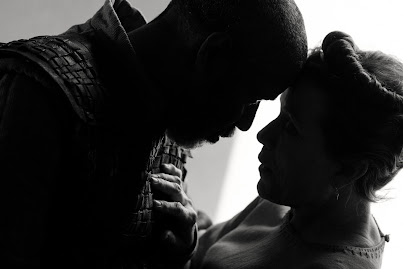
I went to the Watershed yesterday - for only the third time in the past two years (I know!) - to see Joel Coen’s “The Tragedy of Macbeth”, featuring Denzel Washington (Macbeth) and Frances McDormand (Lady Macbeth). We all know the Shakespeare play and there was part of me wondering why they were making another film of it (there have been at least seven other screen adaptations).
But, frankly, it was worth it. Washington and McDormand were both predictably brilliant and the stark black and white film portrayal powerfully and wonderfully apt. I loved designer Stefan Dechant’s imagining of Macbeth’s castle as a giant modernist house, with ‘sharp’ edges, dramatic level changes and courtyards enclosed by huge high walls. The witch apparition was disturbingly impressive and I found Birnam Wood ‘coming to’ Macbeth’s castle, with Malcolm’s soldiers holding tree-branches over their heads, eerily effective.
All in all, it was very good to be back in the cinema (and, happily, EVERYONE was wearing a face-mask!).

Monday, January 17, 2022

january 2022 books…

Allegorizings (Jan Morris): As you probably know, I’m a great lover of Morris’s books. I still regret that I no longer have the hardback copy of the James Morris edition of ‘Oxford’ (published in 1965)(I’ve owned the Jan Morris paperback version, published in 1978, since 1979)… clearly, I ‘lent’ it to someone and sadly never had it returned. One dictionary definition of ‘allegorize’ is to “interpret or represent symbolically” (just so you know). This book of essays/musings was published in 2021 (one year on from her death at the age of 94) and she was well aware that it would be published posthumously; they’re effectively no more than ‘idle thoughts or perhaps ‘whimsy’ (some serious, but mostly funny and entertaining… and one or two that I frankly found quite boring). The range of subjects is wide (understatement) - from falling over; zoos; whistling; hot water bottles; kindness; about her no longer believing in nationality “or the cursed Nation-State”; and even nose-picking! There’s also a wonderful piece about Princess Diana: in Morris’s opinion, she should “have been given the all-but-superannuated royal yacht Britannia, which nobody knew what to do with, and invited to rollick her way around the world on the national behalf, living it up without inhibition, taking a new boyfriend to every port (or finding one there) and distributing a taste of outrageous English gaiety among the nations”! A lovely, very enjoyable book that I’ll no doubt continue to dip into over the years to come.
Go Went Gone (Jenny Erpenbeck): This novel is set in Germany and tells the story of a retired university professor who found a surprising new community among African asylum-seekers who have set up a tent city in Berlin. It’s a story about displacement, upheaval, race, privilege, nationality, rigid bureaucracy and humanity. It’s profound, unsettling and quite, quite brilliant. Erpenbeck has clearly talked to a lot of people who have been through similar, relentless experiences… and so, with so much research, in many ways, the book doesn’t feel like fiction at all. She writes brilliantly. It’s an extraordinary book. You need to read it.
I Am I Am I Am (Maggie O’Farrell): O’Farrell is one my favourite writers and this is a rather special book. Its sub-title (if that’s the right phrase) is “Seventeen Brushes with Death” and it’s a collection of essays in which O’Farrell chronicles her own ‘near misses’ – including haemorrhage during childbirth, miscarriage and leaping off a harbour wall into the sea as a teenager. I spent much of the book reflecting in amazement that such experiences can all happen to one person (I seem to have come off very lightly, so far, in my life!). Unsurprisingly, it’s brilliantly written and utterly captivating (and shocking… and brave… and moving). Ru lent me the book and I read it in a day. Wonderful.
Azadi (Arundhati Roy): This is a series of essays/lectures that deal with matters of freedom in a world of growing authoritarianism. Unsurprisingly, Roy makes regular reference to matters happening in her native India (and she’s massively critical of Narendra Modi’s government and his Hindu nationalist party: “The infrastructure of fascism is staring us in the face, the pandemic is speeding up that process in unimaginable ways, and yet we hesitate to call it by its name”. The essays have reinforced my realisation of how little I know of the complexities of the country: some 780 languages; more nationalities and sub-nationalities, more indigenous tribes and religions than all of Europe. She writes brilliantly (and persuasively) and uses her essays/lectures as ways of highlighting matters of justice, rights and freedoms in the current hostile environment. It doesn’t make for easy reading… but I think it raises fundamentally important issues.
Miss Benson’s Beetle (Rachel Joyce): I loved Joyce’s “The Unlikely Pilgrimage of Harold Fry” and, in a way, this was another novel about pilgrimage. Set in 1950, it tells the story of two unlikely women travelling to the other side of the world in search of a golden beetle that may or may not exist… trekking through dangerous terrain, breaking all the rules and learning about emotional courage. The two principle characters are rather wonderful (very funny, but also joyous individuals). In many ways, I suppose some might regard this as a ‘woman’s novel’ (although, frankly, I would disagree); what it IS is a tender book about heartfelt friendship, compassion, hope and, as the book’s cover says: ‘second chances’. Reading it was a good excuse to avoid all those depressing stories of people offering excuses to justify a certain prime minister’s alleged actions/rule-breaking escapades over the past nine months or so.