Showing posts with label ethics. Show all posts

Wednesday, February 22, 2023

citizen ethics in a time of crisis…

While searching through what we laughingly refer to as our filing system (somewhat predictably, I was unable to trace the actual document I was seeking!), I came across a quite brilliant supplement entitled ‘Citizen Ethics in a Time of Crisis’. It was published in 2010, exactly 13 years ago this week, by the Guardian newspaper (in conjunction with Citizens Ethics Network, Barrow Cadbury and the Joseph Rowntree Charitable Trust). In it, a number of prominent thinkers – philosophers, politicians, economists, theologians and writers – considered how the financial and political events of the previous year (ie. the sense of outrage following such matters as the Banking crisis, Bankers’ bonuses and the MPs’ expenses scandal) had given rise to a crisis of ethics… although it’s interesting that the document relates to “Citizen Ethics” (not politicians’ ethics).
I was so taken by the document that I’d sent away for a copy of 60-page bound version.
 
I’ve been re-reading much of it this morning and it makes for fascinating reflection… especially at this time of a ‘Cost of Living Crisis’, an ‘Energy Crisis’, attitudes towards migration (and refugees) – not to mention (but I will) the dishonesty/lack of integrity of some senior politicians; allegations of sexual misconduct against dozens of MPs; allegations of ‘irregular’ PPE funding during the pandemic, Brexit, Climate Crisis… actually, the list goes on and on).
It speaks about how self-interest and calculation have derailed our values.
 
The document’s articles asked some crucial questions (dozens and dozens of them) – that are JUST as relevant today as they were 13 years ago. Here are just a few examples:
  • Do we leave it to the market to distribute riches or must the state intervene to ensure more justice than market mechanisms have achieved over the last 25 years?
  • We have looked into the abyss where individualism is concerned and we know it won’t do.
  • We have lacked a language to respond. How are we to articulate our misgivings? How can we regain our ability to reason ethically?
  • It is not a manifesto, it is an argument we have left derelict, a crucial public concern.
  • We need a public life with a purpose.
  • A promising measure would be to grant all adults a basic income, leaving it to them to decide how to work. This would make part-time work viable for many.
  • Shareholder value is shorthand for doing whatever it takes to pump up the stock price.
  • What human beings most desire is not material wealth, but social recognition.
  • That the economy should meet human needs means we have to focus on needs, not wants.
  • London and Westminster, the twin epicentres of power, feel as rotten as Rome under Caligula.
  • Politics must come from the people.
  • The ethical human being has a need for meaning in order to sustain a sense of aspiration.
How little has changed in the past 13 years… and, sadly, I suspect things won’t change in my lifetime.
Note: https://www.theguardian.com/commentisfree/series/citizen-ethics

Tuesday, August 02, 2022

vested interests…

Every now and then, I read about/listen to/watch articles/podcasts/documentaries that, on the face of it, seem to have only tenuous connections but which, coming across them within a few days of each other, resonate and leave me ‘pondering’.
Here are three recent examples:
UK GOVERNMENT:
The Tory government continues to depress me (understatement). Mr Johnson’s recent ‘resignation’ shenanigans (with ministers and MPs being offered various ‘incentives’ in order to back him) followed by the farce of the leadership ‘contest’ – with similar inducements and tax-cutting promises (when, of course, I would advocate higher taxes in order to properly fund the NHS, mental health, education, environmental measures etc) – while, at the same time noting such incidental matters as ‘the Tories can do whatever they want because they’ve got a huge majority’ (and a rubbish electoral system); an ineffective Opposition Party; and rumours that Mr Johnson will use his departure to announce the ‘elevation’ of several dozen Tory-backing individuals to the House of Lords (in many cases, rewards for being ‘generous donors’ to the Tory Party). I could write at length on this matter but, of course, my voice doesn’t count.
It’s all about vested interests, power politics, lobbying and greed.
BIG OIL v THE WORLD (Documentary, BBC iPlayer, 2022):
Arguably, this is the most important, depressing story of our time – about what the fossil fuel industry knew about climate change more than FOUR DECADES ago. Scientists who worked for the biggest oil company in the world, Exxon, revealing the warnings they sounded in the 1970s and early 1980s about how fossil fuels would cause climate change – with potentially catastrophic effects. Drawing on thousands of newly discovered documents, the film goes on to chart in revelatory and forensic detail how the oil industry went on to mount a campaign to sow doubt about the science of climate change, the consequences of which we are living through today. And then, how the 2010s became another lost decade in the fight against climate change – as the move to natural gas delayed a transition to more renewable sources of energy – with ‘fracking’ (technique for extracting gas and oil from shale rock) being promoted by powerful corporations as a cleaner energy source, but subsequently realising natural gas (releasing large quantities of methane into the atmosphere) could be even worse for climate change than coal and oil. Meanwhile, in the UK, last week’s newspapers reported that Shell and Centrica had posted profits totalling £11bn as households struggle with bills… and that British Gas had reinstated dividends for its shareholders after operating profits of £1.3bn; and that Shell had reported a £10bn profit between April and June; and that BP reported its biggest quarterly profit for 14 years.
It’s all about vested interests… power politics, lobbying and greed.
ISABELLA TREE’S BOOK WILDING:
The modern farmer was supposed to rationalise, intensify, diversify… get rid of small fields and hedgerows in the interests of getting the best use out of massive prairie-style machines and industrial farming techniques in order to maximise profits. Well, this inspiring book describes an attempt to renew the ecosystem, after decades of intensive agriculture of some 1,400 hectares owned by Tree’s husband Charlie Burrell at Knepp in West Sussex. The project, which began in 2001, is perhaps unique in England, and the results have been spectacular. In what has become a glorious ‘mess’, the animals live out in the open all year round and give birth unassisted by humans. Formerly common plants – but also rare ones – have returned in profusion, together with insects, bats and other organisms. Scrubland, wetland and other habitats are gradually rewiring themselves as herbicides and pesticides disappear. The increase in the variety and abundance of birds has been particularly astonishing. At a time when we’re ‘hammering the environment’, it’s a compelling and hugely encouraging, hopeful account about restoring what we have lost.
It DOESN’T all have to be about vested interests… power politics, lobbying and greed.
 
Somehow, we need to introduce an urgent sense of hope and fairness into the way we run this country. Sadly, at the present time, it seems all about self-interest, powerful corporations and banks, lobbyists… and a government on the side of the privileged and the well-off and where disrespectful/dishonest actions and attitudes go unpunished. Climate Change and Global Warming should be at the very HEART of our government’s agenda… but, at present, it pays only lip-service to an issue that threatens the very future of the planet.
Hamilton Nolan, writing in today’s ‘Guardian’, sums it up thus: “Capitalism is not designed to look several generations down the road. It is not designed to sacrifice for the greater good. It is designed to maximize profits. To pump every last barrel of oil on Earth, sell it, take the money and build a luxurious space ship to leave the planet that has been destroyed by burning all of that gas is a perfectly rational course of action according to the logic of capitalism. As long as there is a trillion dollars a year to be made, the fossil fuel industry will take the money. It is enough money to build a nice villa far, far away from the wars and droughts and floods and wildfires that fossil fuels are causing”. 

Tuesday, April 19, 2022

response to partygate excuses…

Keir Starmer is not my idea of a hugely effective Leader of the Opposition…
However, I think his response to Mr Johnson’s ‘apology’ this afternoon is probably his most powerful speech in the Commons to date. 

This is what he said: 
“What a joke. Even now as the latest mealy-mouthed apology stumbles out of one side of his mouth, a new set of deflections and distortions pour from the other.
But the damage is already done.
The public have made up their mind.
They don’t believe a word the Prime Minister says.
They know what he is.
As ever with this Prime Minister those close to him find themselves ruined and the institutions he vows to protect damaged.
Good ministers forced to walk away from public service.
The Chancellor’s career up in flames.
And the Leader of the Scottish Conservatives rendered pathetic.
For all those unfamiliar with this Prime Minister’s career.
This isn’t some fixable glitch in the system.
It’s the whole point.
It’s what he does.
It’s who he is.
He knows he’s dishonest and incapable of changing.
So he drags everybody else down with him.
The more people debase themselves, parroting his absurd defences, the more the public will believe all politicians are the same.
All as bad as each other.
And that suits this Prime Minister just fine.
Some members opposite seem oblivious to the Prime Minister’s game.
Some know what he’s up to but are too weak to act.
But others are gleefully playing the part the Prime Minister cast for them.
A minister on the radio this morning saying it’s the same as a speeding ticket.
No it’s not.
No one has ever broken down in tears because they couldn’t drive faster than 20mph outside a school.
Don’t insult the public with this nonsense.
But Mr Speaker, as it happens the last Minister who got a speeding ticket and then lied about it ended up in prison and I know because I prosecuted him.
And last week we were treated to a grotesque spectacle.
One of the Prime Minister’s loyal supporters accusing teachers and nurses of drinking in the staff room through lockdown.
Members opposite can associate themselves with that if they want.
But those of us who take pride in our NHS workers, our teachers and every other key worker who got us through those dark days will never forget their contempt.
Plenty didn’t agree with every rule the Prime Minister wrote.
But they followed them nonetheless because in this country we respect others, we put the greater good above narrow self-interest and we understand that the rules apply to all of us.
This morning, I spoke to John Robinson, a constituent for the Member for Lichfield, I want to tell his story.
When his wife died of Covid, John and his family obeyed the Prime Minister’s rules.
He didn’t see her in hospital, he didn’t hold her hand as she died.
Their daughters and grandchildren drove 100 miles up the motorway, clutching a letter from the funeral director in case they were questioned by the police.
They didn’t have a service in the church, John’s son-in-law stayed away because he would have been the forbidden seventh mourner.
Doesn’t the Prime Minister realise that John would have given the world to hold his dying wife’s hand, even if it was just for nine minutes?
But he didn’t.
Because he followed the Prime Minister’s rules.
Rules that we now know the Prime Minister blithely, repeatedly and deliberately ignored.
After months of insulting excuses, today’s half-hearted apology will never be enough for John Robinson.
If the Prime Minister had any respect for John and the millions like him who sacrificed everything to follow the rules he’d resign.
But he won’t.
Because he doesn’t respect John.
He doesn’t respect the sacrifice of the British public.
He is a man without shame.
Looking past the Member for Lichfield and the nodding dogs in the cabinet.
There are many decent, honourable members on the benches opposite.
Who do respect John Robinson.
Who do respect the British public.
They know the damage the Prime Minister is doing.
They know things can’t go on as they are.
And they know it is their responsibility to bring an end to this shameful chapter.
Today I urge them once again.
Don’t follow in the slipstream of an out of touch, out of control Prime Minister.
Put their conscience first, put their country first, put John Robinson first and remove the Prime Minister from office.
Bring decency, honesty and integrity back into our politics.
And stop the denigration of everything that this country stands for”. 

Saturday, March 12, 2022

putin...

For the vast majority of people, recent events have secured Putin’s place as one of the world’s unpopular and most feared individuals.
People (world leaders, politicians, journalists and alike) have expressed shock and surprise at what’s happening in Ukraine and yet, as a documentary first shown on the BBC in March 2018 seems to show, it was only a matter of time.
https://www.bbc.co.uk/iplayer/episode/b09vb7m3/putin-the-new-tsar

Although I was vaguely aware of most of the events highlighted in documentary, I freely admit that I had largely swept such issues aside (yes, I know most of us have had ‘our fill’ of sickening images of the Russian army bombarding Ukraine). BUT I really would recommend that you watch the documentary in an effort to put things into context… and to underline that we shouldn’t have been surprised by Putin’s actions.
Despite his lowly KGB colonel credentials, Putin became President in May 2000. Between 2000-2004, Putin set about the reconstruction of the impoverished condition of the country -  apparently (according to Wikipedia) winning a power-struggle with the Russian oligarchs, reaching a 'grand bargain' with them, which allowed the oligarchs to maintain most of their powers, in exchange for their explicit support for Putin's government (and, it seems, direct financial compensation/contributions/back-handers). Indeed, according to the documentary, Putin was regarded as “the world’s richest man” – in 2015, outspoken critic Boris Nemtsov circulated pamphlets pointing out that Putin’s wealth included 58 jets, 2 yachts and a summer palace (Nemtsov was assassinated soon after). Corruption and institutionalised corruption in the country is now considered rife.
 
In 2008, there was a crisis in Georgia (with Russian tanks sent to the country and a 5-day war resulting); in 2014, there were several Russian military incursions into Ukraine and, as a result of a Russian-organised, widely-criticised referendum, Crimea (then part of Ukrainian territory) was annexed to join Russia.
In the documentary, Sergei Pugachev (who helped Putin come to power) described Putin as a “weak man… an envious and greedy man… and he’s a man who always lies”. Nemtsov described Putin’s attitudes demonstrated the “extreme narcissism of the emperor”. Former Foreign Secretary, William Hague, maintained that Putin “has invented new kinds of warfare which Western countries are still struggling to come to terms with… “with its full spectrum capability”.
But, for me, the most telling words of the documentary came from Gary Kasparov (former World Chess Champion and who, in 2008, had announced his intention to run as a candidate in that year's Russian presidential race - but, after encountering logistical problems in his campaign, for which he blamed "official obstruction", he withdrew).
Kasparov said: “It’s not IF Putin would attack, it’s only when and where”.
Sobering and telling words from four years ago.

Wednesday, February 16, 2022

“you are number 395 in the queue…”

There’s much frustration with the UK government at the present time (understatement).
Two key matters (but, hey, there are MANY more besides… cost of living, energy prices, world peace etc etc) involve a) the so-called ‘Partygate’ issues (and the delays to the publication of Sue Grey’s Report, due to the Met Police’s initial reluctance to undertake their own investigations) and b) the formal Inquiry into the Covid-19 Pandemic.
The government’s handling of the Covid-19 pandemic has been heavily and widely criticised by health officials, politicians, journalists and the general public. Last May, the Prime Minister announced that there would be a formal Inquiry into Covid-19 pandemic… BUT, frustratingly, that this wouldn’t start unit “Spring 2022”.
Meanwhile, back in October 2021, Parliament’s Health and Social Care Committee and the Science and Technology Committee (comprising MPs from all parties) issued a 150-page document, ‘Coronavirus: Lessons learned to date’ (predominantly focussing on the response to the pandemic in England). They described it as “the worst public health failure ever” – with the government initially trying to manage the situation by ‘herd immunity’; delaying introduction of the first lockdown, costing thousands of lives; failing to focus on those who had died and blaming problems with laptops etc (which the committee described as “laughable”); etc etc.
In December 2021, an inquiry set up by the campaign group ‘Keep our NHS Public’ concluded that the UK government’s handling of the coronavirus pandemic was “grossly negligent” and amounted to misconduct in public office. Key findings included that the depleted state of the NHS and other public services before the pandemic was a determining factor in poor outcomes. Additionally, the government was poorly prepared and responded too slowly, adopting an incorrect strategy leading to a loss of life and growing mistrust in its advice. Furthermore, a consistent failure of government policies to reduce inequalities put the most vulnerable at high risk of illness and death from COVID-19.
 
The formal Inquiry announced by Mr Johnson last May will be chaired by Baroness Heather Hallett. No start date has yet been announced – apart from “Spring 2022”. Additional panel members were to be appointed in the new year to “make sure the Inquiry has access to the full range of expertise needed to complete its important work” (as yet no names have been announced). The Prime Minister would be consulting Baroness Hallett and ministers from the devolved administrations on the terms of reference for the Inquiry and these would be published in draft in the new year (as yet no terms of reference have been published).
There is no timeframe/deadline for the Inquiry. You might recall the Chilcott Inquiry into the Iraq War… with Hearings undertaken Nov 2009-Feb 2011 and the Report published in July 2016!
Frustratingly, one can image that Mr Johnson and fellow members of his government will be long since gone by the time any Inquiry Report is published (and, by then, they’ll no doubt have 'retired' from Westminster and be ‘earning’ fat salaries serving on the Boards of influential companies)… and the then government will no doubt issue pathetic statements about “lessons having been learnt” and everything will be swept under the carpet. 

Tuesday, February 01, 2022

not me guv’…

Sue Gray must be fuming… (I’m fuming!).
Thanks to the intervention of the Met Police, her report on the “alleged gatherings on government premises during Covid restrictions” was ‘limited’, to say the least (the BBC’s Laura Kuenssberg describes it as a “terse summary”).
Despite this, the report was still utterly damning of government leadership (and who leads the government?) – a fact that hardly came as a surprise to anyone who’s been following the reported events. Sadly, because of the Metropolitan Police’s intervention, Gray’s report lacks all the crucial details, including (and I quote from the report): emails; Whatsapp messages; text messages; photographs; and building entry and exit logs. Gray lists 16 ‘gatherings’ and goes on to point out that all but 4 of these are currently being investigated by the Met.
Again quoting from the BBC’s political editor (and, frankly, I could have used any number of quotes from other journalists), “it is there now in black and white for all to see - there was rule breaking at the top of government when the country was living through lockdown. The prime minister's original claim that all the guidelines were followed seems almost farcical now”.
In the past, matters of honesty, integrity, trust and responsibility would have been regarded as essential qualities of any prime minister. Given what we already knew, Mr Johnson should have resigned weeks ago. Given the contents of Ms Gray’s much-edited report, he should have resigned yesterday… but, of course, he didn’t.
 
Many Tory MPs have been hugely critical of the prime minister and have made it clear that he no longer receives their support; many others continue to support Mr Johnson through (blind?) loyalty. Others tell us that they’re going to await outcome of the Met Police’s investigations.
When will that be? A fortnight? A month?
Well, yesterday, the Met Police told us that their investigation “would not take more than a year”.
What an utter, utter farce.

In political terms, the key questions are simply: “Did the prime minister mislead parliament?” and “Did the prime minister break the Covid rules?”. If the answer to either of these is “yes”, then Mr Johnson has to resign. In the ridiculous circumstances that we find ourselves in, surely it’s not asking too much for the Met to begin their investigations (from various comments made yesterday, it seems that they have yet to make a start!) by pursuing the specific allegations relating to the ‘gatherings’ that the prime minister apparently attended? Surely, even by the Met’s own ‘speed of operation’ (apologies for irony), it wouldn’t take more than a few days to establish the facts (afterall, Ms Gray has done much of the groundwork)
But, hey, what do I know! I’m just a boring old fogey who despairs of what we’ve become. 
It shouldn’t be like this.   

Thursday, April 19, 2018

facebook…

Like many people, I struggle with the mysterious world of information technology, smart phones, social media and the like… and I simply know that I’ll always struggle.
And like many people, I’ve been appalled by some of the recent revelations/accusations regarding facebook and Cambridge Analytica (eg. the analytics firm apparently having harvested more than 50 million facebook profiles without permission; staff boasting about using manufactured sex scandals, fake news and dirty tricks to swing elections around the world etc etc) and other stories about a digital services firm linked to Cambridge Analytica receiving large payments from a pro-Brexit campaign organisation which potentially violated referendum spending rules.
As a result of these apparent violations to privacy agreements, there’s been a growing #DeleteFacebook movement.
A few of my best friends have decided that they‘ve “had enough” and have either deleted their facebook accounts or are about to do so. I understand that and, obviously, such decisions are very personal and need to be respected. But it saddens me. Will such actions have any real effect? Will the power of facebook or google or one of the myriad of other similar organisations get to them anyway? I really don’t know.

I have over 600 facebook ‘friends’ from all over the world. Of course, I’m probably only in proper, regular contact with a relatively small proportion of these friends but, nevertheless, facebook is the way I ‘keep in touch’ with them… and I love that. “But”, I hear you say, “if they were REAL friends, surely you’d make every effort to see them on a regular basis?”. Well, yes, wouldn’t life be wonderful if we were able to do that… but such options are both impractical and unrealistic. Yes, I could email or telephone my friends (I hate the telephone!), but it wouldn’t be same and it would be hugely time-consuming and inconvenient… not to say, far less effective (and enjoyable).
So (perhaps selfishly?), I’ll be staying with facebook – at least for the time being – and only hope that the privacy issues etc can be satisfactorily and quickly settled… and that I learn the very best ways of protecting my personal data (and that my friends learn to do the same).
I’m really sad that some of my lovely buddies have already decided to delete facebook, but recognise and accept their perfect right to do so (and will miss them big time).
But, of course, as they’re no longer on facebook they won’t be reading this.
Photo: illustration by Mitch Blunt.

Friday, January 19, 2018

the post...

I went to the Watershed again this afternoon (I know!)… this time to see Spielberg’s “The Post”, featuring Merryl Streep (as Washington Post publisher Katherine Graham) and Tom Hanks (as editor Ben Bradlee).
You probably know the story - if you don’t, you’re probably too young (or perhaps you just don’t care about political integrity?). Either way, with President Trump currently in ‘post’, it comes as a timely ode to investigative journalism!

The film centres on The Washington Post’s battle to expose a massive cover up of government secrets relating to the Vietnam War that spanned three decades and for presidents (and, somewhat disturbingly, is effectively a prequel to the Watergate scandal – which started in 1972 and lead to President Nixon’s resignation in 1974).
It’s set in 1971 (the Pentagon Papers are a history of the United States' political-military involvement in Vietnam from 1945 to 1967, compiled by the US Department of Defence) and is a brilliant, stirring defence of press freedom. Of course, we all know the outcome and so we can watch all the drama unfolding knowing it’ll all-come-right-in-the-end! Streep and Hanks are predictably excellent in their respective roles (perhaps not that difficult, given the storyline?). It’s also a reminder about how sexist the world of big business really was in the early 1970s - again and again, Streep is the only woman in a room full of besuited men.
Essentially, it’s a powerful and timely film about idealism set against pragmatism… standing up for what’s right against huge odds.

This afternoon’s cinema audience thoroughly approved… and there was much mocking laughter when, at the end of the film, we see a silhouetted Richard Nixon pacing the White House seeking to use the authority of his office to hobble the free press – telling one of his underlings by telephone to exclude absolutely ANYONE connected with the Washington Post from the White House in future… oh the irony!
PS: Good article/interview with Steven Spielberg by Jonathan Freedland in today’s Guardian.

Saturday, July 08, 2017

racing demon at the theatre royal bath…

Moira and I went along to the Theatre Royal Bath last night to see a revival of David Hare’s play “Racing Demon”, first performed at the National Theatre in 1990.
We’d previously been to see a production at the Theatre Royal, but there’d been a BIT of gap between yesterday evening and the last time we were there… just a FORTY-FOUR YEAR gap!!
On the face of it, the idea of going to see a play about the Church of England (the establishment church?), society, politics, morality and such like might not seem like the best way to enjoy a Friday evening… but that was far from the case. David Hare was a playwright who emerged from the left-wing theatre movement of the 1960s and 70s… someone who was clearly angered by the injustices, as he saw it, of the capitalist system and wanting to see a ‘fairer society’.  
Yes, whilst the play was inevitably ‘dated’ on some matters (eg. regarding the ordination of female bishops and references to the poll tax), it felt very much a play of ‘our time’ – touching on such secular matters as (in addition to the spiritual): austerity; the ‘haves and have-nots’ of society; justice; morality; domestic violence; listening to and supporting people who feel they have no voice… and at a time when many still question the relevance of the Church in today’s world.
When he wrote the play, in the late 1980s, Hare felt that the Anglican Church provided subject matter that was archetypically English and, at worst, represented an old-fashioned institution, stuck in its dogmatic ways and struggling to adapt to ‘modern life’. From the programme notes, it appears that Hare respected many of the clergy he met in his researches, but was conscious of the best of them being “up against a bureaucratic system that worked in opposition to their talents”… with the Church appearing to have become increasingly irrelevant, “debating arcane matters of doctrine instead of looking outwards to fulfil the community’s spiritual needs”.
The play proved to be provocative, challenging, thought-provoking and, as far as we were concerned, still highly relevant today.

One of the prime reasons for going last night was to watch our lovely actor friend Sam Alexander perform…. and he didn’t disappoint (in his role playing Revd Donald ‘Streaky’ Bacon!).
Indeed, the whole cast were excellent… with David Haig quite brilliant as Revd Lionel Espy and Paapa Essiedu very impressive as the curate, Revd Tony Ferris.
A really excellent evening.
Photo: Paapa Essiedu as Revd Tony Ferris.

Friday, February 10, 2017

more ink...

It’s a very proud moment when your daughter has her first novel published – especially when it’s been received by those who ‘know’ about these things with some acclaim.
But, of course, there comes the time when you actually read it for yourself...
I’m not particularly a ‘fiction’ person and I can’t actually think that I’ve read a YA (Young Adult) book before. Wouldn’t it be awful if I loathed it!?
Well, huge relief, I finished it this morning… and I loved it.

I’m not going to spoil things for you and so I’ll just repeat some of the words on the book’s cover: “Imagine a world where your every action, your every deed, is marked on your skin for all to see…”.
Yes, it’s a YA novel almost written in the form of a fable (I’m sure Alice would disagree!), but I also think it could be interpreted as a profound reflection or metaphor (for young adults and adults alike) of what’s happening in the world today. It’s about truth, wisdom, loyalty, justice, love… it’s about fears and taboos; it’s about society and who we are; it’s about greed and power; it’s about belief; it’s about conformity; it’s about passion and beauty; it’s about integrity and honesty; it’s about the future.
Yes, it might ‘just’ be a YA novel for goodness sake(!), but it also spoke to me about such matters as society’s attitudes post-Brexit, what’s happened in Syria and even Mr Trump!
For me, the novel’s transparent world (where your every action is marked on your skin) reminded me of the virtual facebook world - where we can choose to post stuff that allows us to come across as being an enviable ‘good guy’ or ‘the perfect couple’ (complete with happy family photos, news about our latest wonderful world cruise and the like). The difference is that, with facebook, we can also choose to hide our true beliefs and characteristics (and the details are forgotten within a couple of days).

I always knew that Alice could write (and isn’t it wonderful when someone’s childhood dreams really do come true!), but I didn’t realise that she had such a gift for storytelling. I even cried at the end (I’m always crying these days… and feel a bit like Keith Brymer Jones, the judge on TV’s “Great Pottery Throw Down”, crying as he marvels at the achievements of a particular contestant!) - partly because of the simple beauty and power of the story, but also because of a realisation that “oh my goodness, she really has done it… and she’s bloomin’ good too!”.
As a friend on facebook said: “you must be very proud”.
You bet.

Thursday, January 26, 2017

Thomas Friedman talking at the Bristol Festival of Ideas…

Last night, Moira and I went to hear Thomas L Friedman (why do people insist on using their middle name initial?) talk about his current book ‘Thank You For Being Late: An Optimist’s Guide to Thriving in the Age of Accelerations’ as part of the excellent Bristol Festival of Ideas. The pre-talk blurb described it thus: “In today’s changing world of Brexit and Donald Trump’s promises of walls and tariffs, Friedman argues that it is only openness to ideas and trade that will allow us all to thrive. He addresses the need for politically moral leadership…”.
Born in 1953, Friedman is an American journalist, internationally-renowned author and three time Pulitzer Prize winner. He currently writes a weekly column for The New York Times.
I went along with an open mind… ‘this could be inspiring or really, really depressing’!
Well, it proved to be an absolutely fascinating, stimulating evening. He spoke for 45 minutes, without notes. Evidently, he’d been giving this talk around the world since last May… but suitably updated in the light of Mr Trump (and Brexit)! He’s a confident, articulate and engaging speaker.
I can’t begin to summarise Friedman’s wide-ranging talk… so I’ll just highlight a few things that struck me.
He talked about the significance of the year 2007: Steve Job launching the iPhone; facebook; Kindle; The Cloud; YouTube; the beginnings of Airbnb… followed, somewhat ironically, by the worldwide economic recession of 2008. Although we didn’t perhaps notice at the time, digital globilisation and the exponential growth in microchips were transforming our lives.
The pace of change and the pace of new ideas is almost overwhelming… or, as Friedman put it: “Google lives in the future and sends us letters home”.
He talked about the way many of the large Corporations were moving – analysing the capabilities of their employees and being prepared to train them, free of charge, in areas where they needed specific help or improvement… BUT for them to undertake the training in their own time… and if they didn’t fancy that, then they’d be given a redundancy package and removed from the organisation. Corporations see life-long learning as CRUCIAL.

Friedman talked about politics (and specifically US and UK politics)… and how our current political parties are designed to think and work “with an old situation”… in his view, they needed to be “blown up (not literally, hopefully) and re-started… "the age of acceleration is going to be just too fast for them”.
He talked very briefly about taxation… feeling that the current systems should be abandoned in favour of universal carbon taxes and sugar taxes.
He talked about us living in a world where “one of us can kill all of us” (he didn’t specifically mention the Trident ‘deterrent’ but, clearly, implied that such policies were hugely outdated and ineffective).
He talked about ethics; about a cyber world where no one's ‘in charge’; and, perhaps somewhat strangely in the context of the evening(?), about the need for us all to live by the old ‘golden rule’ (“do unto others as you would have them do unto you”); about the need for ‘strong families’ and ‘strong communities’(?)… and about ‘applied hope’. There were lots of things I wanted him to explain more fully, but time didn’t allow… yes, I know, I should have bought his book!
It was all inspiring, fascinating stuff… but even now, writing this the morning after, I’m not sure if his words made me feel depressed or encouraged. They’ve certainly underlined my own naivety in some areas… or, as Friedman put it: “naivety is the new realism”!

Monday, May 30, 2016

occupied territories...

This is the name of a book* written by Garth Hewitt (the founder of the Amos Trust: “a small, creative Christian human rights agency that works with vibrant grassroots partners around the world”). I briefly acted as one of its volunteers at Greenbelt perhaps 10 years ago and again met Garth and his wife Gill on Iona in 2012 when they attended a conference to discuss the division of the West Bank, the encroachment of Israeli settlements and the impact on the lives of Palestinians.
It's a powerful, profound, thought-provoking book and one that I think deserves to be read by anyone who cares about peace, dignity and justice in this brutal, greedy world we live in.
Again and again, I found myself underlining passages from the book (frequently quotes from prominent academics, politicians or church leaders), so I’ve collected just SOME of them together – as a reminder for me and, perhaps, to provide others with food for thought. In no particular order (I hope Garth doesn't mind me quoting from his book - believe me there are LOTS more extracts I could have included!):

“If you are neutral in situations of injustice, you have chosen the side of the oppressor”.
Archbishop Desmond Tutu.

“We need to create a new reality in the Holy land, a new structure where every person that lives here – that was born here, Israeli, Palestinian, Jew, Christian and Muslim, is honoured for who they are so their history and their past is respected”.
Sami Awad, executive director of Holy Land Trust, 2013.

“But this is the frontline. The wall and its offspring road are here and growing, the beautiful valley is being ripped in two. And then there is the ‘tunnel house’. A family has the ‘right’ papers to prove they belong to this land but they (the Israeli army) put them on the ‘wrong side of the line’. The ‘solution’ is to literally wall them in to their own private prison at a cost of $1million. It is obscene. It is obscene that these people in this village are being brutally shown by the wall, the settlements, the demolition orders, the soldiers and the bottomless budget that we want what is yours but we do not want you. We will dehumanise and humiliate you and make simple things so difficult. We will make your life so intolerable that you will leave… How can the world stand by and let this happen?”
Nive Hall, Amos Trust’s operations Manager at the Cremisan monastery.

“It involves difficult decisions and tough choices. However, the choice is not the support for Palestine against Isael or vice versa. Rather:
·         It is a choice for justice, against oppression; for human and political rights, against dispossession.
·         It is a choice for freedom, against an occupation that denies freedom.
·         It is a choice for equal human dignity, against racism and discrimination.
·         It is a choice for non-violent resistance, against the violence that perpetuates a cycle of hatred and recrimination”
“Time for Action”, Kairos Britain – following “The Iona Call” conference, 2012.

“I wonder… if having financial services and arms manufacturing at the core of your country… corrupts you morally?”
Alexei Sayle, The Metro, April 2013.

“As I write this, the richest people in the world are meeting in Davos, Switzerland. Of this meeting Aditya Chakrabortty says ‘More than 2,500 business executives and bankers will converge on the highest town in Europe for the annual World Economic Forum. For the next five days Davos will, it is safe to say, boast more millionaires per square foot than anywhere else on the planet’. He points out there is a basic membership and entrance price tag of £45,000 (approx. $74,000), but then adds: ‘The real business lies in private sessions with industry peers and amenable politicians and access to those start at around £98,500 ($161,600). And this is what makes Davos so fascinating: it is the most perfect case study of how practitioners of free market, globalised capitalism give the public one explanation for what they are doing and why, while privately pursuing the complete opposite. On the one hand there is an event attended by Sharon Stone, Bono and a slew of tame academics (14 Nobel laureates this week alone) the message being, “we are open to anyone”. On the other hand, there are those secret meetings off limits to anyone not in the £100K club… From its inception, the whole point of Davos has been to promulgate the gospel of free market fundamentalism. Earlier generations would have known what to call Davos set of wealth extractors and rip-off merchants’”.
Garth Hewitt, “Occupied Territories”. Aditya Chakrabortty: “An Action-Packed Thriller Is About To Unfold In Davos, Switzerland”, The Guardian, 21 January 2013.

“The greatest threat to world peace is not from nuclear weapons and their possible proliferation, it is from drones and their certain proliferation… Drones are now sweeping the global arms market. There are some 10,000 said to be in service, of which a thousand are armed and mostly American. Some reports say they have killed more non-combatant civilians than died in 9/11. I have not read one independent study of the current drone wars in Afghanistan, Pakistan and the Horn of Africa to suggest these weapons serve any strategic purpose. Their ‘success’ is expressed solely in body count, the number of so-called ‘al-Qaeda linked commanders’ killed… Neither the legality nor the ethics of drone attacks bear examination… It is hard to imagine a greater danger to world peace”.
Simon Jenkins, “Drones Are Fool’s Gold: They Prolong Wars we Can’t Win”, The Guardian, 10 January 2013. 

“The world must urgently set goals to tackle extreme inequality and extreme wealth. It is now widely accepted that rapidly growing extreme wealth and inequality are harmful to human progress, and that something needs to be done. Already we hear the World Economic Forum’s Global Risk Report rated inequality as one of the top global risks of 2013. The IMF and The Economist agree. Around the world, the Occupy protest demonstrated the increasing public anger and feeling that inequality has gone too far.
In the last decade, the focus has been exclusively on one half of the inequality equation – ending extreme poverty. Inequality and the extreme wealth that contributes to it were seen as either not relevant, or a prerequisite for the growth that would help the poorest, as the wealth created trickled down to benefit everyone. There has been great progress in the fight against extreme poverty… (But) we cannot end poverty unless we end inequality rapidly.
That is why we are calling for a new global goal, to end extreme wealth by 2025 and reverse the rapid increase in inequality seen in the majority of countries in the last twenty years”.
Oxfam: “The Cost Of Inequality: How Wealth And Income Extremes Hurt Us All”, 18 January 2013

“Every gun that is made, every warship launched, every rocket fired signifies, in the final sense, a theft from those who hunger and are not fed, those who are cold and are not clothed. The world in arms is not spending money alone. It is spending the sweat of its labourers, the genius of its scientists, the hopes of its children… This is not a way of life at all, in any true sense. Under the cloud of threatening war, it is humanity hanging from a cross of iron”.
US President Dwight D Eisenhower: “The Chance For Peace” speech, 16 April 1953.
Note*: “Occupied Territories” (Garth Hewitt), published by IVP Books, 2013.
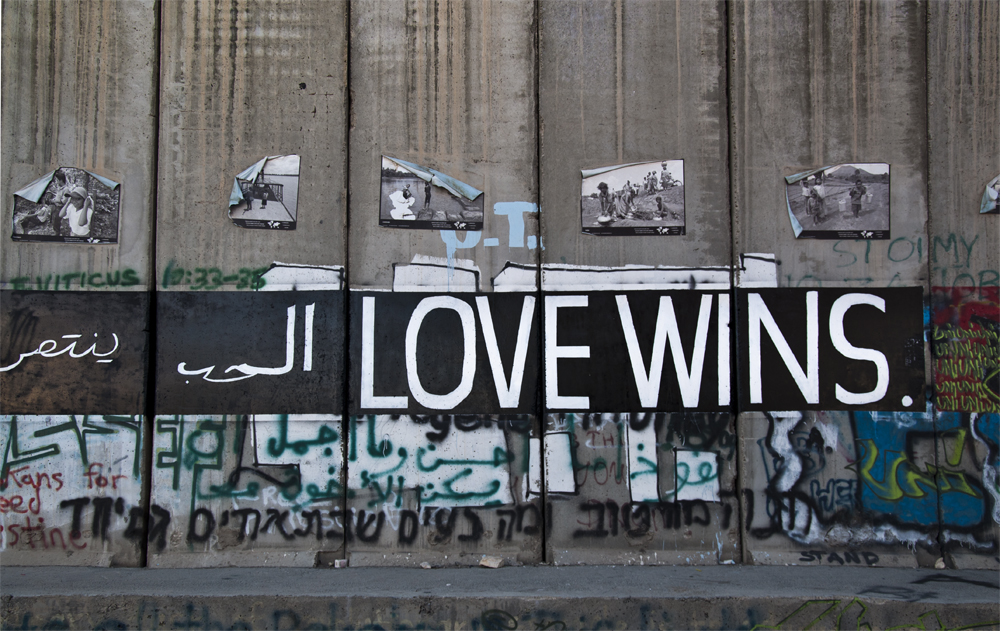
Photo: part of the wall surrounding Bethlehem.

Sunday, February 08, 2015

palestine+israel...


Last night, Moira+I went to listen to Lindsey Sharpe, from Ecumenical Accompaniment to Programme in Palestine+Israel (EAPPI). She talked about her experiences as one of EAPPI’s “ecumenical accompaniers” (EAs) in Jerusalem. EAPPI is a programme coordinated by the World Council of Churches founded in response to a call from the local Heads of Churches in Jerusalem that brings internationals to the West Bank. Since 2002, over 1,500 volunteers have worked in the West Bank for 3 months as EAs. EPPI’s mission is to witness life under occupation, engage with local Palestinians and Israelis pursuing a just peace, to change the international community’s involvement in the conflict, urging them to act against injustice in the region.
As we all know, this “peace process” has been (and continues to be) a long, frustrating, ugly business.
In 1993, with the Oslo Peace Accords, there was hope and engagement between Israel and the Palestinians. More than 20 years on, peace in the Middle East seems more remote than ever. One of the main reasons is undoubtedly Israel’s incessant settlement policy in the West Bank and East Jerusalem. In recent years, this policy has been preventing
the resumption of meaningful peace negotiations. But its negative impact goes much further: it threatens the viability of the two-state solution and therefore the very feasibility of peace.
The facts are frightening (taken from “Trading Away Peace: How Europe helps sustain illegal Israeli settlements”, published in 2012):
1. There are now more than 500,000 Israeli settlers living in over 200 settlements in the West Bank, including East Jerusalem. The settler population has more than doubled since the conclusion of the Oslo peace accords in 1993, which were intended to provide a framework for ending the occupation.
2. The settler population is growing at a much faster rate (an average of 5.3% annually over the last decade) than the Israeli population as a whole (1.8%). Some of the largest settlements, such as Ma’ale Adummim, Ariel and Betar Illit are now sizable towns with tens of thousands of inhabitants.
3. During the past two years in particular, following the failure of US President Obama’s effort to convince the Israeli government to freeze settlement construction, settlement growth has markedly accelerated. More than 16,000 new housing units have been announced or approved since October 2010.
4. Over the same period, Israeli authorities have stepped up demolitions of Palestinian homes, while violent attacks by settlers against Palestinians have also sharply increased.
5. More than 42% of West Bank land and the majority of water and natural resources have been seized from Palestinians and allocated to settlements.
6. Settlements and the related infrastructure, including new road networks and the separation barrier, have carved up Palestinian communities into disconnected enclaves with movement controlled by checkpoints. This “land grab”, that has no legitimate security justification, has dramatically reduced the space available for Palestinians to develop livelihoods and construct housing and infrastructure. At the same time, settlements have been integrated with Israel proper, blurring the internationally accepted pre-1967 border between Israel and the West Bank.
7. Through the establishment of settlements, Israel has created a discriminatory two-tier regime in the West Bank with two populations living separately in the same territory under two different systems of law. While settlers enjoy all the rights and benefits of Israeli citizens, Palestinians are subject to a system of Israeli military laws that deprives them of their fundamental rights.
It shouldn’t be like this.
Despite the fact that, for decades, the United Nations has condemned the Israeli Occupation on numerous occasions and despite the fact that politicians have frequently voiced their disapproval of Israel’s actions, world leaders (including past world leaders, like Tony Blair in his so-called “peace envoy” capacity!) continue to be unable to instigate change.
Again and again, UN resolutions have been disregarded or the US administration has vetoed security council resolutions to condemn Israeli settlements in Palestinian territory. Between 2000-2011 (I don’t have recent figures), the US has used its veto 10 times, nine of which involved backing the Israeli side in the Israeli-Palestinian conflict.
Don’t get me wrong, I appreciate that there are violations and atrocities carried out by BOTH sides. I, like most people, just want an end to the injustice of occupation and a lasting, peaceful solution.
There MUST be a better way.
Photo: maps which show the loss of Palestinian land between 1946 and 2005 (and it’s still happening)... sorry for the poor quality.
PS: Lindsey Sharpe finished her talk by showing this clip from Palestinian poet, Rafeef Ziadah. I’d seen it before, but it IS quite special.

Wednesday, July 23, 2014

uk and the arms trade


Yes, I probably have a very simplistic view of the world of politics and global business, but news that the UK was exporting arms to Russia (despite David Cameron’s previous assertion that an absolute arms embargo had been put in place) should come as no surprise. According to a cross-party group of MPs, there are more than 200 licences in place to sell arms to Putin’s government.
Please note, I’m certainly NOT claiming that this is some sort of Tory conspiracy, because I’m fully aware that ALL UK governments over recent decades have been actively encouraging the growth of arm sales in this country.
I find it all SO depressing.
I suggest you read this article by Owen Jones in today’s Guardian to get a sense of the scale of the UK arms trade.
Presently, the only meaningful constraint on arms exports is political embarrassment. Restrictions on arms sales are put in place when particularly shaming sales are uncovered
or when a buyer, to the Government’s apparent shock, uses the weaponry it has bought.
UK governments have consistently tried to justify the arms trade on the basis that:
a)    Arms exports are important for national security
b)   They’re vital to the UK economy and jobs, and
c)    They’re stringently regulated.
The “Campaign Against Arms Trade” argues that such “justifications” are all false.
Here are some extracts from CAAT’s website:
1. The 55,000 arms export jobs comprise less than 0.2% of the UK workforce.
2. The exports themselves are less than 1.5% of total UK exports, and even this is an overestimate of their importance as 40% of the value of the exports was imported in the first place.
3. Arms exports are subsidised by the taxpayer (27% UK Government research expenditure is spent on arms and 54% UK Trade+Investment staff committed to selling arms).
4. There is an engineering skills shortage.
5. High profile arms export deals rarely result in significant UK jobs as production moves overseas. In August 2010, BAE sold 57 Hawk jets to India in the headline deal of a David Cameron-led trade delegation to the country. All of the aircraft will be made in India and, while the deal is worth £700 million, it will generate only 200 jobs in the UK.

Of the 16 countries identified by the Stockholm International Peace Research Institute as locations of major armed conflict in 2009, the UK sold arms to 12.
In the Foreign Office Report (2010) on Human Rights and Democracy, the following countries were “UK arms buyers” on the Foreign Office’s list of countries with “the most serious wide-ranging human rights concerns”:
Afghanistan, Belarus, China, Colombia, Democratic Republic of Congo, Iraq, Israel, Libya, Pakistan, Russia, Saudi Arabia, Somalia, Sri Lanka, Syria, Vietnam and Yemen.
And it’s ALL being done in OUR name.