Monday, May 30, 2016

occupied territories...

This is the name of a book* written by Garth Hewitt (the founder of the Amos Trust: “a small, creative Christian human rights agency that works with vibrant grassroots partners around the world”). I briefly acted as one of its volunteers at Greenbelt perhaps 10 years ago and again met Garth and his wife Gill on Iona in 2012 when they attended a conference to discuss the division of the West Bank, the encroachment of Israeli settlements and the impact on the lives of Palestinians.
It's a powerful, profound, thought-provoking book and one that I think deserves to be read by anyone who cares about peace, dignity and justice in this brutal, greedy world we live in.
Again and again, I found myself underlining passages from the book (frequently quotes from prominent academics, politicians or church leaders), so I’ve collected just SOME of them together – as a reminder for me and, perhaps, to provide others with food for thought. In no particular order (I hope Garth doesn't mind me quoting from his book - believe me there are LOTS more extracts I could have included!):

“If you are neutral in situations of injustice, you have chosen the side of the oppressor”.
Archbishop Desmond Tutu.

“We need to create a new reality in the Holy land, a new structure where every person that lives here – that was born here, Israeli, Palestinian, Jew, Christian and Muslim, is honoured for who they are so their history and their past is respected”.
Sami Awad, executive director of Holy Land Trust, 2013.

“But this is the frontline. The wall and its offspring road are here and growing, the beautiful valley is being ripped in two. And then there is the ‘tunnel house’. A family has the ‘right’ papers to prove they belong to this land but they (the Israeli army) put them on the ‘wrong side of the line’. The ‘solution’ is to literally wall them in to their own private prison at a cost of $1million. It is obscene. It is obscene that these people in this village are being brutally shown by the wall, the settlements, the demolition orders, the soldiers and the bottomless budget that we want what is yours but we do not want you. We will dehumanise and humiliate you and make simple things so difficult. We will make your life so intolerable that you will leave… How can the world stand by and let this happen?”
Nive Hall, Amos Trust’s operations Manager at the Cremisan monastery.

“It involves difficult decisions and tough choices. However, the choice is not the support for Palestine against Isael or vice versa. Rather:
·         It is a choice for justice, against oppression; for human and political rights, against dispossession.
·         It is a choice for freedom, against an occupation that denies freedom.
·         It is a choice for equal human dignity, against racism and discrimination.
·         It is a choice for non-violent resistance, against the violence that perpetuates a cycle of hatred and recrimination”
“Time for Action”, Kairos Britain – following “The Iona Call” conference, 2012.

“I wonder… if having financial services and arms manufacturing at the core of your country… corrupts you morally?”
Alexei Sayle, The Metro, April 2013.

“As I write this, the richest people in the world are meeting in Davos, Switzerland. Of this meeting Aditya Chakrabortty says ‘More than 2,500 business executives and bankers will converge on the highest town in Europe for the annual World Economic Forum. For the next five days Davos will, it is safe to say, boast more millionaires per square foot than anywhere else on the planet’. He points out there is a basic membership and entrance price tag of £45,000 (approx. $74,000), but then adds: ‘The real business lies in private sessions with industry peers and amenable politicians and access to those start at around £98,500 ($161,600). And this is what makes Davos so fascinating: it is the most perfect case study of how practitioners of free market, globalised capitalism give the public one explanation for what they are doing and why, while privately pursuing the complete opposite. On the one hand there is an event attended by Sharon Stone, Bono and a slew of tame academics (14 Nobel laureates this week alone) the message being, “we are open to anyone”. On the other hand, there are those secret meetings off limits to anyone not in the £100K club… From its inception, the whole point of Davos has been to promulgate the gospel of free market fundamentalism. Earlier generations would have known what to call Davos set of wealth extractors and rip-off merchants’”.
Garth Hewitt, “Occupied Territories”. Aditya Chakrabortty: “An Action-Packed Thriller Is About To Unfold In Davos, Switzerland”, The Guardian, 21 January 2013.

“The greatest threat to world peace is not from nuclear weapons and their possible proliferation, it is from drones and their certain proliferation… Drones are now sweeping the global arms market. There are some 10,000 said to be in service, of which a thousand are armed and mostly American. Some reports say they have killed more non-combatant civilians than died in 9/11. I have not read one independent study of the current drone wars in Afghanistan, Pakistan and the Horn of Africa to suggest these weapons serve any strategic purpose. Their ‘success’ is expressed solely in body count, the number of so-called ‘al-Qaeda linked commanders’ killed… Neither the legality nor the ethics of drone attacks bear examination… It is hard to imagine a greater danger to world peace”.
Simon Jenkins, “Drones Are Fool’s Gold: They Prolong Wars we Can’t Win”, The Guardian, 10 January 2013. 

“The world must urgently set goals to tackle extreme inequality and extreme wealth. It is now widely accepted that rapidly growing extreme wealth and inequality are harmful to human progress, and that something needs to be done. Already we hear the World Economic Forum’s Global Risk Report rated inequality as one of the top global risks of 2013. The IMF and The Economist agree. Around the world, the Occupy protest demonstrated the increasing public anger and feeling that inequality has gone too far.
In the last decade, the focus has been exclusively on one half of the inequality equation – ending extreme poverty. Inequality and the extreme wealth that contributes to it were seen as either not relevant, or a prerequisite for the growth that would help the poorest, as the wealth created trickled down to benefit everyone. There has been great progress in the fight against extreme poverty… (But) we cannot end poverty unless we end inequality rapidly.
That is why we are calling for a new global goal, to end extreme wealth by 2025 and reverse the rapid increase in inequality seen in the majority of countries in the last twenty years”.
Oxfam: “The Cost Of Inequality: How Wealth And Income Extremes Hurt Us All”, 18 January 2013

“Every gun that is made, every warship launched, every rocket fired signifies, in the final sense, a theft from those who hunger and are not fed, those who are cold and are not clothed. The world in arms is not spending money alone. It is spending the sweat of its labourers, the genius of its scientists, the hopes of its children… This is not a way of life at all, in any true sense. Under the cloud of threatening war, it is humanity hanging from a cross of iron”.
US President Dwight D Eisenhower: “The Chance For Peace” speech, 16 April 1953.
Note*: “Occupied Territories” (Garth Hewitt), published by IVP Books, 2013.
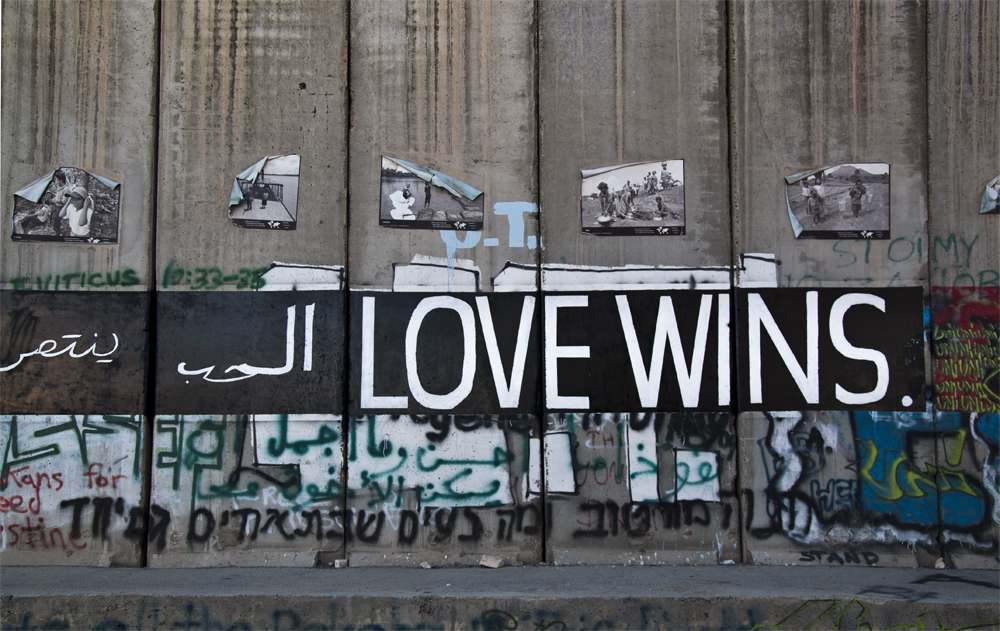
Photo: part of the wall surrounding Bethlehem.

Friday, May 27, 2016

mustang

Moira and I went along to the Watershed yesterday afternoon to see Deniz Gamze Erguven’s film “Mustang”… set in a remote Turkish coastal village. When five orphaned sisters are spotted harmlessly playing with boys on the beach, such "scandalous" behaviour is reported to their grandmother and uncle… who begin a tyrannical regime of imprisonment (to “safeguard their marriage prospects”)… the house ends up becoming a “wife factory”… you get the general idea!
It’s a film which underlines the male dominance of Turkish society… where men seem to feel that have a “right” to pursue women for sex but, at the same time, insist on only marrying a virgin.
A very sad state of affairs.
The Watershed programme contained an extract of an interview with director Erguven in which she was critical of the “constant and hideous sexualisation of women” in Turkey. In it, she also expresses her concern about the increasing censorship in Turkey.
It’s a stark, powerful film – which thankfully includes a fair amount of humour as well as the harsh treatment of the five girls. I’ve seen a number of critics comparing the film to “The Virgin Suicides” and that’s probably appropriate… but I think that, for me, it’s the robust depiction of sisterhood that comes across most strongly.
Definitely worth seeing…

Thursday, May 26, 2016

may 2016 books…

More book stuff:
Daddy’s Gone A-Hunting (Penelope Mortimer): First of all, this was one of Moira’s (very) small collection of beautiful Persephone books. Not only are they are wonderful to look at, but they’re also an absolute pleasure to use (they “feel” very good to hold while you read… look, just get one yourself and try it out!). First published in 1958, this is a novel about a time when expectations of most women were to be home-makers and mothers, who stayed out of the workplace to raise their children. It’s about a middle-class woman who lives in a large house (probably in the Home Counties), whose husband works in London and who, for convenience, has a flat to enable him to work longer hours (and for the convenience of his various mistresses), whose daughter is away studying at Oxford, and whose two younger sons spend all but 16 weeks a year at Boarding School. The woman is lonely, depressed and living a life without purpose. Thanks to an excellent preface (by Valerie Grove), I’m now aware that Mortimer’s writing is invariably indivisible from her personal life (she married divorce lawyer/writer/playwright John Mortimer in 1949 and you can discern exactly what stage the Mortimers’ marriage had reached in this book). It’s a poignant, compelling story and a beautifully written, impressive book.
Quiet (Susan Cain): This is a brilliant book, written by an introvert. The front cover sums up its gist: “The Power of Introverts in a World that Can’t Stop Talking”. Moira had read it and had enthusiastically endorsed it. But why would I want to read a book about introverts? On a personal level, I suspect that most of my family and friends would categorise me as being more extravert than introvert but, interestingly (for me anyway!), I scored 13 out 20 on the book’s self-assessment survey – which rates me more introvert than extravert(?!). Cain argues persuasively about a world that, she maintains, “excessively and misguidedly respects extroverts”. Again and again, I found myself being reminded about situations in our own family and in my own career. Cain talks about the need, for example, for artists and designers (amongst others) to have “extra quiet and privacy in order to do their best work”; she talks about schools (and corporations) where being a “team player” is seen as the only path to “success”; she even refers to research that points to “forceful extroverts” being responsible for the global financial crash! She talks about Harvard Business School where socialising is "an extreme sport". Cain had to persuade a publisher she could conquer her stage fright and promote herself at book festivals before they agreed to take her on. In America, extroverted parents have been known to send their introverted children to psychiatrists to have their introversion "treated" out of them. We admire extroverts because they're charismatic, chatty and self-assured, but Cain maintains we're committing a grave error structuring our society around based on such a premise. She also helpfully (for me) and frequently made her points by relating stories of “real people” and their situations. If I do have a criticism, it’s the huge of number of psychologists she cites in conveying her arguments, but hey! It’s a fascinating and thought-provoking book and a surprising and rewarding one too.
If you haven’t got time to read the book for yourself(!), then please check out this 20 minute TED talk to get a flavour.
My Brilliant Friend (Elena Ferrante): This is our Book Group’s next book. It’s the first of four novels that make up “The Neapolitan Novels”. The book’s narrator, Elena Graco, recalls her childhood and early adolescence in Naples in the late 1950s, where she meets her “brilliant friend”, Lila Cerullo, at school. They both come from relatively impoverished households, they are both clever, but very different (James Wood in The New Yorker describes Lila as “feral, quick, unafraid, vicious in word and deed” while Elena remains on the academic straight and narrow). It’s a powerful, impressive book about Sicilian poverty and deprivation, hopes and ambition, violence and honour - where men dominate society and family feuds are commonplace. The two main characters are wonderfully portrayed. An enthralling, intense book.
The Squire (Enid Bagnold): Another beautiful Persephone book (this relates to the book as an object, rather than the quality of the novel!)... again, I borrowed Moira’s copy. It was first published 1938 and, according to the book’s jacket, Bagnold herself “led a sociable, comfortable, servanted life” and this novel very much encapsulates a similar middle class existence. “The Squire” is in fact a reference to the wife (her husband spends 3 months of the year in India on business) who heads the family of five children – including one by the name of Boniface(!) - and runs a household of seven staff. The wife is in her mid-forties and, in many ways, is a reflection of Bagnold’s own life and attitudes towards middle age with respect to sex and the family (the author herself had four children). Men are essentially eliminated from the book altogether – the butler being the one occasional exception. I found the references to non-family members (staff and Caroline, the squire’s more attractive, aristocratic friend and neighbour… who is “pursued by men”!) slightly more interesting than the squire or her children but, overall, I found myself constantly reacting against the privileged, upper middle-class way of life the book portrayed.
A Song Flung Up To Heaven (Maya Angelou): I’ve been a big fan of Maya Angelou over the years… and have especially loved listening to her voice. I read “I Know Why The Caged Bird Sings” (the first volume of her autobiography) several years ago, but hadn’t read (until now) any of the others – this is the sixth out seven. It recalls the time she returned to America, after a few years living in Ghana, at the height of the civil rights movement. She was returning to work with Malcolm X – who had created a foundation called the Organisation of African-American Unity… and intended to approach the UN world council to intercede on the part of beleaguered blacks. Within days of her return, Malcolm X had been shot dead. The book describes her life at a time of an extraordinarily exciting and tragic political period – including her acquaintance with Martin Luther King and ‘Jimmy’ Baldwin. Despite the cruelty, discrimination and poverty she experienced in her life, the book is full of her compassion, wisdom and wit. I’ll no doubt be reading the other volumes in due course.

Monday, May 23, 2016

chilcott…

The long-awaited Chilcott Report (it’s taken nearly SEVEN years to produce!) is due to be published on 6 July 2016 - a fortnight after the EU Referendum. According to today’s Independent newspaper, Tony Blair (and other government officials, including Jack Straw) is set to be savaged in an “absolutely brutal” verdict on the failings of the occupation.
Like so many UK citizens, I opposed the war and, like hundreds of thousands, joined the London anti-war protest march on 15 February 2003.

I’ve just re-read my letter dated 25 January 2003 sent to Prime Minister Blair (he must have received thousands along similar lines), his Cabinet, the Leader of the Opposition (Iain Duncan Smith), the Leader of the Liberal Democrats (Charles Kennedy) and my MP at the time, Boris Johnson. It’s a sickening reminder of politics of power (I was tempted to write “egotistical political legacies”!) and the devastating implications of war. This is what I wrote:
Dear Mr Blair
I am writing to express my very deep concern at your Government's apparent commitment to go to war with Iraq.  A sceptical view would suggest that a decision had already been taken to invade Iraq - irrespective of public opinion in this country or support from the UN Security Council - and that the Government was merely "going through the motions" of securing evidence and justification to do so while the UK/USA forces take up their positions. 
As a committed Christian (and as someone who has voted for the Labour Party over the past twenty years or so, and who wholehearted celebrated the arrival of the Labour Government in 1997!), I feel a real sense of unease at recent developments and your Governments' handling of the situation.  I would seriously question the morality and legality of war against Iraq at the present time and would urge that force should be considered only as a last resort - and, crucially, ONLY with UN support.
Whilst there seems little doubt about the evil nature of Saddam's regime, I feel it is essential that any action against it should only be taken if it can be proved that Iraq is in breach of the UN resolution and, at this stage, we still await evidence from the UN weapon inspectors.  When the decision was taken to send the inspectors back into Iraq, there was a sense of "now we'll be able to show the world that Iraq holds weapons of mass destruction"; only weeks later, the UK/USA Administrations are saying that weapons inspections "could not continue for unlimited time".  Condemning Iraq for failing to prove a negative would hardly appear to count as justification for war.
Whilst I can obviously see the justification of ridding the world of any weapons of mass destruction, I am far from convinced that the consequences of any invasion have been properly thought through.  To my mind, a war will almost certainly result in unpredictable and unintended consequences - high numbers of civilian casualties; the death of many servicemen and women; more instability and violent chain reactions in the already volatile Middle East; more anti-American and British sentiment around the world; and, almost certainly, even more terrorism.
Regardless of your exhortations, public opinion in this country has remained stubbornly sceptical about the need for war with Iraq - people are not convinced that the threat from Saddam is great enough to justify war; people are suspicious of US President George Bush.  There is wide-spread opposition to war from church leaders - throughout the world.
You have predicted that the public would eventually back a war against Saddam Hussein's regime in Iraq if other means of disarming him failed.  You said this week that we had not reached the circumstances where you told the British people we were in conflict with Iraq but that "when and if that time came, people would find the reasons acceptable and satisfactory because there is no other route available to us".  The time needed to persuade us (or not) could be very limited; there is speculation that, irrespective of any support from the UN, war could start by the end of February.  Unless convincing evidence is produced within this time, it would appear that this country could be at war with Iraq without the support of the British people - an alarming prospect in a democratic society, with potentially devastating consequences for the future of this country and the world.
Yours sincerely
Steven Broadway
cc            all members of The Cabinet
cc            Mr Iain Duncan Smith MP, Leader of the Opposition
cc            Mr Charles Kennedy MP, Liberal Democrat Leader
cc            Mr Boris Johnson MP (Henley Constituency)

Blair opened a debate in parliament on 18 March 2003 (click here to read his full speech). On 20 March, starting with an air strike on the presidential palace in Baghdad, a combined force of troops from The United States, the United Kingdom, Australia, Spain and Poland invaded Iraq…
The invasion consisted of 21 days of “major combat operations”.
At no time did the United Nations Security Council support a resolution backing the war.
At a cost of $1billion, 1,625 UN and US inspectors had spent two years searching for weapons of mass destruction.
None were ever found.
It’s absolutely scandalous that the Chilcott Report has taken so long to be published. All the key players have long since disappeared from the main political stage… but their shameful legacy remains.
Photo: from The Huffington Post

Thursday, May 05, 2016

tom robinson…

I went along to St George’s last night to hear Tom Robinson.
The venue is usually full but, last night, as I sat upstairs in the gallery before the concert started, the place was barely one-third full. Not a very good omen, I thought…
Well, how wrong can you be!
With only a brief break, Robinson talked and sang for over two-and-a-hours… about his musical journey, but also about his fight for gay rights, his fight against fascism… together with some of the stories behind his songs, the people he met over the years and his appalling treatment by the Sunday People newspaper.
It proved to be an intimate, entertaining, funny and poignant evening… Robinson is an excellent communicator (and a very good musician!). I love the fact that, despite getting banned by the BBC for being “Glad to be Gay” in 1976, he’s subsequently presented programmes on all seven of the corporation’s national radio networks! He made a number of references to his age during the evening… which made me feel a little ancient (he’s a year younger than me!).
It was a great evening – the audience was completely captivated by Robinson from the start (at times, it was almost as if he was sitting in the corner of a bar talking to friends and playing his guitar).
He’s touring the show around the country over the course of May; this was the first evening of the tour… if you get a chance to see him, then I highly recommend that you do so.

Saturday, April 30, 2016

son of saul

I went along to the Watershed yesterday to see Laszlo Nemes’ acclaimed film “Son of Saul” (winner of the Best Foreign Language Film Oscar and Golden Globe) – an unforgettable Holocaust drama set in the Aushwitz II-Birkenau death camp in 1944 (I still struggle to realise that the holocaust happened just FIVE years before I was born).
Saul (brilliantly played by Géza Röhrig), is a Jewish prisoner who has been made part of the Sonderkommando, inmates given tiny, temporary privileges in return for policing their own extermination. They have to deal with the day-to-day business of herding bewildered prisoners out of the trains and up to the very doors of the gas chambers… and then removing the bodies. The film pulls no punches. It actually STARTS with a gas chamber scene.
It was shot entirely on 35mm film, and for most of it, the focus is on Saul’s agonised face, in tight close-up almost throughout - with the surrounding and background details often left blurred or indistinctly glimpsed.
In the gas chamber, Saul discovers the body of a boy, whom he believes to be his son, and he sets out to find a rabbi among the prisoners to give him a proper burial.
At times, I found it difficult to understand precisely what was going on… but, ultimately, this didn’t matter.
It’s a completely uncompromising and remarkable film. Unrelenting and courageous.
It’s not an easy film to watch, but one that I highly recommend that you do.

Tuesday, April 26, 2016

april 2016 books…

More book stuff:
The Narrow Road To The Deep North (Richard Flanagan): A simply brilliant, exhausting book… about, amongst other things, the despair, degradation and nightmare of a Japanese POW camp on the Death Railway. Reading it, I felt as though I was actually experiencing what it must have been like to be a prisoner. The book’s flysheet describes it as a “savagely beautiful novel… about the many forms of love and death, of war and truth…” – and I can’t argue with that. Flanagan is a wonderful writer and I was particularly drawn to his focus on how hard it is to live after survival. Dedicated to his father (Prisoner 335 – who, himself, was a POW prisoner), it’s a book about the incredible power of the human spirit. A stunning, wonderfully powerful book – probably in my all-time top ten list of books. Yes, THAT good!
Attention All Shipping (Charlie Connelly): Moira found this book in a charity shop and thought it would appeal to me. It’s essentially a book about the Shipping Forecast – or, rather, the thirty-one sea areas that make up the Met Office’s Shipping Forecast on Radio4. Connelly decides it would be a good idea to take a journey around all these sea areas. Frankly, it took me some time to “get into” the book. It seemed like a pretty spurious excuse for a book and, initially at least, I found his “humour” just a little tiresome and a “bit over-the-top”. However, I gradually warmed to both his task and his writing style and the book proved to be a fascinating, informative and amusing travel book.
Ariel (Sylvia Plath): Plath died in 1963. She committed suicide, aged just 30. She was married to Ted Hughes and I’d previously read his book of poems (“Birthday Letters”), published 35 years after Plath’s death. I have to admit I struggled somewhat with “Ariel” (published in 1965) – the writing is beautifully eloquent but, all too often, I found myself labouring over the meaning of individual poems (perhaps my intellect just wasn’t up to it?!) and yearned to read some background notes for each of them to help put them in context. I found them very dark and they frequently seemed to point to her impending suicide. Interestingly, I’ve just read an article by Lauren Niland in The Guardian, dated October 2012 (“Sylvia Plath – reviews from the archive”) in which she points out that: “The majority of her poetry was published posthumously, and most of the reviews of her work react against the knowledge of her suicide. Reading through reviews of her work, before her poetry became so intrinsically linked to her death, is an interesting experiment”… Bernard Bergonzi, for example, had reviewed her first collection of poems (published in 1960) and had admired Plath’s “highly personal tone and way of looking at the world", concluding that he "read this collection with considerable pleasure". By and large, it was only AFTER her death that her “Ariel” poems “established the idea that she raced headlong into suicide through her art”, as Niland puts it.
Starter For Ten (David Nicholls): This is a book (published in 2003) about a student (Brian Jackson) in his first year at university in 1985. The “Starter for Ten” title is a reference to Jackson’s place on the college’s University Challenge team. It felt like I was reading a book entitled “Adrian Mole, aged eighteen-and-a-quarter”… it was entertaining, funny and, at the same time, an excruciating reminder of all those embarrassing memories of my early years of university life (actually, not ALL my early memories are embarrassing, I hasten to add!). An enjoyable, albeit “unchallenging”, read.
Ethan Frome (Edith Wharton): Published in 1911, this short novel is about life in a fictional, desolate town in New England. Ethan Frome is a man with a history of thwarted dreams. He and his never-happy and sickly wife are joined by his wife’s cousin (who lives with them to help out around the house and farm). It’s a sad, haunting, compelling tale of their relationship – told in “flashback” form, 24 years after a life-changing incident. I found it a very good read.

Monday, April 25, 2016

music at saint stephen’s, bristol…

I know we’re coming a little late to the party (as it were), but Moira and I have been to a couple of excellent concerts at Saint Stephen’s Church – right in the heart of Bristol city centre – over the past three days.
The first one was last Saturday evening, entitled “Sanctuary”, hosted by Friendly Stage Bristol and Foundation Bristol, featuring The Rubber Wellies (followed by an Open Mic session) – in aid of the wonderful, local charity B-Friend, who work with refugees. Lots of happy people in attendance, a great atmosphere and fine music (and a lot of money raised for B-Friend). I think there’s another Friendly Stage evening being organised for later in the year.
The second was today’s “Monday Lunchtime Concert” (1.10-1.55pm and free!). These have been happening every week (except Bank Holidays) for quite a long time - certainly well before we became members of the Community of Saint Stephen’s, 9 months or so ago. Today’s concert featured the excellent singer songwriter Rosie Sleightholme (who has a voice to match Judy Collins and Eddi Reader and an ability to play guitar, ukulele, banjo and piano - plus, apparently, cello, violin, electric bass and zither(!) – to an extremely high standard!).

The type of music at these concerts varies. I see that May’s programme includes a jazz-rocker teaming up with a trumpeter; an eclectic concert featuring TWO double bassists; and a singer/guitarist playing Americana+Country Blues.
Not only that, there’s a concert this Thursday, 28 April at 8pm (tickets £7, I think?), featuring highly-acclaimed folk singer Saska Griffiths-Moore plus three other top Bristol female singers (tickets from www.bristolticketshop.co.uk).
Saint Stephen’s Café is also now open again and well worth a visit (9.30am-3.30pm Monday to Friday)… and features informal music sessions most Fridays in the café (one or two sets, sometime between 12 noon and 3pm). These have only recently started but, already, are proving to be very popular.
You can find out more on the Saint Stephen’s website: http://www.saint-stephens.com/

Talking to some of the people involved in organising these concerts/sessions, I sense that Saint Stephen’s is going to become an increasingly important centre for music and performance within the city over the next five years.
Exciting times!
Photos: Rosie Sleightholme at today’s lunchtime concert (top) and The Rubber Wellies at the “Sanctuary” concert on Saturday 23 April (bottom).

Monday, April 11, 2016

march-april 2016 books

More book stuff:
60 Degrees North (Mallachy Tallack): Tallack has spent most of his life in Shetland, which is itself on the sixtieth parallel. This is an account of the author’s journey westward, exploring the landscapes of the parallel (taking in such locations as Greenland, Alaska, Siberia and St Petersburg) before returning to Shetland. Tallack decided to make this journey not long after his father had died… and he admits that it was his “fixation” on the parallel that triggered his adventure (and hence this book). It felt a little like a pilgrimage that Tallack believed he’d been called to undertake before he felt able to accept Shetland as his “home”. It’s a very readable, frank and personal, book but one that, for me, lacked the quality and instincts of someone like Robert MacFarlane.
Raffles: The Amateur Cracksman (E W Hornung): I bought this on a whim in a charity bookshop. The Raffles character has always had a vague appeal but, I have to admit, I was distinctly under-whelmed by these eight short stories. I didn’t find either the quality of the stories or the cleverness of the plots impressive in any way. Hornung had apparently been encouraged to write a series about a public school villain by his brother-in-law Arthur Conan Doyle. I’m afraid there is absolutely no contest between Raffles+Bunny and Holmes+Watson. Very disappointing.
My Life In Houses (Margaret Forster): This is our Book Group’s next book. I have to admit that this is my first Forster book, so I read it without having acquired any ‘baggage’ from her other work (I knew she was married to Hunter Davies, but that was about it). It’s an interesting format: an autobiography (of sorts) written through her experiences of the houses she has lived in during the course of her life. Her first home was a council house in Carlisle and, until her early 20s at least, she clearly struggled to make ends meet… but I later found myself getting a little annoyed when she (and her husband) – as a life time socialist - began acquiring another home in the Algarve and then one in the Lake District, and another one near their parents’ homes in Carlisle (and ended up living six months a year in the Lake District and six months in London). I have to say, I didn’t particularly warm to her as a person. The book was published in 2014 and was written after she’d been diagnosed with cancer again – she’d had breast cancer in the 1970 (she died in February 2016) – and, for me, it comes across as just an ordinary, light (if rather charming) reflection of her life through her various homes. I felt that “I could have written that” – and I must admit that it did make me starting to list the houses I’d lived in during the course of MY life! I suspect that in many ways it was written because she simply needed to keep on her routine of writing that had become her way of life. I can certainly empathise that one’s domestic surroundings affect one’s mood and quality of life, but I would have liked “people” to have featured rather more than they did.
A Clue To The Exit (Edward St Aubyn): Ok, here’s the scenario: a successful screenwriter, ex-husband and absent father has been given six months to live… he heads for the south of France and resolves to stake half his fortune on a couple of turns of the roulette wheel and to write a novel… about consciousness. The novel is awful (about “spiralling self-awareness”) and he gives it up… As far as the roulette wheel is concerned, he comes to an agreement with a sex-obsessed, compulsive gambling, woman – he will allow her one million francs a day in exchange for passionate sex in luxury hotels. This might sound absolutely fascinating and thought-provoking… actually, I found it somewhat tedious (but, then again, maybe I wasn’t clever enough to appreciate it?). I’ve seen the book described as a “subtly disturbing comedy”… well, it didn’t do much for me, I’m afraid!
Regeneration (Pat Barker): This is the first book of the “Regeneration Trilogy”… somewhat typically, I read book two first (last December)! The book is set in the Craiglockhart War Hospital, Scotland in 1917, where army psychiatrist William Rivers is treating shell-shocked officers (soldiers from the ranks aren’t given such ‘consideration’) – with a view to making them fit(?) enough to return to the front-line in France. It weaves fact and fiction (Siegfried Sassoon, Wilfred Owen and Robert Graves, in addition to Rivers, feature prominently). The books starts with Sassoon’s passionate declaration, written in July 1917 (which he described as “an act of wilful defiance of military authority”), against the prolongation of the war: “I have seen and endured the suffering of the troops, and I can no longer be a party to prolong these sufferings for ends which I believe to be evil and unjust. I am not protesting against the conduct of the war, but against the political errors and insincerities for which the fighting men are being sacrificed”. It’s a powerful, inspiring, moving book which tells the chilling (largely previously-ignored) story of the ‘silenced voices’ from World War I. A frightening evocation of our attitude towards war (and its objectives of the time)… and the men brutalised by the experience.

Monday, March 28, 2016

iona (the film)...

Moira and I, along with friends Gareth, Alan, Eilidh and Ed went to the Watershed this afternoon to see Scott Graham’s film “Iona”. The storyline is about a woman called Iona (played by Ruth Negga) who, after a brutal crime, has sought refuge with her teenage son, Bull (played by Ben Gallacher), on the island of her birth that's also her namesake.
As you might imagine, having visited the island a number of times and having spent two months there as a volunteer with the Iona Community in 2012, this was obviously a must-see film for me… and so I spent a good deal of the film thinking to myself “yes, I know that place very well… and just down there lives so-and-so” and remembering the weekly ceilidh in the village hall (where we were NOT allowed any alcohol, incidentally!).   
Another plus-point was that the film also featured the excellent Douglas Henshall (who played Jimmy Perez in the “Shetland” TV series) as a widower crofter.
Graham makes excellent use of the Hebridean landscapes (even though the weather wasn’t as good as my time on the island in 2012!) and pays close attention to the part religion plays in the island's life (but perhaps a little too fleetingly to my mind?). He also deals sensitively with the courtship between Bull and a beautiful young girl (played by Sorcha Groundsell) who can't walk.
The film moves at a very slow pace and dialogue is relatively sparse… which seems only to accentuate the unspoken mystery of past events. The more we learn about the characters, the less mysterious they become. The plot is only revealed very slowly…
It would be wrong for me to give away too much about the storyline(!)… but it essentially involves guilt between members of a small family and one is left with the feeling that, within a tiny island community, “the truth will out, so don’t try to hide it”.
I’ve just read through some reviews of the film and some of them (particularly the American ones?) don’t seem to have much knowledge or comprehension of what it’s like to live on a tiny Scottish island such as this.
I enjoyed the film very much – although perhaps I’m slightly biased!

Saturday, March 26, 2016

more on academy schools...

You won’t be surprised to learn that I don’t pretend to know the finer points of property law!
However, I do understand that, before the general election, councils in England held the title deeds to schools and land valued at over £2.5 billion.
Sadly, as far as I can tell, the government’s proposals for Academy Schools will have depressing and far-reaching (and probably irreversible) implications for education:
1. When a school becomes an academy, the title deeds of the school and the land are transferred to a private company

2. The government borrows £25,000 to pay the legal fees for the private companies to ensure the title deeds are transferred from the council (ie. us, the taxpayers who paid to build the schools) to these private companies.
3. To date, it seems that £1billion of title deeds for academy schools have been transferred from councils/taxpayers to private companies (high of it for legal fees alone).
It seems that Academy Schools are not primarily about education - they are about asset-stripping (with the directors and shareholders of the sponsoring private companies being the beneficiaries). I’ve come across one example of this via the internet – where an academy sold part of its school grounds to Sainsbury’s for £21million… and where the company running the academy is listed as operating from the Cayman Islands (ie. double whammy: with taxpayers missing out twice).
Be afraid. Be very afraid!
PS: if you know different and I’ve misunderstood things, please do let me know!

Friday, March 25, 2016

high-rise

Moira+I spent yesterday afternoon at the Watershed cinema, this time to see Ben Wheatley’s film “High Rise”, based on JG Ballard’s 1975 novel of the same name, and
with the excellent Tom Hiddleston playing the lead character (a well-off young surgeon who takes one of the bachelor flats near the top of a huge new apartment block).
One of my architectural heroes, Le Corbusier, saw the idea of the tower block as a way of providing spacious, peaceful, light-filled homes for the masses and, by building upwards, space would be liberated to surround such buildings with gardens and sports and cultural facilities. One of his most celebrated designs, built in 1952, was the 12-storey, "Unité d'Habitation" (originally called the “radiant city”) in Marseilles and included floors for shopping, social clubs, child care, a gym, a hotel, a rooftop garden and a swimming pool.
Well, this high-rise development, set in the 1970s (with Jeremy Irons playing the role of the block’s arrogant, somewhat demented, architect), is perhaps similar to Le Corbusier’s vision for living… but with added class conflict – a grand social experiment, a “crucible for change” (the lower classes live in cheaper flats on the lower floors, the middle classes on the middle floors and the upper classes “touching the sky”). Phrases like “know your place” and “don’t get ideas above your station” seemed particularly appropriate!
This building, however, also seems to be designed to isolate the occupants from the outside world, allowing for the possibility to create their own closed environment… but with the outdoor spaces appearing to consist mainly of car parking (with a very impressive array of vehicles from the1970s!).
It all disintegrates into the world reminiscent of an urban “Lord of the Flies”: life in the high-rise begins to degenerate quickly (perhaps a little too quickly in the film?), as power failures, refuse shoots blocked to capacity and petty annoyances among neighbours turn to violence. Scuffles are fought throughout the building, as floors try to claim lifts and hold them for their own. Groups gather to defend their rights to the swimming pools… and party-goers attack "enemy floors" to raid and vandalise them.
There were times when I felt the film was looking back on “class conflicts” of the present age (well, not class conflict exactly, more like the battle between society’s “haves” and “have-nots”)… and perhaps it does echo something of today’s capitalist world of rich, greedy landlords and how the less well-off are being forced out of cities, neighbourhoods and the like. I had expected to see a film that was a metaphor for today’s consumer culture, but it didn’t quite come across like that… and in many ways, I was a little disappointed.
I’ve never read any of Ballard’s books, but think of his work as being provocative, disturbing and frequently apocalyptic. This film was all those things…
Impressive, confusing, self-indulgent… and somewhat incoherent.
I think you probably need to see it for yourself.
PS: there were times when I almost found myself mixing up Hiddleston’s role with the one he’s playing currently in TV’s “The Night Manager”… (he's probably decided that this type of role earns him most money!).

Sunday, March 20, 2016

academy schools…

The government’s latest education “initiative”, to make ALL schools in England Academy schools by 2020, fills me with absolute horror.
Be under no illusions, the government’s plans for academies represent a disaster for our education system – a system that has already suffered devastating, damaging and potentially irreversible revisions since 2010.
Some years ago, I worked in a secondary school which took on Academy status. I certainly felt that the decision to change was taken quickly, with minimum meaningful consultation, and implemented without the full implications being explained to either staff or parents. Essentially, it appeared that the powers-that-be at the school were ‘told’ by the government that, if they wanted extra money for their budget, then Academy status was their only realistic option.
Of course, Academy status was being ‘sold’ to schools in a flagrantly sugar-coated way (schools would be able to “take control of our own futures”, “achieve confidence and independence”; achieve “innovation and creativity” and schools would be “free from the shackles of bureaucracy”!)…
The government has also been promoting Academy Schools as a way to improve standards in education. It endeavours puts a positive spin on its Academy status policy – but academic analysis has simply refuted much of its key assertions.
Academy status will mean (amongst other things): schools not having to employ qualified teachers; an end to parent governors (in future, professionals with the ‘right skills’ will replace the parents with a multitude of skills!); and removing schools out of LEA control. All academy chains and academies will effectively be able to operate in secret, avoiding any accountability to anyone, let alone society as a whole.
Ron Glatter, Emeritus professor of educational administration and management at the Open University, describes the government’s current policy as appearing “to be based on a combination of ideological zeal and extraordinary organisational naivety” (eg. “1,000 trusts, each responsible for at least 10 academies, will be required by 2020. As of last July, there were just 39 trusts with more than 10 academies. Each new trust will need a chief executive, and the heads of some of the largest chains now have salaries in the range £150,000 to £225,000”).

I STRONGLY recommend that you watch this excellent 55 minute documentary, made by parents and teachers from Downhills School in Tottenham in their battle to stop Education secretary, Michael Gove, forcing them to become an Academy School in 2013.
As you might imagine (and no doubt read some yourself), there have also been lots of worthy words written about Academy Schools, following the Chancellor’s Budget announcement last week (nothing about such a policy in the Tory general election manifesto, of course!). You might to check out some of the following:
1.    An article in the TES by a Hampshire headteacher.
2.    Another article in the TES by a Suffolk headteacher.
3.    Reaction from the teaching profession in The Independent newspaper.
4.    Letters to The Guardian newspaper.
5.    An article in The Guardian on former education secretary David Blunkett’s reactions to the policy.
Hey, but these are just a few! No doubt, you’ll have your own examples…

Peter Bunyan, in a recent letter to The Guardian, maintains that “'executive' heads of multi-academy trusts… will have to be creative, and that is finding ways to cut costs and save money, as the supply from central government is reduced. The obvious way is to employ fewer teachers on lower salaries and employ more poorly paid teaching assistants. Another is to extend the school day, but add time saved on to extra holidays so that less money has to be spent on cleaning, general maintenance, office staff and providing meals. That is, cut down on hourly paid workers, the poorest in society. It will be interesting to see, over the coming years, what other ‘creative’ strategies will be adopted as all schools become small businesses, competing with each other for that valued ‘client’, the child”.

Apologies for all my negativity!
I read one anguished comment on facebook a couple of days ago, about the government’s latest education initiative, from a worn-down, disillusioned and angry teacher. She said: “Thank goodness that I’ll be retiring in a couple of years… I can’t stand much more of this” (or words to that effect).
I can only sympathise with her sentiments.
Sadly, it’s today’s children and tomorrow’s children (and society in general) who will have to suffer the consequences of the government’s ideology.
PS: Oh, and just in case you thought university education was all hunky dory, you might like to check out this article in The Observer newspaper: "a government adviser and crossbench peer has warned there could be an 'American-style catastrophe' in English higher education if ministers push ahead with plans to expand opportunities for private providers to become universities".

Friday, March 18, 2016

march 2016 books...

More book stuff:
A Year Of Marvellous Ways (Sarah Winman): A truly magical, life-affirming book. Our daughter had read it and loved it… and I’m in complete agreement with her! The book begins in 1947… Marvellous Ways is an 89 year-old woman who has lived alone in a remote Cornish creek for nearly all her life… she’s waiting for something, but doesn’t know what. It comes in the shape of Francis Drake, a young man recently returned from the battlefields of France. He’s on an errand to deliver a letter to a grieving father from a fellow soldier who died in the trenches. “Magical realism” is a phrase that I’ve only recently come across and this book seems to embody this… beautiful prose, imagery and a story of love, death and hope. I absolutely loved it!
The Unknown Terrorist (Richard Flanagan): This is my first book by Flanagan. I’d watched an “Imagine” TV programme about him and he seemed a fascinating, original writer. This book is set in Sydney, Australia not long after the atrocities of 9/11. It’s a thriller – on the face of it, not exactly my “cup of tea”, but I found it absolutely gripping. It’s about how a person can suddenly find themselves falsely accused of, in this case, involvement in terrorism. Politicians and the police urgently seek culprits and the media needs to sell newspapers and boost television ratings. It’s about the underworld of drugs, greed, pornography and smuggled immigrants and people’s racist attitudes towards Australia’s “non-whites”. In some ways, it reminded me of when Jean Charles de Menezes was shot dead at Stockwell Station, London after he was wrongly deemed to be one of the fugitives involved in a failed bombing attempt. I found myself silently pleading with the suspect to take particular courses of action (which she consistently ignored!). Compelling and chilling… a brilliant book.
The Year Of Living Danishly (Helen Russell): I LOVED this book and really enjoyed Russell’s wonderful, funny and self-deprecating writing style. Essentially, her husband gets a job at Lego HQ in Denmark and so she spends 12 months trying to discover what makes it the world’s happiest country. Yes, it’s not ALL sweetness and light but I think I’m a convert! High taxes BUT a comprehensive welfare system, free healthcare, free education (including university tuition), subsidised childcare and unemployment insurance guaranteeing 80% of your wages for two years. And there’s more, including: almost 90% of packaging is recycled; around two-thirds of Danes belong to a trade union; Danish employees are the happiest in the world and also rank top when it comes to worker motivation, work-life balance AND productivity; Danes work an average of 34 hours per week; 53% of all Danes undertake voluntary work; oh, and Danes over the age of 18 are paid to study. As Russell points out: “Yes, it’s expensive here. But it’s Denmark – it’s worth it. I don’t mind paying more for a coffee here because I know that it means the person serving me doesn’t a) hate me or b) have a crappy life. Everyone is paid a decent wage, everyone is looked after, and everyone pays their taxes”. The only thing I found slightly disconcerting was the colour choice of the book’s cover (bold blue and yellow made it look just like the Swedish flag!)… but, hey, nothing can be perfect! A really good, entertaining, informative read – HIGHLY recommended!
Rose (Georgina Hounsome+Alexandra Higlett): This book is written and wonderfully illustrated by my good friends Georgie+Alex (you could almost call it a graphic short story?)… and it’s simply beautiful. The short story is about a young woman who had lost her memory. In some ways, it seems a little strange to include this very small book in my reading log, but it’s such a delightful, gentle and poignant piece of work that I just couldn’t leave it out… and the illustrations are just perfect. I’m rather in awe of my lovely friends.
The Life And Death Of Sophie Stark (Anna North): Beware… the title contains spoilers!! This is a novel about an enigmatic film director (Sophie Stark), told posthumously by the six people who loved her most (her lover; her brother; her husband; a boy at college she had a crush on; her colleague; and the journalist who followed her film-making career. The book cover describes the Stark character as “brilliant, infuriating, all-seeing and unknowable” and that’s pretty spot-on for me. She’s talented and unorthodox, selfish and generous, in and out of people’s lives without warning or agreement (her brother Robbie reckoned that all his “strongest memories of Sophie were of her leaving”). It’s a dark story of a woman “on the edge”. It’s haunting and completely captivating. In her pursuit of producing great art, Sophie uses her friends unapologetically but, in some ways, this pursuit helped them to realise their own potential. A very good book.