Thursday, June 01, 2023

may-june 2023 books...

Anything Is Possible (Elizabeth Strout): I’ve only fairly recently ‘discovered’ Elizabeth Strout… this is the third of her ‘Lucy Barton’ novels I’ve read (and, somewhat typically, I’ve read them out of order – this is number 2!). This one tells the story of the inhabitants of a rural, rundown town in Illinois (the hometown of Lucy Barton – successful New York writer – who finally returns after 17 years of absence to visit siblings she left behind). Each of the book’s chapters effectively represents a short story… about relationships, class, memories, feelings and emotions. Many of the chapters make reference to characters who appear elsewhere in the book (I frequently found quite difficult to recall who was related to who etc – but that’s me!). I love Strout’s writing – intimate, wise and managing to capture empathy without sentimentality… there are some similarities between her and author Kent Haruf methinks.
Lady Sings The Blues (Billie Holiday): This is next Storysmith bookclub book (music theme), published in 1956 (3 years before her death, aged 44). It’s an unflinching, disturbing account of her life (somewhat disappointingly “written with William Dufty”, but hey!) – about all the racist incidents; about being raped as a 10-year-old; about her upbringing in poverty (she grew up scrubbing floors and running errands in a brothel before she began singing); about how she was often directed to the ‘Black’ entrance when she performed; about the constant use of the N-word in public; about her mother (who was just 13 when she was born and died aged 38); about her struggles with drugs; about her time in prison; about her ‘adventures in love’; about her frequent lack of money when she performed; about her clothes… but, crucially, it’s also about the age of jazz and, in particular, her own music and style. Somewhat bizarrely, I found myself contrasting Holiday’s talented and creative life with that of Frida Kahlo (who died in 1954, aged 47). The book feels like an honest and raw account of her life (it’s also full of humour) - but, also at times, it felt as if some facts might have been ‘massaged’ for effect. I felt that there were also occasions when her struggles/relapses with drugs was glossed over (perhaps unsurprisingly?) – everything going swimmingly well, then suddenly turning sour when it became clear she had also become drug-dependent. However, the genuine passion for her music comes through clearly in the book and I found it a fascinating and absorbing read.
Mothercare (Lynne Tillman): Tillman is an American novelist (although I’d not read any of her books), but this book (published in 2023) is her account of how she and her two sisters looked after their mother (who died aged 98) for 11 years. Her mother actually died in 2006 and the author ended up converting an essay she’d written at the time into the final book… as something of a cautionary tale/sympathetic guidance for anyone who becomes a caregiver. In fact, although the sisters were ‘in charge’ of the caregiving (they seemed to take it in turns to be with their mother most weekends), the bulk of the actual caring was undertaken by a series of live-in staff (and how, invariably – shockingly in my view – these were ‘black women on low pay’… and sometimes ‘undocumented workers’). The book deals with the author’s life-long difficult relationship with her mother, but also focusses on the battles the sisters had a) in getting their mother’s condition properly recognised and b) employing/changing/criticising (and occasionally endorsing!) the various consultations they used… “why did no one tell us we should use a geriatric psychiatrist before now?”… “why did no one tell us about hospice care?” etc etc. There were lots of things in the book that I found somewhat questionable (eg. they spent LOTS of money each year arranging extravagant birthday parties for their mother – whether she wanted them or not… and also a sense that they perhaps seemed focussed on keeping their mother alive beyond a time when it was reasonable to do so? Obviously, caring for a loved one in their final days is a pretty grim prospect but, at times, I found myself feeling angered by the somewhat selfish attitude of the writer (it all seemed so time-consuming and inconvenient for her etc)… but that’s probably a little unfair. Before I’d read the book, I went to hear Tillman talk about her book/experiences at one of Storysmith’s writer evenings and I have to say that she came across as a warm and engaging individual. A fascinating, challenging book.
Slow Horses (Mick Herron): This is the first of Herron’s books I’ve read. It’s a complex, clever, spy-thriller (in the Le Carré style) based in London; the title refers to those individuals within the Intelligence Service who were once high-fliers, but who made a “noisy mess of their careers” and ended up as ‘slow horses’ in Slough House. All these individuals share the common desire to be ‘back in the action’. As is often the case with ‘clever’ books, I spent much of the time trying (and failing) to remember the names, key details and relationships of the ‘slow horses’… and, ultimately (of course!), the complicated plot itself. It all felt chillingly plausible, wonderfully cynical and with lots of dark humour. I was very impressed by the book… and look forward to reading more from Herron in future.
Cards On The Table (Agatha Christie): First published in 1936, our 1962 copy priced at 2s6d!). I find Christie’s books (and I’ve read a LOT of them) very appealing and, despite their sometimes complicated plots, quite easy, relaxing(?!) reading. This novel tells the story of four people playing bridge; meanwhile, their host (who is in the same room, but is ‘sitting out’) is murdered. One of the four players must have committed the murder… AND, it transpires, each player has previously committed at least one murder. The only clues are the people themselves. Fortunately, Hercule Poirot is on hand! Clever, intriguing and, of course, the finger of suspicion is pointed to each of the players in turn.


Saturday, May 27, 2023

eight mountains…

Yesterday afternoon, I went to the Watershed to see “Eight Mountains” (by Belgian film-makers Felix van Groeningen and Charlotte Vandermeersch, adapted from the 2016 novel by Italian author Paolo Cognetti).
It’s difficult to sum up what the film’s about…
Essentially, it’s a film about the friendship of two men, Pietro and Bruno (going back to their childhoods) and the challenges and experiences they face (both good and bad) on their respective journeys through life. The film is set in the stunningly beautiful Italian Alpine valley of Aosta and begins with the two 12-year-old boys getting to know each other when Pietro’s mum and dad – to get away from the cut+thrust of city life in Turin – come to an isolated village where Pietro befriends local boy Bruno, who is staying with his farmer uncle and aunt… they spend a lot of time together in the mountains and valleys exploring the magical location. Pietro’s parents try to encourage Bruno to join them in Turin; Bruno’s absent father objects… Pietro never forgives his father for splitting them up (and never speaks to his dad again).
But, fate reunites the grown-up Bruno and Pietro (played by Alessandro Borghi and Luca Marinelli) and, after a hesitant reconnection, they spend an Alpine summer re-building a shack in the valley that will become their special place. Pietro is hurt when he discovers that his ‘wounded’ father actually became a friend to the grown-up Bruno, hiking with him in the valley and becoming a quasi-father to him. Pietro feels to need to move on and ends up travelling to Nepal (and becomes a celebrated writer), but is consumed with the thought that his friendship with Bruno was the ‘best of him’ (and that Bruno was the ‘better man’ in being satisfied to make his home in the mountains). I think I’ll leave it there… (you need to see it for yourself!).
The film is stunningly photographed… and it’s sad, encouraging and compassionate and deals with issues of love, compassion, friendship and dreams.
It’s a long film (2hrs27mins), but WELL, well worth it.
Note: the ‘eight mountains’ of the title refers to the eight highest peaks of Nepal: a ‘mysterious symbol of worldly ambition and conquest’.
PS: It was a beautiful sunny afternoon yesterday and I can therefore fully appreciate that most people wanted to be outside, if they could… but it felt a little strange to be part of an audience of FIVE who watched the film!


Sunday, May 07, 2023

o’hooley+tidow at st george’s…

Rosa and I went along to St George’s last night to see O’Hooley+Tidow (I think it was the third time I’d seen them). Sadly, Heidi Tidow was ill and was unable to take part and so Belinda O’Hooley performed alone… which was a great shame, because the combination of their voices and characters is crucial to who they are and what they can give to audiences.
But, hey, Belinda and St George’s beloved Steinway piano is a brilliant combination and she didn’t let the audience down!
She was absolutely excellent!
O’Hooley+Tidow were booked to perform at St George’s as part of this year’s Bristol Folk Festival and I suppose ‘folk’ music is the appropriate classification… and yet they’re much more than ‘folk singers/musicians’. Indeed, there were times last night that I felt that O’Hooley and her exquisite piano playing reminded me of a ‘female Rufus Wainwright’ in the breadth and depth of her songs.
Anyway, although we all missed Heidi Tidow’s presence, Belinda O’Hooley went down a storm last night… and the audience loved her (and Rosa was also duly impressed!).
Photo: From last night’s performance (including when she sang unaccompanied and ‘un-miked’… and the audience watched/listened ‘spellbound’… stunning!).

Saturday, May 06, 2023

april-may 2023 books…

Biography Of X (Catherine Lacey): I’d previously read Lacey’s book “Pew” and purchased this one after going to hear her speak at a Storysmith book evening. She’s a very impressive, intelligent, articulate woman. This ‘epic novel’ is entirely a work of fiction… a fake biography of ‘X’ (she’s “an iconoclastic artist, writer and shapeshifter”) supposedly written by her fictional wife, CM Lucca (‘CM’). CM justifies writing the ‘biography’ on the grounds that she wanted to dispel the lies (in her view) contained writer Theodore Smith’s earlier biography of X. X lived something of a wild life… of secrets and betrayals; the novels recounts of her supposed collaborations (and feuds) with the likes of David Bowie, Tom Waits and Susan Sontag. She ‘died’ in 1996, but it seems she was one of the more enigmatic cultural figures of the 20th century. She always refused to confirm her place or date of birth, and after she took the pseudonym ‘X’ in 1982, it was never clear which if any of her previous identities – Dorothy Eagle, Clyde Hill, Caroline Walker, Bee Converse – corresponded to her actual name. It’s a wonderfully detailed and complicated book supposedly drawing on X’s archives and a range of interviews with the people closest to her – complete with “original images assembled by X’s ‘widow’ and hundreds of cross-references to fictional interviews, books, performances.
Pretty soon it also becomes clear that the events of the book take place on “an alternative timeline of US history in a world very different from our own” (as The Guardian’s review puts it). There’s a female socialist president in the 1940s; some of the southern states have their own dictatorial governance (complete with their own morality police) – walled off from the rest of the country until 1996; the north, meanwhile, has pursued (but not actually realised thus far) a range of enlightened, progressive policies. It’s a long (some 400 pages), haunting, clever book – sometimes so clever that I failed to maintain my concentration!
Whale (Cheon Myewong-Kwan): This is our Storysmith’s bookgroup next book (it’s one of the longlisted International Booker Prize 2023 books). It’s a complicated, bizarre saga set in a remote village in mid-20th century South Korea and blends fable, farce and fantasy. It follows the lives of three linked characters: Geumbok (an extremely ambitious, enterprising, somewhat selfish woman with a shrewd business brain despite being born into poverty) who thrilled at her first sighting of a whale in the ocean; Geumbok’s mute ‘giant’ daughter (she weighed 15 pounds at birth), Chunhui, who communicates with elephants and is a gifted brick-maker; and a one-eyed woman who controls honeybees with a whistle. It’s a long, surreal, satirical book (367 pages) in three parts - with a complex list of characters and situations. It’s a fascinating, clever, frequently funny book, but also an unsettling one (eg. sexual attitudes and behaviour of men towards women; violence; the plight of women in 20th century Korea etc). Although I found it a very impressive book in many ways, it wasn’t really quite ‘my cup of tea’.
Hugh Casson’s Oxford (Hugh Casson): After the intensity and complexities of the previous two books, it really was rather lovely to envelope myself in Hugh Casson’s book of Oxford (which I’d been given for the 40th birthday by my architect partner and friend Eric Hardy). It’s a book of the author’s wonderful watercolours and alongside his insights on a city he knew intimately (he died in 1999). His ‘sketching’ technique is very impressive – quick, accurate watercolours depicting the building details with, often, just the merest hint of pen/ink embellishment. My lovely old boss at The Oxford Architects Partnership, Geoffrey Beard, even gets a brief mention.
Death And The Penguin (Andrey Kurkov): This is our next ‘Blokes’ book. This book, first published in 1996) is the second of Kurkov’s books I’ve read (the other was ‘Grey Bees’). Russian-born Kurkov lives in Kiev and, sadly – given the Russian invasion last year – this political satire of a novel neatly reflects ‘life imitating art’. The background to the book is one of contract killings, executed journalists, rampaging political corruption and an environment of profound moral chaos. The novel's hero, Viktor Zolotaryov, is a frustrated, unsuccessful short story-writer who reluctantly takes up a job as star obituarist for a newspaper… with a brief to select powerful figures from Ukrainian high society and prepare mournful, pithy articles in readiness for the possibility that they might suddenly die… which, of course, they do! I’ll refrain from providing further details (*no spoilers*), but Viktor's ‘career’ is watched over by his pet penguin, Misha - adopted a few months earlier from the impoverished city zoo… and it’s the penguin that is the only being capable of inspiring any real affection in Viktor. In the cynical atmosphere of post-communist Kiev, the penguin is the only being which inspires in Viktor real affection (and produces delightful dark humour into the novel). Apparently, the author saw the penguin as something representing a portrayal of post-Soviet chaos ('the penguin is a collective animal who is at a loss when he is alone. In the Antarctic, they live in huge groups and all their movements are programmed in their brains so that they follow one another. When you take one away from the others he is lost… This is what happened to the Soviet people who were collective animals - used to being helped by one another. With the collapse of the Soviet Union suddenly they found themselves alone, no longer felt protected by their neighbours, in a completely unfamiliar situation where they couldn't understand the new rules of life'). It’s a depressing story but, despite its bleak moral landscape, one which I also found very funny and nourishing.
Shy (Max Porter): This is the author’s fourth book… and I’ve read all of them. It’s set in 1995 and Shy, a 16-year-old boy, is a pupil at the Last Chance boarding school – an unconventional institution for the rehabilitation of some of the most disturbed and violent young offenders in the country. He’s been expelled from two other schools and has a history of drugs, violence, crime and, not surprisingly, has alienated his mother. The novel is about childhood, cruelty, compassion and despair. It makes for a tough, disquieting and exhilarating read… brilliantly impressive in the way Porter gets inside Shy’s head and expresses his thinking and actions in a blunt, shocking way. I don’t want to divulge how the story evolves; all I’ll say is that, as with Porter’s previous books, I love the way he constructs his stories - even how they appear on the page… different type faces and font sizes, careful considered layouts. I’m a great lover of Porter’s writing style and found this short, but intense, book hugely impressive.

Wednesday, May 03, 2023

the challenge of technology…

We just wanted to change our internet provider…
The deal is duly done (it’s really a very simple matter).
“Your connection will be made on Wednesday…” (that’s 19 April)
“Oh, sorry, we’ve had to change our plans… make that Thursday…”
“Sorry, another change… make that Monday…”
“Your service is ready to go…” (Monday 24th)
“Your Home Tech Expert’s visit is tomorrow…” (referring to Tuesday)
Tuesday: Home Tech Expert (HTE) duly arrives… (we’d booked one, because we’re useless at technology stuff)
There’s something wrong: the connection isn’t working…
HTE reckons the engineer who ‘connected’ us, remotely, on Monday failed to carry out the necessary checks…
HTE departs telling us that, when the lights on our new hub turn to blue, it means our connection has been completed…
“It’s a good job you’ve still got your Virgin Media link…” (he really said this!)
“How long will it take before everything is sorted?” (we ask HTE)…
“Don’t know… perhaps a couple of days?” (says HTE)… HTE departs.
The following day (our hub lights still aren’t blue!)…
We check our emails for updates (none)…
We check online (there appears to be no way for us to actually SPEAK to anyone)…
There isn’t even a way of us getting specific online help (or even know that someone’s dealing with it)(which they weren’t)…
Cutting a long story short… (choose option 1 blah blah etc etc).
We end up being asked to text the word ‘fault’ to a particular number…
“We will then run some tests to see how your service is performing…” (it’s NOT!!).
“We got your (fault) message and will get back in touch shortly, usually within 15mins…”
“We’ve passed your case on to one of our agents to call you back within 20 mins (calls may be recorded for training and monitoring purposes)…”
We hear nothing… 4 hours later, I reply to their text: “still waiting”.
“We’ve passed your case on to one of our agents to call you back within 20 mins (calls may be recorded for training and monitoring purposes)…”
“Your service should now be back up and running. But if you’re still having problems simply reply ‘1’… (it obviously WASN’T!).
But hey, we then DO receive a call from one of their agents (and actually she was very helpful)… she undertakes remote checks and eventually confirms that they’ve booked an engineer appointment for us on Friday 28th… (phew!).
Having listened to our frustrations, she asks if I’d like to register a complaint…
Yes, I would (because the process has been something of a nightmare)… she makes notes.
Within a couple of hours, we receive this text: “Based on your recent interaction, how likely are you to recommend XX to friends or family?...” You couldn’t make it up!!
“Your bill is ready…” (Wednesday evening email). Really? We haven’t even been connected yet!!
“We’ve closed your complaint… thanks for getting in touch with us recently” (Wednesday evening email) Really?… hang on, it’s not yet sorted!!
“Our engineer will be visiting you shortly, he won’t need to come into your home, but might need to get into the main building…” (Friday)
Engineer Jake duly arrived and immediately apologised that he DID need to get into our flat (one of the outlets apparently wasn’t working - and he also detected a fault in the street service cabinet “210 metres away”). Actually, Jake was brilliant and sorted out the fault and connected our system (Friday).
I actually managed to SPEAK to someone at XX (Sunday) – in response to a text reply I’d sent to one of their previous messages – and, amazingly, they’ve set up by their Home Tech Expert to come on Wednesday (3rd)!
He came. He was freelance, he explained (he didn’t work for XX). He asked if he could park his car in our parking space (fine, but such things have not previously happened with plumbers, electricians and the like that we'd booked at other times... seemed strange).
Personable and clearly had good engineering knowledge but, strangely, wasn’t really able to answer some of my specific queries… and I found it frustrating that he always seemed to answer my questions while typing on his phone at the same time.
Anyway, it happened… we’re now connected (even if I don’t yet really know how the system works).
I duly contacted Virgin Media (via chat line) and cancelled our account. This took an hour (but Roberto was very helpful)… and I now know about when (and how much) our final bill will be(!)… and that we’ll also receive a refund within 45 days(!) and that we’ll be sent an “equipment returns package” for us to deal with.
I then contacted (again via chat line) XX (Sougadip was incredibly helpful) to ask some very basic/naïve questions about retaining our current email address (answer: I think we can… but only time will tell). At the end, I thanked him for his patience and help and received this rather amusing (but lovely) reply: “It was lovely chatting with you, you were very co-operative throughout the chat. Trust me you are the most co-operative person we have ever come across. I am sure your friends and family are happy to get you in their life as we are glad to get you as our customer”. If I was going to have a gravestone (which I’m not!), these words would take pride of place on it!!
It’s only taken 14 days, but we think we’re there (although there’ll no doubt be teething problems - or worse - ahead!). 

Tuesday, May 02, 2023

the unlikely pilgrimage of harold fry…

I went along to the Cinema de Lux earlier today with Ru and my good friend Ed to see Hettie MacDonald’s film based on Rachel Joyce’s novel (which I first read 10 years ago… and re-read a couple of years ago).
Recently-retired Harold Fry (Jim Broadbent) takes a stroll to the postbox one Devon morning to post a letter to an old work colleague (Queenie, played by Linda Bassett) who’s dying of cancer. But for some reason he can’t bring himself to post the letter and then, following a chance encounter in a petrol station, he decides to walk from Devon to Berwick-upon-Tweed (something like 500 miles!), where Queenie is receiving palliative care in a hospice… leaving his wife Maureen (Penelope Wilton) feeling just a little hurt and confused (understatement!) by her husband’s abandonment. Fry somehow believes that, by walking through the B-roads of Britain, he can save his friend’s life.
But the film is much more than this… it explores all sorts of other stuff (life, love, family, loss, relationships, friendships, purpose, boredom, old age…).
Like the book, I enjoyed the relatively gentle (pedestrian even!) pace of the film – which felt absolutely ‘right’ and appropriate for Harold’s pilgrimage.
The film also represents something of a fantasy… 500 miles walked in deck shoes and with virtually no equipment by a retired, somewhat overweight man unused to exercise? Some days (at times, when Harold was joined by a ‘gang’ of marching supporters), they were apparently only covering a mile day? Doing the journey utilising B-roads and without maps (and a compass for only the latter stages) seemed like a breeze (a walk in the park?)? But, hey, I’ll forgive it…
I loved the book and very much enjoyed the film version… and felt hugely relieved that it was done ‘well’ – keeping more or less to the book’s storyline and, crucially, using perfect actors for the key roles (Jim Broadbent and Penelope Wilton were both absolutely excellent).
PS: Sadly, this film wasn’t on the Watershed’s current programme… Cinema de Lux was fine (larger seats, more legroom… and more expensive!) but you had to put up with the VERY loud (even for me without my hearing aids!) Dolby Sound System, not to mention the 25-30 minutes of adverts and promotions at the start.
PPS: There were less than a dozen people in the audience (for the 11.05am screening!).

Friday, April 14, 2023

godland…

After a frustrating morning following the abandonment of the cricket in Bristol (despite the sunshine and blue skies, “the umpires have decided that there will be no play today, due to a wet outfield”), I decided, at the last minute (having seen Peter Bradshaw’s 5-star review in The Guardian), to go along to the Watershed to see Hlynur Pálmason’s film ‘Godland’ – his fictional account of a Danish pastor sent to Iceland in the 19th century.
It proved to be a perfect, rewarding substitution.
The story was apparently inspired (according to the film’s opening credits) by the supposed discovery in Iceland of seven glass-plate photographs of people and places taken there in the late 1800s – something reflected by the small, square format of the cinema screen.
It’s a film of austere harshness, beauty and some terror – all stunningly captured visually.
Elliott Crosset Hove plays Lucas, a highly-strung young clergyman instructed by his bishop to travel to a pioneer community in Iceland (then a Danish dependency), oversee the construction of a church-building and install himself as parish priest. It’s perilous journey first by sea with horses (taking among his luggage a huge and burdensome cross and his bulky tripod-mounted camera equipment), climbing mountains and fording rivers with it. It’s a journey he could have taken almost entirely by sea, but Lucas is determined to experience more. It proves to be one of hardship and physical pain.
The film has some wonderful characters: Lucas’s tough, disapproving Icelandic guide, Ragnar (Ingvar Sigurdsson); level-headed widower/host Carl (Jacob Lohmann) and his two daughters, the eldest Anna (who he suspects Lucas has designs on) and the younger Ida (amusingly played by Ida Mekkin Hlynsdottir).
It’s quite a long film (143 minutes), but I found that the time just flew by… I was completely absorbed and entranced. The landscape is dauntingly breath-taking; the music hauntingly beautiful; and the storyline and the interplay of the characters utterly mesmerising.
I really think you should try to see it. I thought it was rather wonderful.
Will I see a better film this year? Probably not.

Sunday, April 09, 2023

march-april 2023 books…

Beyond A Fringe (Andrew Mitchell): I’ve long-maintained that there are good politicians in Westminster from across all parties and so, being a lover of political memoirs, it seemed only ‘right’ to read Mitchell’s. From the start, he confesses to have had a privileged upbringing and has passed through a whole series of British institutions – prep school, through the Army to Cambridge, the City of London (working for a finance institution despite having initially failed O-Level Maths!) and the Palace of Westminster – but, in the process, he’s become (refreshingly, from my perspective) rather more cynical about the Establishment. You will almost certainly recall his experiences over ‘Plebgate’… and the book describes the devastating effect it had on him (in terms of health, ministerial position and financial loss). At times, he seems a somewhat arrogant and ambitious man (certainly in the early part of his career). Clearly, I don’t agree with most of his ‘Tory-thinking’, but I’ve long been an admirer of the work he undertook as Secretary of State at the Department for International Development – especially his fight for the UK’s 0.7% of GDP spending target to be maintained… which, despite ‘absolute assurances’, was subsequently abandoned by PM Johnson (yes, it’s not only Parliament that Mr Johnson who lies to!). Mitchell talks of the various Tory leadership campaigns and the fact that he was a key supporter in Johnson’s ‘campaign team’ – much to the absolute disgust of Mitchell’s wife and his two adult daughters!! It’s a very frank book about such matters as the so-called ‘procedures’ of high finance and the ‘dark arts’ of the government Whips’ Office. He talks quite movingly in the last chapter about what he describes as the ‘three potential stages’ to a career in the House of Commons – especially the advice he would offer to new MPs and the time he is currently enjoying in his ‘latter years’ on the back benches (he’s 67), where he now feels more able to speak his mind. I’ve long been of the view that, here in the UK, we fail to utilise the wisdom and experience of politicians (from all parties) in the way we should. It’s an enjoyable, self-deprecating, thought-provoking and frequently quite funny book.
Riccardino (Andrea Camilleri): This is the last book in the Detective Montalbano series. Published posthumously (in 2021 – he died in 2019), it was Camilleri’s 28th novel in the crime fiction series (I think this will be the 12th one I’ve read). He actually wrote it in 2005, but subsequently decided to ‘adjust’ the story in 2016 (when he was 91). It’s the usual mix of fictional Sicily, murder, humour, food, the mafia and the Catholic church… but, this time, Montalbano (who has grown ever more weary and cynical), is joined, for the first time, by the author himself. The fictional Camilleri repeatedly chides Montalbano for his lack of progress investigating the death of a man with a colourful private life who has been gunned down in the street by an unknown killer on a motorbike… and even suggests how he feels the inspector should proceed. I’ll leave it there (*no spoilers!*)… but entertaining and enjoyable to the last.
My Name Is Lucy Barton (Elizabeth Strout): This is my second Elizabeth Strout ‘Lucy Barton’ book (this one published 2016). There are four in the series (thus far) and, somewhat predictably, I’ve started to read them out of order (‘Oh, William!’ from 2021); I’ve still to read ‘Anything Is Possible’, 2017 and ‘Lucy By The Sea’, 2022). Lucy, a successful New York writer, reflects on her time, several years ago, spent in hospital… with her mother (who she’d hardly seen in recent years) at the foot of her bed to keep her company. They slowly reconnected (albeit awkwardly) talking about people from their hometown in Illinois. It’s a deeply affecting novel, in which the main character endeavours to make sense of her story in spite of the vagaries of memory, the power of collective denial and the uncanny ability of those closest to her to shroud her emotional needs in misunderstandings and control. I love Strout’s storytelling and her sparse, hesitant writing style. I need to read her other books!
The Public Image (Muriel Spark): Continuing on my ‘Catching up on Murial Spark’s novels’ self-imposed challenge, this book (published in 1968) was already on our bookshelves. Annabel Christopher is a glamorous actress, living in publicity-mad Rome, with a devoted, handsome husband. Her public image is everything to her. To keep the paparazzi and her adoring public under her spell, her perfect image must be carefully cultivated, whatever the cost. Beneath the facade, though, her husband cannot bear her (or what is perceived as their perfect marriage). Envious of her success, he plots his revenge and stages a scandal – his own suicide – in an attempt to destroy her public image. Clever, intriguing… but I have to admit to being left somewhat disappointed.
Wilderness Taunts (Ian Adams): I think this is the third time I’ve used Ian’s excellent book for my Lent reflections. As ever, I found it both stimulating and challenging… and, indeed, some particular passages really resonated for me. This year on the whole, has felt a little different (and more difficult) than recent years… because I’m currently feeling very much in the spiritual wilderness and far away from God. But still with a strong sense and acceptance that God hasn’t abandoned me – even if it frequently feels that I’ve abandoned him/her. I enjoyed the discipline of reading this, out loud, each morning through Lent… and it helped me reflect on a broad range of faith-related issues. 

Saturday, April 08, 2023

special day...

Last Thursday, I was privileged to enjoy a rather special day with various family members.
In the morning, I’d caught a train to Birmingham to meet up for lunch with my lovely brother Alan and cousin Barry (at the Old Joint Stock ‘Ale and Pie’ pub). We had a very lovely time catching up on stuff, putting the world to rights(!), comparing ‘old age moans+groans’ and reflecting on all the memories and experiences we’d shared together over the years. Our families were very close during our childhoods and we regularly got together at weekends – for Sunday ‘teas’ (which frequently included a projector and holiday slides!), picnics and games (Sutton Park, Cannock Chase etc) and various sporting encounters (Albion, Villa and keeping quiet when our grandfather Fred was listening to the football results on the wireless and filling in his pools coupon!).
We reflected on how lucky we’d been to have lived in what seems to have been something of a golden age… we hadn’t been asked to fight in any wars; the NHS came into being; university education was free (and, in my case, also came with a full grant); housing had been ‘almost affordable’. It seemed to be the case that every subsequent generation would ‘have it better’ than the last one… but, sadly, that was no longer the case.
It really was a rather wonderful lunchtime (over several beers, of course!) and we laughed an awful lot remembering lots of the silly, embarrassing things we did together.
In the late afternoon, I trained home to Bristol (feeling somewhat relieved that the train was relatively empty, despite the imminent holiday weekend, and that I hadn’t drunk too many beers!) and managed to arrive home by 7pm.
Alice and Dan were down from Lancashire for three days and Ru, Stu, Iris and Rosa were round for supper… and it was a very lovely, relaxed evening (again lots of laughter, playing catch-up etc etc)… and, afterwards, Moira and I reflecting just how ‘grown up’ our grandchildren had become (Dan is now over 6ft tall and Iris+Rosa were both looking rather beautiful!).
It was really great to get together again (Han+Fee+Ursa were away on holiday in Scotland, so weren’t able to join us) and lovely to hear more about the various things they’re all up to. It almost felt like Christmas!
 
Over the past few days, I’ve subsequently found myself reflecting on all that happened last Thursday… a morning spent with people ‘my age’ - looking back - recalling tales from our younger days and reflecting on all that’s happened in our lives… followed by an evening with people of the next two generations (apologies to Moira!) - looking forward - talking about their hopes and dreams (but also about all the challenges that they face – both now and over the coming years).
The sort of very special, privileged day that doesn’t happen very often… and one that I need to cherish and ‘drink from’ over the coming days, months and years.
Photo: Sadly, I don’t have any photographs from our evening gathering (understandably, our grandchildren, in particular, are very protective of their public images!)… so you’ll just have to put up with this one from our morning ‘session’ (featuring Barry, Alan and me in the pub!). 

Thursday, March 23, 2023

march 2023 books…

Consolations (David Whyte): Having recently read Whyte’s “Essentials”, I decided to read this earlier book of his (published in 2019). He describes it as “the solace, nourishment and underlying meaning of everyday words” and the book consists of a series of mini-essays on these words (52 of them – with one word titles such as: ‘Anger’, ‘Denial’, ‘Memory’ and ‘Regret’). I read two of them out loud to myself very early each morning… and found that they provided a wonderful start to the structure and rhythm of the new day. I found it a powerful, thought-provoking, very beautiful book. I know I’ll keep ‘dipping into it’ over the coming years.
The Instant (Amy Liptrot): I was hugely impressed by Liptrot’s first book (“The Outrun”) – in which the then 30 year-old author finds herself ‘washed up’ back home on Orkney after a previous ten years had seen her leaving the island, ending up in London and started a downward spiral of hellish alcohol addiction. I thought it was an incredibly brave, eloquent and hopeful book… and was intrigued to discover what she came up with for her follow-up book. She ends up leaving the isolation of Orkney Island and books a one-way flight to Berlin on a whim… looking for new challenges, work, love (and sex!) via the screen on her phone. She ends up staying in Berlin for a year… encountering the city’s wildlife, tracing cycles of the moon, the flight paths of migratory birds and “surrendering to the addictive power of love and lust”. She ends up falling passionately in love with a German man (and her feelings are duly reciprocated). Life is magically wonderful and, then, with no warning he leaves her… and she is utterly devastated. The second half of the book is something of a manic appraisal of what went wrong and how and why… which, for me, I found a little tiresome at times (who me?). Having said that, I thought it was a brutally honest and poignant account of connection and disconnection in the digital age. *Spoiler Alert*: the epilogue, written 4 years later, finds her with a new partner and her baby… and with the ability to reflect on the healing that has taken place after all the hurt.
The Old Man And The Sea (Ernest Hemingway): This is our next Blokes’ Book… I first read it (published in 1952) a couple of years ago after watching a TV documentary about the author. It tells the story of an old Cuban fisherman; life has rather worn him down and yet he still dreams. Lately, the old man has endured 84 days without a catch (and much ridicule among his fellow fishermen)… but, today, will be HIS day. He eventually, single-handedly, catches an enormous fish (‘18ft from nose to tail’) but, in bringing home his trophy (tied to the side of his old skiff) numerous sharks attack and feast on the fish’s flesh – leaving him with just the skeleton of his ‘catch’ to bear witness to his exploits. He ends up winning the battle, but losing the prize. Poignant, powerful and profound.
The Driver’s Seat (Muriel Spark): Reading Spark’s “The Prime Of Miss Jean Brodie” last month made me realise that I’d not previously read any other of her books (and we have a number on our bookshelves!)… so I felt I had some catching up to do. This short novel (published in 1970) is something of a psychological thriller - by the third chapter, it’s revealed that the principal character, 36 year-old Lise, will be murdered. Lise has been driven to distraction by working in the same accountants' office for sixteen years and so decides to leave everything behind her and transforms herself into a laughing, garishly-dressed temptress and flies abroad on the holiday of a lifetime (it’s eventually revealed that she’s suffered years of illness; she behaves erratically and often confrontationally, and wears garish clothing). But her search for adventure, sex and new experiences takes on a far darker significance as she flies off on a journey of self-destruction, ostensibly to meet her illusory boyfriend. Spark’s writing is quite brilliant – sparse and compelling – and captures what I suppose could be described as the “extravagant madness” of the woman hugely effectively. Impressive.
A Murder Of Quality (John Le Carré): Published in 1962 (Le Carré’s second novel), this is a George Smiley murder investigation… apparently, it’s Le Carré’s only Smiley book set outside the espionage community. It’s set in a public school “one of the Great Schools… where the rich send their sons to be instructed”. The wife of one of the school’s junior masters writes to the editor of the small ‘Christian Voice’ newspaper asking for help because she fears her husband intends to kill her. The concerned editor consults her former colleague from the war-time secret service, the retired agent George Smiley… but, of course, by this time, the woman has indeed been murdered. It’s a short novel focussing on the post-Second World War class divisions and the big gap between the Town and Gown which seems to prevent the police investigating the murder fully. The recently-retired Smiley offers to help out by making his own discreet enquiries. I enjoyed it… predictably clever and intriguing! 

Monday, March 20, 2023

metropolitan orchestra at st george’s (again)…

My week of culture continued last night when I went along to St George’s, Bristol again – this time to see/hear Bristol’s impressive Metropolitan Orchestra. My great friend Ed plays the horn… he’s third from the left in the back-but-one row in the photograph (click on the image to enlarge).
Always lovely to hear a full orchestra in good ‘voice’… SO impressive.
Of course, with an orchestra of some 60 players, they can almost guarantee that each player will bring along a couple of guests… which, in turn, more or less ensures of full house (which it was).
Last night’s programme included: Tchaikovsky’s Symphony No. 4 (not my favourite Tchaikovsky symphony, but hey); Mozart’s Flute Concerto; Smetana’s Vltava (The Moldau);
and Dani Howard’s Argentum.
A really lovely evening.
Photo: the orchestra from my ‘usual’ seat in the gallery. 

Friday, March 17, 2023

three cane whale at st george’s (again)…

Last night, I went to the Three Cane Whale concert at St George’s, Bristol. I think I’ve seen them/Paul Bradley perhaps ten times over the past 10 years. They really are an extraordinary, ridiculously-talented group of musicians (and very nice blokes too).
They often like to associate their music with ‘Place’ and have recorded a number of their pieces ‘on location’ – in barns, old chapels, on hillsides and even next to main roads (A303 being one example!).
The three musicians (Alex Vann, Pete Judge and Paul Bradley) play an incredible, eclectic range of instruments – last night, I counted thirteen of them!!
I first came across the band in December 2013 when I was part of a pop-up Christmas shop at The Architecture Centre here in Bristol… heard their (beautiful) song “Sluice” and listed it in my top music of the year blog reflections. Within a matter of minutes of posting my list, my lovely friend Mark Louden had posted the following message: “So glad you like Three Cane Whale. My dear old friend Paul Bradley is one of the three. You should listen to the amazing Bristol Kitchen Radio podcast which he and his fabulous wife Ellen Hughes do from their house in Redlands. Always featured an improvised song or two from Paul”.
Mark, his wife Ellen, Moira and I were part of our ‘Foundation’ church community at the time. Last night’s concert was the first Three Cane Whale concert I’ve attended since Mark’s sad death a couple of years ago. I duly raised my glass to them last night. Special memories, special man. I chatted briefly to Paul at the end of the concert and he pointed out that his and Mark’s friendship went back to 1979.
Last night’s concert – in the perfect venue - was quite exceptional… brilliant, beautiful, intricate, uplifting and joyful.
Photo: from last night’s concert.
PS: This YouTube clip gives a flavour of their music.
PPS: Last night’s support band, ‘Firelight Trio’, were also excellent… my one criticism was that they went on for perhaps two songs too long! 

Wednesday, March 15, 2023

lunana: a yak in the classroom…

After seeing a trailer for this film at the Watershed last week, I decided that it might be the perfect antidote to the somewhat depressing ‘goings-on’ in the world at the present time.
Pawo Choyning Dorji’s film “Lunana: A Yak in the Classroom” is about a disillusioned teacher in his final fifth year of mandatory government service who is sent to a remote Himalayan school (an eight-day hike from the nearest bus stop). 
Aspiring musician Ugyen (Sherab Dorji) has one eye on a new life in Australia. In his teaching role, he has distinguished himself with his lack of motivation and little else. To his surprise, he ends up engaging with tradition, yaks and a class full of bright-eyed, keen pupils. The villages tell him that being a teacher is a wonderful thing “because a teacher touches the future” (perhaps someone should tell the UK government?).
It’s a ridiculously heartwarming, staggeringly photogenic film… yes, unashamedly sentimental, but absolutely perfect (for me) and I loved it.
I think you should treat yourself!
PS: This from a recent article in TheGuardian (big thanks to Sarah for highlighting): “One standout performance is from a nine-year-old village girl, Pem Zam. In life, as in the film, she is the daughter of an alcoholic father, raised by her grandmother after her mother’s death”. The film’s director was determined to save her from the usual fate of local children, which was to quit school at 11 or 12 to become yak herders. Pem Zam, who is now a teenager, was recently accepted by one of Bhutan’s most prestigious schools.


Friday, March 10, 2023

february-march 2023 books…

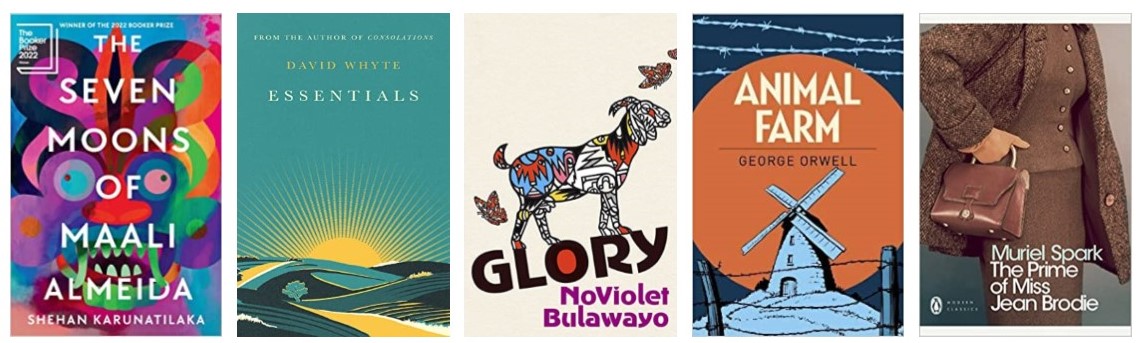
The Seven Moons Of Maali Almeida (Shehan Karunatilaka): Right, this is a FIRST. Once I’ve started a book, I ALWAYS finish it… but I’m afraid that, this time (despite the fact that the book only went and won the 2022 Booker Prize, for goodness sake!!), I gave up. The book is set amid the murderous mayhem of the civil war in Sri Lanka, 1990. Maali Ameida, war photographer, has woken up dead and his dismembered body is sinking into a lake and he has no idea how he died. In the afterlife, he has seven moons to try to contact his beloved friends and lead them to a hidden cache of photos that will rock the country. It’s quite a long book and simply broken down into seven sections (one for each moon)… I yearned for short(ish) chapters to help digest what I was reading. It’s an energetic and hugely imaginative satire but, frankly, it was all too much for me (perhaps just beyond me intellectually?) and I gave up after the first moon (84 pages), feeling somewhat confused, bewildered and something of a failure!
Essentials (David Whyte): Alice gave me this book of poetry+words (she thought that if I liked Mary Oliver, then I’d like David Whyte – and how right she was!) and I’ve been slowly working my way through it, reading 2 or 3 poems each morning (out loud… to myself!). I’d not previously come across Whyte’s work, but his voice has really resonated with me. He’s an Anglo-Irish poet and we’re of a similar age (ok, well, he’s 7 years younger!) and, I think, we share a similar philosophy of life. I loved his poetry and his words… and also that the book included brief comments about the context/background of how he came to write each of the pieces. I loved it… and have ordered another book of his (‘Consolation’) to continue the exploration.
Glory (NoViolet Bulawayo): The author, NoViolet Bulawayo (I just LOVE her name!), grew up in Zimbabwe. Apparently, she first attempted to write about Zimbabwe’s November 2017 coup and the fall of Robert Mugabe in nonfiction, but ended up deciding to go down the political satire route – hence this book. Inspired by George Orwell’s Animal Farm, ‘Glory’ is set in the animal kingdom of Jidada. After a 40-year rule, the “Old Horse” is ousted in a coup, along with his much-despised wife, a donkey named Marvellous. At first there is great rejoicing and hope for change under a new ruling horse (the former vice-president turned rival of Old Horse). But hope soon vanishes and into the period of post-coup despair steps a young goat named Destiny, who returns from exile to bear witness to a land where greed, corruption and false prophets are rampant. It took me some time to get properly ‘into’ this book (it’s 400 pages long)(shortlisted for the Booker Prize 2022) but, once I’d done so, I found it incredibly powerful and quite brilliant.
Animal Farm (George Orwell): I first read this book (first published 1945) ages ago - long before I ever blogged ‘reviews’ – but, after reading ‘Glory’, I thought it was time for a re-read. You’re probably well aware of the story: a farm is taken over by its overworked, mistreated animals. With fiery idealism and stirring slogans, they set out to create a paradise of progress, justice, and equality. This wonderful, satirical book (now nearly 80 years old) records the evolution from revolution against tyranny and, in turn, the devastating converse. The book includes the famous words: “All animals are equal, but some animals are more equal than others”. Times might have changed, but the message is still powerfully fresh. Quite brilliant.
The Prime Of Miss Jean Brodie (Muriel Spark): This is our latest Storysmith book group book (the theme is a non-English British book!). Published in 1961 and set, initially, in the early 1930s, it recounts the exploits of an unconventional, maverick schoolmistress and her free-thinking ideas at a time when the schoolmistress, Jean Brodie, described herself as being in her “prime”. At first, her mysterious glamour and charm dazzle and seduce her girls (they were a set of six: Sandy, Rose, Mary, Jenny, Monica, and Eunice) – “the crème de la crème” – at an Edinburgh school. “Give me a girl at an impressionable age,” she boasts, “and she is mine for life.” Throughout this time the Headmistress is endeavouring to force Miss Brodie out of the school (because of her unconventional teaching methods and attitudes), but Miss Brodie remains defiant. The set remained together under Miss Brodie during their early teenage years but, gradually, the sense of obsession and obedience begins to fade as the girls mature and, ultimately end in her downfall/betrayal. I can’t quite believe I’ve not read it before now (and only seen snippets of the film)… but I thought it was rather wonderful. Beautifully-written, very funny but also poignant and intriguing. 

Tuesday, March 07, 2023

broker…

I went along to the Watershed this afternoon to see Hirokazu Kore-eda’s film “Broker”. It’s set in Korea and inspired by the Korean phenomenon of ‘baby boxes’ put out by churches for unwanted newborns (I’d never heard about these ‘baby boxes’ before seeing the film). Korean actor Song Kang-ho plays a volunteer at a local church that has one of these boxes -  but, in reality, he is running a ‘broker’ scam: occasionally he steals a newborn for himself – erasing the church’s CCTV footage that prove a baby was left there – and offers it for sale on the adoption black market, with potential couples lined up by his partner.
Everything falls apart when one of the mothers named, played by Lee-Ji-eun, returns to the church to get her baby back, stumbling onto the operation. Detectives are also on the case… it’s complicated, but I’ll leave it there.
Somewhat surprisingly(?), the film turns out to be something of a ‘feel good’ road movie –
featuring two lovable, flawed men who are apparently romantics at heart.
The Watershed’s blurb describes it as “heartwarming, funny and moving; a film of gentle humanity and great warmth”. However, the Guardian’s critic, Peter Bradshaw, has a slightly different view and sums it up thus (in his 2-star review): “A sudsy road-movie heartwarmer set in Korea… fundamentally silly, with tiringly shallow characterisation and broad streaks of crime-drama intrigue, which only underline the fact that not a single word of it is really believable”!
Actually, while I usually rate Bradshaw’s opinions very highly but, on this occasion, I think his verdict is somewhat harsh. I found the film very watchable and I warmed to the characters (despite their flaws). Yes, a difficult subject and, yes, the plot is somewhat far-fetched and, yes, the two blokes were trying to earn money for crimes which involved black market adoptions of newborn infants… but I enjoyed the lighter moments (and there were several).
I actually thought it was very enjoyable and quite charming… sorry Peter!

Wednesday, February 22, 2023

citizen ethics in a time of crisis…

While searching through what we laughingly refer to as our filing system (somewhat predictably, I was unable to trace the actual document I was seeking!), I came across a quite brilliant supplement entitled ‘Citizen Ethics in a Time of Crisis’. It was published in 2010, exactly 13 years ago this week, by the Guardian newspaper (in conjunction with Citizens Ethics Network, Barrow Cadbury and the Joseph Rowntree Charitable Trust). In it, a number of prominent thinkers – philosophers, politicians, economists, theologians and writers – considered how the financial and political events of the previous year (ie. the sense of outrage following such matters as the Banking crisis, Bankers’ bonuses and the MPs’ expenses scandal) had given rise to a crisis of ethics… although it’s interesting that the document relates to “Citizen Ethics” (not politicians’ ethics).
I was so taken by the document that I’d sent away for a copy of 60-page bound version.
 
I’ve been re-reading much of it this morning and it makes for fascinating reflection… especially at this time of a ‘Cost of Living Crisis’, an ‘Energy Crisis’, attitudes towards migration (and refugees) – not to mention (but I will) the dishonesty/lack of integrity of some senior politicians; allegations of sexual misconduct against dozens of MPs; allegations of ‘irregular’ PPE funding during the pandemic, Brexit, Climate Crisis… actually, the list goes on and on).
It speaks about how self-interest and calculation have derailed our values.
 
The document’s articles asked some crucial questions (dozens and dozens of them) – that are JUST as relevant today as they were 13 years ago. Here are just a few examples:
  • Do we leave it to the market to distribute riches or must the state intervene to ensure more justice than market mechanisms have achieved over the last 25 years?
  • We have looked into the abyss where individualism is concerned and we know it won’t do.
  • We have lacked a language to respond. How are we to articulate our misgivings? How can we regain our ability to reason ethically?
  • It is not a manifesto, it is an argument we have left derelict, a crucial public concern.
  • We need a public life with a purpose.
  • A promising measure would be to grant all adults a basic income, leaving it to them to decide how to work. This would make part-time work viable for many.
  • Shareholder value is shorthand for doing whatever it takes to pump up the stock price.
  • What human beings most desire is not material wealth, but social recognition.
  • That the economy should meet human needs means we have to focus on needs, not wants.
  • London and Westminster, the twin epicentres of power, feel as rotten as Rome under Caligula.
  • Politics must come from the people.
  • The ethical human being has a need for meaning in order to sustain a sense of aspiration.
How little has changed in the past 13 years… and, sadly, I suspect things won’t change in my lifetime.
Note: https://www.theguardian.com/commentisfree/series/citizen-ethics

Monday, February 20, 2023

february 2023 books…

Diary Of A Void (Emi Yagi): This is something of a surreal novel (understatement!). The protagonist (Shibata) has a mundane office job at a Tokyo paper-core manufacturing company. She is the only woman in a sea of men and she’s been expected to do ‘little things’ outside of her job description: make coffee for everyone during a client visit, replenish the printer ink, tidy up around the office. One fateful day, she finds she can’t handle this anymore and, on the spur of the moment, decides to ‘become pregnant’… and her life immediately changes. She’s no longer expected (or allowed) to undertake the menial tasks; she’s no longer expected to stay late at the office… In fact, Shibata completely ‘takes on’ her fantasy pregnancy (gets a seat on public transport; watches films in newly-acquired spare time; registers for an aerobics class for expectant mothers etc). She doesn’t go overboard in trying to convince people she’s pregnant, she merely allows people to believe what they want to believe and uses the experience to discover what she really wants out of life. The novel takes us through her ‘pregnancy’ from week 5 to week 40 and beyond (with the help of her Baby-N-Me App!). Intriguing, weird, delightful and entertaining.
A Will To Kill (RV Raman): This is our Storysmith bookgroup’s next book (on ‘whodunnit?’ theme). Published in 2020, it’s RV Raman first novel in the ‘Harith Athreya Mystery’ series and is set in a remote mansion within the Nilgiri mountains of modern-day eastern India. A rich, aging and wheelchair-bound patriarch, Bhaskar, has invited relatives to his mansion, knowing that family members expect to gain from his death, so he writes two conflicting wills (which of them comes into force will depend on how he dies). Harith Athreya, a ‘seasoned investigator’, has been called in to watch what unfolds… It’s a classic ‘classic locked-room murder mystery’ that could have been written by Agatha Christie or her contemporaries (but the mention of mobile phones and people going jogging acts as a stark reminder that it’s not the 1920-40s!). Because it uses typical plot devices from the ‘golden age of crime fiction’, I was initially quite sceptical… but it’s quite a clever, detailed mystery novel and I ended up quite enjoying it (escapism from our present world?!)… and I liked the Athreya character.
Devotions (Mary Oliver): I love Mary Oliver’s writing. I love the simple, crafted reality of her words and her ‘take’ on the world. This is a collection of her poems spanning more than five decades (the first published in 1963, aged 28, the last in 2015)(she died in 2019, aged 83). Her most recent poems are at the beginning of the book… and her first at the end. I read the collection quite slowly – perhaps three or four pieces each morning – and frequently out loud (to myself!). Most of her poems are self-explanatory but, for some, I would have loved to have had some additional words to set things in context perhaps. For me (and perhaps it’s part of my own ageing process?), I think I loved her later poems best… they seemed to capture the wisdom and experience of old age with beautiful simplicity. It’s a VERY special book that I know I will dip into frequently over the coming years.
The Secret Lives Of Church Ladies (Deesha Philyaw): When I first picked up this book, I thought it would be about ladies who ‘do-the-flowers’ at some quintessential English parish church(!). How wrong can you be?! The author is a young, black American woman and the book is a series of short stories exploring the “raw and tender places where Black women and girls dare to follow their desires, and pursue a momentary reprieve from being good” (as the book’s cover puts it). It’s rather wonderful in its way… beautiful, bruised, intimate, sad and very funny. Surprisingly good and very readable.
The Seven Dials Mystery (Agatha Christie): First published in 1929 (we have 34 Christie books on our bookshelves, but this is one I hadn’t previously read!). There’s always room for a classic crime novel as a form of relief from our challenging world. Predictably, it’s set in a world of high society and privilege and features the exploits of Lady Eileen Brent (a highly-intelligent young woman, affectionately known as ‘Bundle’) and Superintendent Battle. Inevitably, there are some deaths and a complex trail of clues and deceptions. Seven Dials turns out to be a seedy nightclub and gambling den and Bundle manages to get into a secret room there, where she hides in a cupboard and witnesses a meeting of seven people wearing hoods with clock faces (as you do!)… I’ll leave things there *no spoilers*. It’s a typical, ingenious Agatha Christie plot but, for my money, I felt somewhat cheated. Instead of being able to make an educated guess at the ‘solution’ on the basis of clues contained within the novel, Christie holds back information which the reader should have had(?) and, on top of that, I felt that the solution itself was pretty preposterous/far-fetched (but I still enjoyed it!). Hey ho! 

Tuesday, February 14, 2023

cricket, lovely cricket…

The cricket season starts in two months’ time (13 April)... and, yes, it's that time of the year for my annual moan about the game!
Gloucestershire are my ‘home’ side (just a short bus-ride away and, thanks to my bus pass, free) and, despite the fact that they were relegated to Division Two last year, I’d still like to attend as many of their 2023 home County Championship games as I can… afterall, this is the format most readily associated with Test Cricket.
“You need to become a member then”, I hear you say.
Basic membership at Gloucestershire costs £256. It includes the five home 4-day County games played in Bristol; attendance at all the home T20 Vitality Blast matches; the home one-day cup matches; and two 4-day games at Cheltenham.
The trouble is that I ONLY want to attend the 4-day games in Bristol.
In reality, the County Championship season is reduced to a mere FIVE games in Bristol (I KNOW!)… three of them take place in ‘balmy’ April and May; one in June; and the final one in the middle of September)… July and August are reserved for bish-bosh cricket (and, of course, 'The Hundred' - which takes up most of August, but doesn't happen in Bristol).
Whatever happened to our so-called ‘Summer Game’?
Last year, I wrote to the club secretary and asked if there were any reduced rates for people like me. Well, it seems they HAD considered it, but decided not to bother.
Daily attendance at Championship games is pathetically poor at Bristol – maybe 200-250 mid-week. Perhaps it would make more sense for the Club to waive entry fees altogether for Championship games? 
Controversial? Foolhardy? Revolutionary? Sensible?
Answers on a postcard…
Think I might just concentrate on watching cricket at Bedminster CC for free instead!


Thursday, February 09, 2023

drive your plow over the bones of the dead…

Moira and I (together with a number of us from my Storysmith bookgroup – the novel of the same name was one of our discussion books) went along to the Bristol Old Vic last night to see international touring company Complicité present a play, directed by Simon McBurney, based on Nobel Prize-winning author Olga Tokarczuk’s novel of the same name.
I’ve previously read the book twice before… so was very keen that the play shouldn’t ruin the book for me. I needn’t have worried!
 
It’s set in a small community on a remote mountainside near the Czech-Polish border. Men from the local hunting club are dying in mysterious circumstances. The principal character, Janina Duszejko (brilliantly played by Amanda Hadingue), is an ex-engineer, environmentalist, devoted astrologer and enthusiastic translator of William Blake… and she has her suspicions (she’s been watching the animals with whom the community shares their isolated, rural home, and believes they are acting strangely)… they couldn’t have committed the murders, could they?
 
Olga Tokarczuk's book is wonderfully weird fable in the form of mystery whodunnit and represents something of a rallying cry for nature (exposing as it sees the hypocrisy of institutional power). Asking such questions as: why is the killing of animals regarded as sport and that of humans murder?
It’s a hugely impressive play. The acting is absolutely excellent throughout and the set design, lighting and music powerfully perfect.
A brilliant evening.
Photo: The image (copyright Bristol Old Vic) actually shows Kathryn Hunter in the role of Janina. She and Hadinque shared the role during the course of the play’s run in Bristol (with Hunter performing 19-31 Jan and Hadinque playing Janina 1-11 Feb).
Footnote: Moira and I usually find ourselves part of the largely silver-haired generation of theatre-goers(!), but we noticed last night that the age range of the audience was significantly younger. Was it something to do with the cost of the tickets perhaps? Last night, tickets were available from £14, whereas they’re often double that... and there was a full house. 

Friday, February 03, 2023

january/february 2023 books…

Tin Man (Sarah Winman): This is the third Winman book I’ve read and I have to admit that I’ve become a huge fan. There are LOTS of reasons I loved this book, namely: a) it was set in Oxford, b) much of the ‘action’ takes place a mere half mile from where we used to live, c) the story takes place at the time when we were actually still living in Oxford, d) the two male characters were pretty well my age… but also e) it is a beautiful story. Ellis, Annie and Michael form a tight friendship and they absolutely adore one another. The novel is about sexual identity and the 1980s Aids epidemic, love, loneliness and loss (heartrending and emotional)… but also about celebrating life and even relinquished dreams. It evoked wonderful memories of our own time as students in the city at that transition stage in our lives… away from home for the first time, full of wonder at finding ourselves in beautiful Oxford, making mistakes but still feeling keen to discover new things, forming new friendships… and still naïve enough, perhaps, to think we could probably change the world. I loved this book.
Pew (Catherine Lacey): This is our next Storysmith bookgroup book. It’s a haunting, mysterious fable about a silent stranger of indeterminate age, gender and ethnicity who wakes up on a pew during Sunday morning service in a church in a small American town. The individual – who for want of a better name is called ‘Pew’ by the family who discover him/her – is unwilling to speak, has no memory of who they are or where they came from (although the opening chapter indicates something of a recent life of rough sleeping). It all takes place in a small, sinister, devout town in the Bible-belt American south and book describes the events of the next seven days in seven chapters. The family who finds Pew decides to ‘do the Christian thing’ and take him/her in. The narrow-minded townspeople can’t agree on anything about Pew (Pew isn’t really given any choice in the matter): some think he’s a child, others believe she’s a young woman… and even the colour of their skin is confusing. To complicate matters, the story takes place over a week leading up to an ominous-sounding ‘Forgiveness Festival’. The fact that Pew doesn’t correspond to community’s conservative Christianity principles presents an intolerable challenge to the town’s ‘leaders’. At times, it almost felt like reading ‘1984’ – where society was insisting on compliance to its rules by all members, without question. A sinister, disturbing and somewhat depressing read.
The Trees (Percival Everett): This is another of the shortlisted Booker Prize 2022 books. It’s potent satire of US racism involving the investigation of gruesome murders in Mississippi (more murders, it seems, than the opening frames of a Clint Eastwood ‘Spaghetti Western’?). The book is, somewhat ridiculously, brilliantly funny (and horrific). It’s set in the small town of Money in deep south Mississippi… and begins with the bizarre murders (and brutal disfigurement) of three members of a dysfunctional white family… but, as one critic points out, unit with its morose matriarch Granny C, her son Wheat Bryant, and her nephew, Junior Junior. “this time it’s the white folks’ turn to be rendered in grotesque caricature, and the actions of this feckless clan are played as broad knockabout, almost like a reverse minstrel show”. It transpires that the family had been partly responsible for the death, by lynching, of a 14-year-old black boy in 1955, after being wrongly accused by a white woman (from the family) of making suggestive remarks. The 105-year-old black grandmother character points out that “Less than 1 percent of lynchers were ever convicted of a crime. Only a fraction of those ever served a sentence… No one was interviewed. No suspects were identified. No one was arrested. No one was charged. No one cared”. The latest murders lead to a gruesome series of copy-cat murders around the country and the plot escalates as the lynched dead begin to rise up. The initial crimes are investigated by (among others) two hilariously funny black officers of the Mississippi Bureau of Investigation. It all gets very complicated(!), but the central focus of the book (taking a direct aim at racism and police violence) leaves a lasting, powerful impression.
Things Fall Apart (Chinua Achebe): This is our Blokes’ Book group’s next book selection. The novel is set in the late 19th century (first published in 1958) and tells a story of the colonisation of Africa at the height of the ‘scramble’ for African territories by the great European powers. It focusses on Okonkwo, a proud and highly respected Igbo from Umuofia, somewhere near the Lower Niger. Okonkwo's clan are farmers, their complex society a patriarchal, democratic one and where village life has not changed substantially in generations…  but then the English arrive, with the Bible and the gun. The white man is allowed to stay, but he essentially regards the incumbents as a primitive people who need to be educated and brought to faith. The story is set against the background of Ibo culture and the complexities and traditions of Umuofian society. It represents something of an embarrassing, shameful indictment of the colonisation of Africa. It’s a stark, beautifully-written, tragic story and I found it profoundly impressive.
Ink (Alice Broadway): This is our daughter’s first book of the ‘Ink Trilogy’ (published in 2017) and, obviously I’ve previously read it (twice)! I re-read it AGAIN while recently staying at Alice’s – having finished the book I’d taken with me. The words on the book’s cover set up the story: “Imagine a world where your every action, your every deed, is marked on your skin for all to see…”. It’s a powerful, quite brilliant, YA novel (me? biased?) written in the form of a fable which in some ways, perhaps, reflects what’s happening in the world today. It’s about truth, wisdom, loyalty, justice, love… it’s about fears and taboos; it’s about greed and power; it’s about belief and conformity; it’s about integrity and honesty… Our daughter has a real gift for storytelling!