Thursday, February 10, 2022

dr semmelweis…


Moira and I went to the theatre for the first time since the FIRST lockdown this afternoon… to see “Dr Semmelweis”, based on an original idea from and featuring Mark Rylance (as the doctor) and developed with Writer Stephen Brown and Director Tom Morris. We’ve missed the theatre hugely and it was great to be back.
You’ve probably never heard of Dr Ignaz Semmelweis, but he was a pioneer (and controversial) surgeon practicing in 19th century Vienna – when the city was confronted by the terrible death toll of childbed fever. Semmelweis, a Hungarian, makes a discovery that had the potential to save hundreds of thousands of new mothers, but he faced strong opposition in the form of the medical establishment – who question his methods, reject his theory and even doubt his sanity.
During the current Covid pandemic, we’ve all been urged to “wash your hands”. Well, although the play was conceived before the pandemic, Semmelweis’s similar pleas for his fellow doctors to wash their hands represents a poignant reminder of how much we’ve learnt and how little we knew.
 
The production was elaborate and very impressive – a total of 22 performers (actors, musicians and dancers) are listed in the programme and, on top of that, there are large creative and production teams. Theatre is an expensive business – and one that’s suffered enormously over the past two grim, pandemic years.
It was an incredibly impressive production, with wonderful performances by very talented performers. The Old Vic was full and the audience’s hugely positive reaction at the end was both appropriate and telling.
I’ve been to a lot of theatre over the years and I’ve seen some pretty outstanding individual performances by some pretty amazing actors, but I honestly don’t think I’ve ever witnessed a performance to match that of Mark Rylance. Utterly mesmerising. Quite, quite breathtaking. It will live in the memory for the rest of my days.
Oh, how I’ve missed the theatre!
PS: ‘Our’ Felix (Hayes) played Dr Ferdinand von Hebra… and, of course, was very good!
PPS: I know I keep going on about face masks(!) but, again, the entire audience wore masks… those few who were unmasked as they took their seats were soon handed a face mask by one of the stewards and asked, unless they were unable to for medical reasons, to do so (and I didn’t see anyone object). 

Tuesday, February 08, 2022

parallel mothers…

I went along to the Watershed AGAIN this afternoon (that’s twice in less than a week – just like old times!), this time to see Pedro Almodóvar’s film “Parallel Mothers”. It’s a baby-swap drama (sorry about the spoiler, but it’s difficult to describe the film without reference to it) about two single mothers (played by Penélope Cruz and Milena Smit) and buried secrets from the Spanish civil war.
These heavily pregnant women share a hospital room and bond over their decision to go it alone. The two women’s newborns are whisked away for observational reasons at the same time… over time, one of them begins to doubt whether her child is really hers and orders a DNA test online. The disquieting results mean that the two women get back in touch and re-establish their extraordinary relationship… and experiences of their own mothers… and also the unhealed wound of Spain’s fascist past. The father of one of children is an anthropologist working with a historical unit formed to trace people murdered by Francoists during the civil war and buried in unmarked mass graves… and the mother (Cruz) believes that her great-grandfather was one such victim.
I think I’d best leave it there (things are somewhat more complicated than I’ve inferred).
I decided to see the film after reading Peter Bradshaw’s 5-star review in The Guardian and, although I did enjoy the film, it left me feeling a little disappointed.
For me, although I found the film both absorbing and quite moving, I also felt it was somewhat contrived and implausible.
PS: Again, I’m delighted to report that the entire audience wore face masks. Thank you Watershed!

january-february 2022 books…

Convenience Store Woman (Sayaka Murata): This is our next Storysmith bookgroup book. It’s a novel about a 36 year-old woman, Keiko, who’s been working in the same Japanese convenience store for 18 years. Keiko is an oddball character (bullied and friendless at school)… she once hit a boy with a spade to stop him fighting; another time she asks her mother if she can eat a dead budgie found in the park. I came to the conclusion that she was perhaps slightly autistic(?) – certainly her love of organisation, structure and routine was hugely important to her. She’s never had a boyfriend. Her parents want her to get a better job. Her friends wonder why she won’t get married… but Keiko loves her job and she’s an excellent employee – efficient, courteous, never late, never absent. She knows what makes her happy and she’s not going to let anyone take her away from her convenience store. Much of the book reads more like a non-fiction description of convenience store life and routines. It’s a ridiculously absurd novel and yet also quite compelling, funny and charming.
No One Is Talking About This (Patricia Lockwood): Four of my friends nominated this novel as their favourite book of 2021… so I thought I’d give it a go! The first half of the book is something of a whirlwind description of the absurdity (and reliance?) of online life. Frankly (not being part of any Twitterworld and not even really understanding such things), it took some time to get my head around what Lockwood was talking about - “the new communication, the new slipstream of information”. It’s written as something of a third-person diary and, clearly, Lockwood is a very gifted, imaginative and exceptional writer - even though I really struggled to keep up with her ‘stream of consciousness’ observations (bluntly, perhaps I’m just not clever enough?). While the second half of the novel continues in similar vein, it abruptly becomes far more ‘real’ in that the central character’s sister becomes pregnant, and the child is born with very severe birth defects (the book’s acknowledgements refer to Lockwood’s real-life sister and brother-in-law who let her “share in their daughter’s life” – she had been diagnosed with Proteus Syndrome). It’s something of an emotional rollercoaster – when (as the book jacket tells us) “real life collides with the increasing absurdity of a world accessed through a screen”. Impressive in its way, but not exactly my particular cup-of-tea.
When The Lights Go Out (Carys Bray): This is our next “Bloke’s Books” selection. It’s a novel about relationships and families set against the background of financial insecurity, climate change and the nature of faith. The husband is something of an obsessive eco-warrior - as well as being a struggling self-employed gardener/odd job man – who’s become a paranoid stockpiler of food, who turns off the domestic heating and is a constant moaner about everything that life conjures up for him; the wife also used to be a keen fighter for the environment, peace, the preservation of public services and worked as a librarian (until they closed her library). She’s now the one left to take up the household burden – coping with her two sons and their challenging, adolescent ways… and her ‘difficult’ husband. They live in the north-west of England, in an area that seems to be regularly battling against flooding issues. Things come to a head at Christmas when the husband’s mother turns up for a visit… and the cracks start to show. I think I’ll leave it there (*no spoilers)… apart from saying that, although the novel addressed a lot of complicated and relevant issues and was a very ‘easy read’, I found it rather lacked depth.
The Beekeeper Of Aleppo (Christy Lefteri): My good friend Ed lent me this book (published in 2019) and I think it’ll end up as one of my books of the year. The author worked in a refugee centre in Athens. While she was hugely affected by the stories she heard of traumatised people from Syria and Afghanistan, she also realised no one else would tell them.  So the tale of Afra, a woman blinded by the explosion that killed her son, and Nuri, her beekeeper husband, formed in her mind. This powerful, courageous book is the result: a heart-breaking story of loss and resilience, but also of love and hope, as the couple escape Syria for, eventually, the UK. At least 350,000 people have died in 10 years of fighting in Syria, and this number is likely to be higher according to the UN, with 13.5 million people (half the population) forcibly displaced. The passage in which Nuri describes his meeting with the UK authorities (and the ridiculous questions they asked) when he was seeking asylum is both shocking and shameful. Having worked myself with a 20 year-old asylum-seeker from Afghanistan (whose family had all apparently been killed by the Taliban) for 18 months and being instructed that I shouldn’t ask him for details of his ‘story’/journey to the UK, I’m well aware of some of the frustrations of this broken process. My friend was refused asylum and has had to appeal against the decision – largely, it seems, because he got some details of his story ‘wrong’ (his passport indicated he’d been through Greece, for example, but he couldn’t remember… he was 16 at the time and traumatised, for goodness sake! This is a wonderful, inspiring book and I think you’d love it too (and perhaps learn a little about the perils and challenges facing refugees).
Bad Apples (Will Dean): This was my fourth Nordic noir crime novel by Dean - set in the northern wilds of rural Sweden (Dean grew up in the English Midlands and now lives in the middle of a Swedish forest). Tuva Moodyson is a deaf reporter, recently promoted to deputy editor of the local newspaper in Visberg. All I can say is that she works in a pretty dangerous environment (think ‘Midsomer Murders’?) – if it’s not the elks or the wolves, it’s the odd murderer in their midst! I love the Tuva character and the pace of these ‘adventures’… LOTS of suspense and uncertainty. It’s probably best if I don’t try to explain any plot-related stuff (* no spoilers) – except perhaps that ‘heads roll’ and that it’s tense right up to the end. There will no doubt be a sequel. As usual with Dean’s novels, I read it very quickly (and am now ‘in recovery’).

Friday, February 04, 2022

belfast...

Moira and I went along to the Watershed yesterday to see Kenneth Branagh’s autobiographical movie about the Belfast of his childhood.
It’s set in 1969. The family (husband played by Jamie Dornam; long-suffering wife by Caitríona Balfe; and their two sons – played by Lewis McAskie and Jude Hill) lives in a mainly Protestant area of north Belfast, alongside a few Catholic families (and in relative harmony).
But violence explodes when unionist hardmen burn the Catholics out of their homes and set up barricades to protect their new neighbourhood against republican retaliation and the film represents a salient reminder of those awful times – all in the ‘name of religion’(!). 
At times, it all makes for difficult viewing but, thankfully, the despair of the Northern Irish situation is far outweighed by pragmatism and humour of the ‘ordinary’ people.
 
The film is largely shot in a black and white and is beautifully acted. Judi Dench is brilliant as the grandmother; Jude Law is quite remarkable as Buddy; but, for me, the real star was the mother, Caitríona Balfe.
At times, despite the painful references to the ‘Troubles’, it perhaps felt a little too ‘sugar-coated’ or sentimental – helped by the wonderful Van Morrison on the soundtrack (Van Morrison, of course, was the ONLY appropriate music to accompany the film!) – but the mix worked very well for me.
I think my only criticism was the difficulty, at times, in understanding what was being said – not because I couldn’t hear, but because I couldn’t make out what people were saying. Some of this was undoubtedly due to my failure to catch the Northern Irish accent. Sadly, I’ve become so used to watching the telly with sub-titles these days that I really missed them!  
I went to the cinema thinking this film might not be for me… but I was completely wrong. I thought it was rather special.
PS: My second film of the year at the Watershed (and also my second black+white film) and I’m delighted to report that, once again, EVERY member of the audience wore a face-mask!

Tuesday, February 01, 2022

not me guv’…

Sue Gray must be fuming… (I’m fuming!).
Thanks to the intervention of the Met Police, her report on the “alleged gatherings on government premises during Covid restrictions” was ‘limited’, to say the least (the BBC’s Laura Kuenssberg describes it as a “terse summary”).
Despite this, the report was still utterly damning of government leadership (and who leads the government?) – a fact that hardly came as a surprise to anyone who’s been following the reported events. Sadly, because of the Metropolitan Police’s intervention, Gray’s report lacks all the crucial details, including (and I quote from the report): emails; Whatsapp messages; text messages; photographs; and building entry and exit logs. Gray lists 16 ‘gatherings’ and goes on to point out that all but 4 of these are currently being investigated by the Met.
Again quoting from the BBC’s political editor (and, frankly, I could have used any number of quotes from other journalists), “it is there now in black and white for all to see - there was rule breaking at the top of government when the country was living through lockdown. The prime minister's original claim that all the guidelines were followed seems almost farcical now”.
In the past, matters of honesty, integrity, trust and responsibility would have been regarded as essential qualities of any prime minister. Given what we already knew, Mr Johnson should have resigned weeks ago. Given the contents of Ms Gray’s much-edited report, he should have resigned yesterday… but, of course, he didn’t.
 
Many Tory MPs have been hugely critical of the prime minister and have made it clear that he no longer receives their support; many others continue to support Mr Johnson through (blind?) loyalty. Others tell us that they’re going to await outcome of the Met Police’s investigations.
When will that be? A fortnight? A month?
Well, yesterday, the Met Police told us that their investigation “would not take more than a year”.
What an utter, utter farce.

In political terms, the key questions are simply: “Did the prime minister mislead parliament?” and “Did the prime minister break the Covid rules?”. If the answer to either of these is “yes”, then Mr Johnson has to resign. In the ridiculous circumstances that we find ourselves in, surely it’s not asking too much for the Met to begin their investigations (from various comments made yesterday, it seems that they have yet to make a start!) by pursuing the specific allegations relating to the ‘gatherings’ that the prime minister apparently attended? Surely, even by the Met’s own ‘speed of operation’ (apologies for irony), it wouldn’t take more than a few days to establish the facts (afterall, Ms Gray has done much of the groundwork)
But, hey, what do I know! I’m just a boring old fogey who despairs of what we’ve become. 
It shouldn’t be like this.   

Friday, January 21, 2022

cricket, lovely cricket?

After the humiliating Ashes series in Australia, the ECB has just released the cricket fixtures for the coming season. Unsurprisingly, once again, the four-day County Championship games (the closest format to Test cricket) have been largely relegated to the beginning and end of the season – although the ECB is at pains to tell us that this isn’t QUITE as bad as last year. The details obviously very from team to team but, essentially, it will provide six matches in April+May, four games in June+July; and four games in August+September. Once again, the bish-bosh white ball cricket (in the form of the Vitality Blast and Royal London Cup) take pride of place in the height of the English summer – with The Hundred tournament following on from July onwards.
Following events in Australia, people have been reaffirming their belief that Test cricket is the finest form of the game and urging the powers-that-be to make changes to ensure the County Championship is given a much higher priority. Unlike the ‘old days’, the coming season will feature England Test matches against New Zealand… and India… oh, and South Africa – with fixtures being played June-September!
So, if the County Championship is the ‘feeder nursery’ servicing the England Test team with fresh, young talented players, you really do wonder how this will happen.
You really couldn’t make it up.
These days, many of the current England Test players have central contracts from the ECB (20 annual contracts covering both red and white ball cricket). This effectively takes away England’s Test players from the County Championship (eg. I think Joe Root played just the two games for Yorkshire last season). So, today’s County cricketers are getting virtually no experience of playing against/with Test cricketers… until perhaps (if they’re very ‘lucky’ and England have to seek players from outside the contracted individuals) when they’re ‘called up’ into the Test team (probably at very short notice)!
The four-day County Championship format is the closest to emulating five-day Test cricket. It’s the ONLY ‘training’ format that provides aspiring Test cricketers with the opportunity of ‘building an innings’ or ‘develop bowling techniques and tactics’ or even captaincy. I was brought up watching games played between counties and the international touring sides and these all featured the very best players the English counties could provide – watching cricket that featured ‘proper stars’ of the game. These days, county championship teams are reduced to fielding ‘non-stars’ (featuring players either at the beginning or the end of their careers).
But, as things stand, these county cricketers also have to ‘perform’ in the white-ball, bish-bosh games to justify their place at their county clubs.
You really couldn’t make it up.
As you’re probably aware (from my various cricket blogposts over the years), I am a great lover of County Cricket – I enjoy its rhythm and pace, the traditional field settings (not like the limited overs games with fielders frequently relegated to the boundary rope), the tactics and the skills. Yes, I’m definitely an old codger, but I genuinely fear for the future of the game unless drastic changes are made over the next two or three seasons. I absolutely accept that the limited overs cricket matches provide the counties with a significant proportion of their finances (other than the sums provided by the ECB from Test Match incomes) but I do believe that the game needs to be fundamentally changed to cater for two DIFFERENT formats of cricket in which counties each have TWO teams – one exclusively for red-ball matches and the other for the white-ball game. I also feel that the number of Test Matches needs to be reduced, so that England Test players (for example) are able to perform in far more County Championship games (and also allow more international cricketers to be able spend time learning the game in its traditional format).
Yes, I’m just a boring, old cricket-lover and, yes, the Australia, India and New Zealand Test cricket sides don’t seem to be suffering in the same way as their English counterparts… but SOMETHING has to be done (and quickly!).
But, hey, what do I know?! 

the tragedy of macbeth…

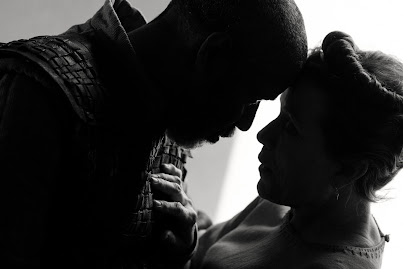
I went to the Watershed yesterday - for only the third time in the past two years (I know!) - to see Joel Coen’s “The Tragedy of Macbeth”, featuring Denzel Washington (Macbeth) and Frances McDormand (Lady Macbeth). We all know the Shakespeare play and there was part of me wondering why they were making another film of it (there have been at least seven other screen adaptations).
But, frankly, it was worth it. Washington and McDormand were both predictably brilliant and the stark black and white film portrayal powerfully and wonderfully apt. I loved designer Stefan Dechant’s imagining of Macbeth’s castle as a giant modernist house, with ‘sharp’ edges, dramatic level changes and courtyards enclosed by huge high walls. The witch apparition was disturbingly impressive and I found Birnam Wood ‘coming to’ Macbeth’s castle, with Malcolm’s soldiers holding tree-branches over their heads, eerily effective.
All in all, it was very good to be back in the cinema (and, happily, EVERYONE was wearing a face-mask!).

Monday, January 17, 2022

january 2022 books…

Allegorizings (Jan Morris): As you probably know, I’m a great lover of Morris’s books. I still regret that I no longer have the hardback copy of the James Morris edition of ‘Oxford’ (published in 1965)(I’ve owned the Jan Morris paperback version, published in 1978, since 1979)… clearly, I ‘lent’ it to someone and sadly never had it returned. One dictionary definition of ‘allegorize’ is to “interpret or represent symbolically” (just so you know). This book of essays/musings was published in 2021 (one year on from her death at the age of 94) and she was well aware that it would be published posthumously; they’re effectively no more than ‘idle thoughts or perhaps ‘whimsy’ (some serious, but mostly funny and entertaining… and one or two that I frankly found quite boring). The range of subjects is wide (understatement) - from falling over; zoos; whistling; hot water bottles; kindness; about her no longer believing in nationality “or the cursed Nation-State”; and even nose-picking! There’s also a wonderful piece about Princess Diana: in Morris’s opinion, she should “have been given the all-but-superannuated royal yacht Britannia, which nobody knew what to do with, and invited to rollick her way around the world on the national behalf, living it up without inhibition, taking a new boyfriend to every port (or finding one there) and distributing a taste of outrageous English gaiety among the nations”! A lovely, very enjoyable book that I’ll no doubt continue to dip into over the years to come.
Go Went Gone (Jenny Erpenbeck): This novel is set in Germany and tells the story of a retired university professor who found a surprising new community among African asylum-seekers who have set up a tent city in Berlin. It’s a story about displacement, upheaval, race, privilege, nationality, rigid bureaucracy and humanity. It’s profound, unsettling and quite, quite brilliant. Erpenbeck has clearly talked to a lot of people who have been through similar, relentless experiences… and so, with so much research, in many ways, the book doesn’t feel like fiction at all. She writes brilliantly. It’s an extraordinary book. You need to read it.
I Am I Am I Am (Maggie O’Farrell): O’Farrell is one my favourite writers and this is a rather special book. Its sub-title (if that’s the right phrase) is “Seventeen Brushes with Death” and it’s a collection of essays in which O’Farrell chronicles her own ‘near misses’ – including haemorrhage during childbirth, miscarriage and leaping off a harbour wall into the sea as a teenager. I spent much of the book reflecting in amazement that such experiences can all happen to one person (I seem to have come off very lightly, so far, in my life!). Unsurprisingly, it’s brilliantly written and utterly captivating (and shocking… and brave… and moving). Ru lent me the book and I read it in a day. Wonderful.
Azadi (Arundhati Roy): This is a series of essays/lectures that deal with matters of freedom in a world of growing authoritarianism. Unsurprisingly, Roy makes regular reference to matters happening in her native India (and she’s massively critical of Narendra Modi’s government and his Hindu nationalist party: “The infrastructure of fascism is staring us in the face, the pandemic is speeding up that process in unimaginable ways, and yet we hesitate to call it by its name”. The essays have reinforced my realisation of how little I know of the complexities of the country: some 780 languages; more nationalities and sub-nationalities, more indigenous tribes and religions than all of Europe. She writes brilliantly (and persuasively) and uses her essays/lectures as ways of highlighting matters of justice, rights and freedoms in the current hostile environment. It doesn’t make for easy reading… but I think it raises fundamentally important issues.
Miss Benson’s Beetle (Rachel Joyce): I loved Joyce’s “The Unlikely Pilgrimage of Harold Fry” and, in a way, this was another novel about pilgrimage. Set in 1950, it tells the story of two unlikely women travelling to the other side of the world in search of a golden beetle that may or may not exist… trekking through dangerous terrain, breaking all the rules and learning about emotional courage. The two principle characters are rather wonderful (very funny, but also joyous individuals). In many ways, I suppose some might regard this as a ‘woman’s novel’ (although, frankly, I would disagree); what it IS is a tender book about heartfelt friendship, compassion, hope and, as the book’s cover says: ‘second chances’. Reading it was a good excuse to avoid all those depressing stories of people offering excuses to justify a certain prime minister’s alleged actions/rule-breaking escapades over the past nine months or so. 

Thursday, December 30, 2021

new year reflections: december 2021…

I’ve been scribbling New Year reflections on my blog for a number of years now (as always – just a reminder for ME… because I forget stuff so easily!). This now all seems a little tedious and repetitive, so I’ll keep it much shorter than usual! Given the continuing fall-out from the pandemic, this year has been another year of huge uncertainty… and, for some, pain and devastation. In my reflections of a year ago, I referred to “more than 70,000 deaths and some 2.3million cases of Covid-19”; in the past 12 months (and despite the vaccines), these figures have more than doubled.
This year’s reflections are somewhat curtailed compared with previous years…
WONDERFUL BOOKS:
The Storysmith Book Group (run by our lovely local bookshop) has continued to be brilliant - interesting books, lovely people and good fun too (albeit that we had to ‘meet’ via zoom in the early part of the year)… and I’ve also been part of the ‘Blokes Books’ bookgroup involving some great mates – but it seems to take ages to read each book/organise a meet-up! Here are 15 of my favourites (in no particular order): 
Still Life (Sarah Winman), Hamnet (Maggie O’Farrell), English Pastoral (James Rebanks), The Shepherd’s Life (James Rebanks), The Manningtree Witches (AK Blakemore), We’ll Always Have Paris (Emma Beddington), Shuggie Bain (Douglas Stewart), Many Different Kinds Of Love (Michael Rosen), Tales From Lindford (Catherine Fox), Broken Greek (Pete Paphides), Wintering (Katherine May), Homesick (Catrina Davies), Motherwell (Deborah Orr), The Man Who Died Twice (Richard Osman) and And Away (Bob Mortimer).
 
GREAT FILMS:
I’ve continued to watch lots of films via BBC iPlayer (and also, more recently, via Netflix) but, in the circumstances, it seems pointless to list my favourites. I’ve only been to the ‘actual’ cinema twice this year (the beginning of October was the first time since March 2020!)… the two films I saw were ‘Anthropcene: the Human Epoch’ and the wonderful Wes Anderson’s ‘The French Dispatch’.
 
LOVELY LIVE PERFORMANCES/EXHIBITIONS:
It’s been SO sad not to have been able to go to the theatre, concerts and see exhibitions this year. We’ve really missed it. Here are the few that we did get to experience (hardly any!):

THEATRE:
Nil.
CONCERTS:
Karine Polwart (St George’s)(wonderful).
Three Cane Whale (St George’s).
EXHIBITIONS:
Moonlit (Ruth Broadway)(Devon Guild, Bovey Tracey)(brilliant exhibition!!)
Netsuke: Miniature Masterpieces from Japan (Bristol Museum+Art Gallery)
Grayson’s Art Club (Bristol Museum+Art Gallery).
SPORTING MOMENTS:
I haven’t watched ANY first-class sport in the past year. I didn’t renew my season ticket for the Bristol Bears (rugby) due to my reluctance to gather in large crowds. Sadly, I also didn’t get to watch a single first-class cricket game (that’s two years running!)… I went to Bedminster Cricket Club perhaps three or four times (on their beautiful, scenic ground overlooking the suspension bridge), but that was all. Despite my initial reservations, I DID end up watching the cricket ‘Hundred’ competition whenever it was on terrestrial telly – and ended up enjoying it.
  
ART STUFF:
Despite Covid, it’s been another enjoyable, busy year, including:
1. I’ve still very much enjoyed continuing to post a drawing or photograph every day as part of my “One Day Like This” blog (just over 3,400 consecutive days – that’s some 1,700 drawings and 1,700 photographs - since I started in September 2012, more than 9 years ago). Circumstances have limited the number of times I’ve been able to draw ‘on location’, but ‘being adaptable’ has seemed to be the key requirement this year and it’s been fine.
2. The brilliant Drawing Group I joined in 2017 – organised by the lovely, talented artists Charlotte and Alice Pain – has been probably come to an end. Hopefully, we might organise the occasional get-together over the coming months.
3. Sadly, there was no ‘live’ South Bristol Arts Trail again this year (we’d previously participated for 15 consecutive years). Following our house move (and no studio space etc), I’m pretty sure we’ve now done our share of arts trails.
4. Urban Sketchers, Bristol: I’ve continued to really enjoy this wonderful group (which I joined in March 2018)… it’s a worldwide organisation and, here in Bristol, in ‘normal times’, we’d meet up every month and regularly get more than 20 people coming along. This year has again proved difficult(!), but we’ve adapted wonderfully well (again, thanks to technology)… and have continued to ‘meet’ together in various locations around the world via Google/Streetview. Happily, over some of the summer and autumn months, we’ve also been able to meet up ‘on location’ – and it’s been great to be able to meet up with lovely friends again. It’s a real highlight and joy.
5. Blurb book (‘The Winter’s Tale’): I put together another self-published book of photographs (plus a few sketches) – this time covering the second six months of the pandemic (September 20-March 21).
 
HOLIDAYS/LEISURE: 
No proper holidays at all this year (for the second year running) – although we did have two days in Lytham in late October… which, very happily, we were able to combine with a visit to Alice+Dave+co (the first time we’d actually seen the grandchildren for two years!).

SPIRITUAL LIFE: 
We continue to be part of the Community of Saint Stephens in the heart of the city, but I have to admit that, rather like the previous 12 months, I’ve struggled faith-wise over the past year (not helped that our brilliant leader, Lee Barnes, moved on to pastures new in September). We’ve been alternating services with our sister church community at Holy Trinity Hotwells. Church services have continued to be affected by Covid restrictions and, sadly, I’ve missed the intimacy and informality that I felt we used to have (certainly at Saint Stephen’s). Six or so of us ‘meet up’ most Wednesday mornings at 7.30am at the Society Café on the harbourside (or via zoom) for “Bloke’s Prayer”… and it’s something which has proved to be hugely rewarding. Regular Tuesday night ‘Resonate’ meetings have also proved interesting (although, again, reduced in regularity due to Covid).
 
HEALTH:
My health has been pretty good this year… apart from the normal ageing process. My teeth continue to fall out; my back feels ‘delicate’ most mornings when I first wake (but settles down); my hearing is deteriorating (I have hearing aids, but don’t use them!); I take tablets for my atrial fibrillation plus blood thinners and statins; I take eye drops to deter my glaucoma; and I’m pretty sure that my left hip will need replacing over the next few years!!
OTHER STUFF:
We continue to be a no-car household… and use a local car club very occasionally (but only once this year, I think!). We've continued to be rather Bristol-bound - and have only used buses and trains very occasionally.

I love reflecting back on the things that have happened over the previous twelve months and, each year, it’s a reminder that there WILL be some very special things that they will happen in the coming year (setting aside pandemics!) – even though, at this moment, I don’t know what the coming year will bring. Clearly, I’m also aware that there will inevitably be some sad stuff too… and perhaps challenges we feel ill-equipped to face. In such times, families and friendships will, once again, see us through.  

For us as a family, it’s been another good year… and we continue to count our blessings.
I wish you (and all yours) a very happy, healthy and peaceful 2022… and perhaps a return to some kind of normality would be a huge bonus!
Photo: Moira and me on the balcony just after our ‘move’.

2021 (moving) reflections…

Despite the continuing pandemic issues, it’s been a pretty special year for us, so I thought I’d scribble some reflections (for posterity, you understand!). We moved house to a two-bed apartment in the heart of Bristol (the Central Library and Cathedral are our new neighbours). As you might imagine - after living in a three-storey house in Southville for the past 18 years – the adjustment has been quite significant.

It was Moira who was keen for us to make the move… she felt that we needed to have a home that was relatively straightforward to maintain in our dotage (not something that could be said of our 175 year-old Southville house!). We’d talked about a possible move for some time but, frankly, I wasn’t that keen and would have been very happy (or perhaps simply too lazy or stubborn?) to have remained at Mount Pleasant Terrace (MPT) for the rest of our lives. But we were also conscious of the cost implications of maintaining an old house and so that, in the end, was the driving force for our move (despite my own reservations).Inevitably (thank goodness!), it was also Moira who did all the homework (what might be available; size; location; costs etc). I rather opted out of the process – almost on the basis that if I didn’t think about it, we’d stay in our old house!In the event, after perhaps 2 or 3 months of ‘trawling’ by Moira, we began the ‘serious’ process of seeing what was available in April. 

We put our house on the market at the end of April and were very fortunate to have the sale agreed within a matter of a few days. Somewhat ridiculously, you might think, we ourselves only actually viewed one other property before seeing the property that ended up becoming our home. That was at the beginning of May and, again, things went ahead without a hitch and our offer was quickly accepted (and so we were in the fortunate position of having no chain in either selling or purchase!). We ended up ‘moving in’ on 24 August.
Everything has gone remarkable well (so far!) and, even though there were no serious glitches in the whole process (and neither of us had jobs to maintain or childcare to manage!), we did find it all pretty stressful. It certainly made us appreciate the fact that we’d moved at the ‘right’ time… the thought of us moving in, say, 10 years’ time made us realise that, by then, we’d have become incredibly dependent on our children to help us move. The business of ‘downsizing’ has obviously been quite tough at times (especially given all the stuff we used to store in the basement at MPT and ALL of our books – well over 2,000 of them)(we gave away some 600 others to charity), but we seem to have managed the changes remarkably well. Much of our old furniture has been sold or given away and we’ve managed to purchase more practical replacements. Thanks, in part, to the wonderful help from son-in-law Dave, we now have shelves, worktops and storage units in place (I did produce some shelves myself, but not in the same class!). Thanks to Mary+Amy (Painting in Plaits), we’ve redecorated the living/dining area. We’ve installed a new carpet, changed light fittings. In short, within four months of moving, we’ve basically managed to ‘sort out’ the apartment to our satisfaction… and, as an added bonus, we didn’t put the heating on until the start of December!!

So, coming towards the end of the year, we look back and feel very ‘good’ about our move. We love the apartment’s location – within a stone’s throw of College Green – with easy access to a multitude of bus routes (including to Ru+Stu’s and Han+Fee’s, as necessary), train station, theatre, cinema, concert halls, galleries, harbour, church and the like. I particularly love the fact that the Watershed cinema – somewhere I would frequent on almost a weekly basis pre-Covid - is now only a 5-minute walk away… so I’m hoping to get back into cinema-going again in 2022 (albeit still cautiously). We’ve also been pleasantly surprised that supermarket (and other) deliveries have been very straightforward and efficient. There are some downsides, of course. The main one is the lack of small, independent stores nearby… we have the fortnightly farmers’ market at St Nick’s (and, of course, Hugo’s fruit+veg and Storysmith bookshop is still only a 30 minute walk away). I love walking through College Green in the early morning (especially with the sunlit breaking through the trees)… and having Brandon Hill on our doorstep (literally) is a huge bonus.

Obviously, moving away from MPT has also meant that we no longer have the studio in the basement… and, of course (and very sadly), Ru has had to find herself alternative studio space. We hugely miss having Ru with us on a regular basis for morning coffees and snack lunches. In the same way, we miss having Iris+Rosa round for supper a couple of times a week after school. Obviously, our apartment is no longer on the school route, so things would have changed anyway but, after 18 months of ‘lockdown’, they’re both 20 months older and far more independent are into very different routines these days.

Our apartment is two floors up from the street frontage (four floors up on the south side)(and with a decent lift!). We love our south-facing balcony – which runs the full width of our living/dining area and allows in plenty of sunlight. Living on an upper floor level, we’ve also discovered the added bonus (given the fully-glazed ‘wall’ between our living/dining area and balcony) of being even more aware of the sky… and, strangely, of the birdlife. Perhaps because I’m more aware of observing early mornings from our balcony, I haven’t been on as many ‘dawn walks’ as I used to… but I’m also aware that the Broken Dock/Millennium Promenade might have become my ‘Marina substitute place’ (although it’s more impressive at dusk than dawn).

Some people will no doubt see our move as something of a concluding chapter as we enter our ‘declining years’(!)… but, perhaps somewhat strangely, we see it simply as the next chapter in our ‘life adventure’ together. We don’t quite know what the future will bring, but it feels like an exciting time - with fresh challenges and new things to discovery and enjoy. 
We feel very fortunate people. X
Photo: balcony skies. 

Wednesday, December 29, 2021

december 2021 books…

The Migrant (Paul Alkazraji): This is our next Bloke’s Books book. The novel is set in the Balkan Peninsula at a time when Greece was struggling with the aftermath of its debt crisis and austerity and in a world featuring “fascist populists, callous sex-traffickers and violent anti-austerity riots” - in which an English pastor, based in Albania, sets out to “rescue” a “vulnerable 19-year old from the Athenian underworld”. I’m afraid I really didn’t like this book at all. I thought it was poorly written and I frequently found the writing style laughably appalling. I thought the plot was flawed (or, at the very least, made me question why so many people were unreasonably put in danger in order to ‘justify’ the plot); I found it exasperating when characters paused and prayed at various stages (I should have realised that “Instant Apostle” is a pioneering publishing house “seeking to bring new and existing authors to the market” and that they publish books “written from a Christian perspective”)(much too ‘evangelical for my liking!). I thought it was poorly edited (if at all) and it seemed that the writer was desperate to impress his readers that he’d put in his research – to the extent that descriptions were frequently far too detailed (and massively unnecessary). I was SO pleased when I finished the book.
The Honjin Murders (Seishi Yokomizo): First published in serial form in 1946, this murder mystery novel, set in a Japanese village in 1937, is the first Yokomizo book I’ve read. It features a young, somewhat scruffy-looking, amateur detective by the name of Kosuke Kindaichi (now regarded as Japan’s most famous fictional detectives) who arrives on the scene to solve a seemingly impossible crime. The book takes the form of the classic crimes novels of the 1920s-40s – with meticulous detail, blind turns, red herrings, dubious alibis and an ingenious (if rather ridiculously-complicated) plot. Enjoyable and entertaining nevertheless.
Carry On, Jeeves (PG Wodehouse): I succumbed to the prospect of (yet) another Jeeves+Wooster book… this one (first published in 1925) is a series of short(ish) stories and observations supposedly from the hand of Wooster (except for the final one – penned in the words of his gentleman’s gentleman). They’re all very predictable… about the hallowed world of the moneyed aristocracy and privilege (which, naturally, includes an Oxbridge education despite the apparent lack of intellect). It’s all painfully familiar – with Jeeves coming to the rescue whenever Wooster or his friends require an excuse to break an engagement (of the impending marriage kind); or salvaging honour from an ill-advised business venture; or avoiding the wrath of an ancient aunt (always aunts!) or whatever. It all makes for light, hilarious, entertaining reading (Wodehouse has an absolute gift for dialogue and descriptions) – a very welcome relief from today’s world of political sleaze and disease.
111 Places in Bristol (Martin Booth): This guidebook takes you off the beaten track and identifies 111 quirky, strange and beautiful places to visit in Bristol. I was probably familiar with (or at least aware of) perhaps 90 of those included. A rather lovely reminder of places I need to re-visit or re-discover in our lovely city.


Like last year, the number of books I read in 2021 was somewhat less than in recent years (64… compared with 74 and 94 in 2020 and 2019). Probably something to do with different routines and, of course, time being swallowed by our house move.

Wednesday, December 15, 2021

november-december 2021 books…

Mystery Mile (Margery Allingham): First published in 1930, this is my third Allingham novel (and third ‘Campion Mystery’). I have to admit that I’m not a great lover of the Albert Campion character… Google(!) describes him as: “affable, inoffensive and bland, with a deceptively blank and unintelligent expression”. This book tells the story of an American judge who has found evidence pointing to the identity of a criminal mastermind behind a sinister gang. After four attempts on his life, he seeks the help of Campion. Predictably, it was very much a crime novel of its time – with an intricate plot, middle-class leanings and, of course, came with its own “Map of Mystery Mile” (a Suffolk village joined to the mainland by a narrow road of ‘hard land’ and surrounded by impassable mud flats)! I thought it was fine, but nothing exceptional… a welcome break from the political frustrations and the continuing pandemic concerns.
The Manningtree Witches (AK Blakemore): This is our latest Storysmith bookgroup book (theme: ‘2021 paperback’). The book is a fictional account of the Essex witch trials of the 1640s – a time when puritanical fervour had gripped the nation and when places were depleted of men due to the Civil War. A self-appointed ‘Witch-finder General’ (and his assistant) was active across East Anglia and the Home Counties during this time and was estimated to ‘have had a hand’ in the execution (for witchcraft) of some 100-300 women (and some men). In the past, I’ve frequently expressed a dislike for ‘fictionalised history’ (with all its invented conversations)… but I’ve since been won over by the likes of Hilary Mantel and Maggie O’Farrell! Well, I found this book absolutely compelling – wonderfully written (Blakemore is a prize-winner poet) and extensively researched. It’s a deeply-moving account of the appalling witch-hunts (based on trial accounts) and provides a powerful insight into the fears, lives and deaths of the many voiceless victims. A brilliant book.
Think Like A Mountain (Aldo Leopold): This is a series of beautiful, lyrical essays on America’s wildlands. They were all written before I was born (Leopold died in 1948) and provide a fascinating insight on wildlife ecology and sowed the seeds of contemporary environmental thinking. Leopold recognises and celebrates the interdependence between humanity and the natural world. He was clearly way ahead of his time and was hugely critical of what he saw as the insensitivity and greed of people who were out to change landscapes and habitat for short-term financial gains and long-term environmental catastrophe. A really impressive, thought-provoking and challenging set of essays.
The Man Who Died Twice (Richard Osman): Well, I have to admit that I feel a certain resentment when celebrities already earning a small fortune on television turn their hand to writing books and are quite brilliant at it! You’ve probably read Osman’s amazingly-successful first ‘Thursday Murder Club’ book. If you did, then you have another treat in store with this second one (and, if you didn’t, start dropping massive hints for it to be added to your Christmas stocking). It’s another crime novel set in an affluent retirement village where, every Thursday, four of the over-60s inmates/amateur sleuths gather to investigate stuff that the local police force have failed to solve. This time the plot involves a local teenage thug; a tough-nut female drug dealer who has a ‘soft spot’ (understatement) for the retirement village’s Polish handyman… there are stolen diamonds; high-level dealers and fixers; the mafia; and a somewhat disreputable ex-husband of one of club members. Quite brilliant - very easy, humorous reading, great plot – and with lovely, lovely characters. I didn’t want it to end.  
Essex Girls (Sarah Perry): The book is based on a 2018 Harriet Martineau lecture by Perry as part of the Norfolk+Norwich Festival; the book’s cover boldly states: “For Profane and Opinionated Women Everywhere”. Perry (who was born and raised in Chelmsford) mounts an exhilarating feminist defence of the Essex girl and re-examines her relationship with her much maligned home county. Perry’s publisher sums things up rather well: “In this brilliantly wide-ranging and fiercely feminist essay, she embraces her native county with both arms, celebrating the many Essex girls past and present who have refused to be quiet or know their place, and helping us to see why we should all allow our inner Essex girls out with pride”. A fascinating read – even for blokes! 

Sunday, December 05, 2021

three cane whale at st george’s…

Last night, I went to the Three Cane Whale concert at St George’s, Bristol. I think this was something like the seventh time I’ve seen them perform (but who’s counting?). They’re an extraordinary, ridiculously-talented group of musicians (Alex Vann, Pete Judge and Paul Bradley) … last night, they played some 14 different musical instruments between them!
After missing out on their regular pre-Christmas concert at St George’s last year, due to the pandemic, it was lovely to have them ‘back’ last night. A lot of their music is associated with ‘place’; they’ve recorded a number of their pieces ‘on location’ – in barns and old chapels… but also on hillsides – which seemed to fit in perfectly with many people’s pandemic experiences and the need to reconnect with nature.
It proved to be a wonderful, mesmerising, uplifting evening in a perfect venue… joyous, intricate, poignant and magical music. 
An occasion to gladden the hearts and to remind us about some of the ‘good stuff’ out there in these difficult times of continuing uncertainty, political sleaze, selfishness, greed, climate crisis and the increasing gap between the haves and the have-nots.
PS: The support ‘band’ was pretty amazing too! ‘Eleven Magpies’ – a perfect foil to the ‘main act’!
Photo: ‘Three Cane Whale’ plus ‘Eleven Magpies’ at last night’s concert. 

Tuesday, November 23, 2021

october-november 2021 books…


Still Life (Sarah Winman):
This is a JOYOUS book… I absolutely loved it. It begins in 1944, in the ruined wine cellar of Tuscan villa. A soldier and a sexagenarian art historian (she has come to Italy to salvage paintings from the ruins and to relive her memories of Florence) meet and share an extraordinary evening together… They discover they are kindred spirits and her love of truth and beauty plants a seed that will shape the soldier’s life over the next our decades. The story takes in the Tuscan hills, the piazzas of Florence and the East End of London and, in doing so, introduces us to a collection of a rather wonderful characters (and a Shakespeare-quoting parrot!). It’s a book about people; about found family and friendships; about beauty; and about art, love and the everyday unfolding of life. It’s quite, quite magical.  While reading the book, I came across a blogpost by the author in which she said this: “I, consciously, wanted to write a book that was pro-European, joyous and kind – the antithesis of the stories being told in the tabloid press and government. I wanted to write a book about togetherness and opportunity”. Absolutely!! I think you need to read it (it’s not yet out in paperback, but would make a wonderful Christmas present!).
Motherwell: A Girlhood (Deborah Orr): This memoir (published in 2020) by renowned journalist Deborah Orr – who died from breast cancer in 2019, aged 57 – about her working-class Scottish life growing up in Motherwell in the 1960s+70s and about her loving, but difficult, relationship with her parents (Win and John). Orr summarised the relationship thus: “The rules were Win’s – and the power – but John tended to be their enforcer”. It’s a raw, compelling, unsentimental book about a tense and growing unease between them… but it’s also full of compassion, warmth and humour. Orr wrote the book several years after the death of both parents and, in some ways, uses it as an attempt to make sense of her upbringing in a town dominated by Ravenscraig steelworks (where her father worked). The word “narcissism” seems to occur on every other page and the vivid portrait of her parents’ narcissism (and also of her own) is central to the struggle of their lives and relationship. I thought it was pretty brilliant.
Hangman’s Holiday (Dorothy L Sayers): I think this is my first Dorothy L Sayers’ book (I know!). This is a collection of short ‘detective’ stories (first published in 1933) featuring, among others, her well-loved character Lord Peter Wimsey and the lesser-known Mr Montague Egg. The stories are entertaining, fairly ‘light’ in nature and, understandably, pretty dated(!). They seem to follow the well-trodden guidelines for all crime fiction authors of that ‘golden age’: set the scene in some detail; follow a long line of intricate (and sometimes quite laughable) deductions; and, finally, reveal the scientific solution. Along the way, we come across the somewhat cruel depiction of policeman (of various ranks) – who all seem to talk like this: “Best be off, sir… I’ll settle this. Now, my lad…”. But, hey, at a time when the world seems fall of bad news and difficult issues, we all need some escapist crime fiction!
The Hidden Life Of Trees (Peter Wohlleben): This wouldn’t be my ‘normal’ book genre choice, but I was intrigued by the title and decided to ‘give it a go’. I’m afraid it really didn’t capture my imagination at all. Wohlleben manages a forest in the Eifel mountains in Germany. He knows an awful lot about trees and the book is full of fascinating aspects of life, death and regeneration in his woodland… but I’m afraid he’s no Attenborough or MacFarlane! I found his writing style (perhaps not helped by the translation?) very dry and even boring. Perhaps he tried to incorporate too many factual details in this 250-page book? Perhaps he should have concentrated on far fewer of them? I’m sure that there will LOTS of people who find the book wonderfully absorbing… but I’m afraid I wasn’t one of them.
And Away (Bob Mortimer): Mortimer’s an interesting bloke. He’s intelligent and funny… and I’ve absolutely loved the ‘Gone Fishing’ telly programmes (with Mortimer and Paul Whitehouse). The framework for this memoir (and in many ways of the ‘Gone Fishing’ programme) was the unnerving experience of being diagnosed with a heart condition in 2015. It’s a poignant and affirming memoir reflecting on his childhood in Middlesbrough, his shyness, his work as a solicitor and the chance encounter in a London pub when he first met an aspiring comedian by the name of Vic Reeves. I consumed this book in three days and loved it (I smiled a lot).

Friday, October 29, 2021

september-october 2021 books…

A Singular Vision: Dod Procter 1890-1972 (Alison James): I have something of a passion for UK art of the 1920s and 30s and first came across Dod Procter’s work via a book I read about one of her contemporary artists (and lifelong friend), Dame Laura Knight. Her family moved to Newlyn in 1907, after the death of her father, and there enrolled at the school of painting, aged 15. For a period in the 1920s, she was perhaps the most famous artist in Britain and her painting ‘Morning’ (of a reclining young woman) caught the public imagination and was purchased ‘for the nation’ by the Daily Mail from the Royal Academy annual show in 1927. She was elected an RA in 1932 (a rare event for women at that time). There’s a piece in the book about the RA’s Annual Banquet to which, shockingly (but at the same time perhaps not so surprising!), no women were allowed. Procter was an RA for 25 YEARS before she was allowed to attend this event! I love Procter’s paintings of women (I’m not so keen on her flower pieces)… but, sadly, it seems that ‘difficulties’ with interpreting images of children and adolescents are rooted in the contemporary sensitivities of an age have resulted in her work now being regarded as ‘unfashionable’… which is a great shame. I very much enjoyed the book.
The Sin Of Certainty (Peter Enns): My friend Phil recommended this book (quite appropriate in my on-going spiritual wilderness). For some time now, I’ve been frequently frustrated (and even a little infuriated at times!) by Christians (some writers and some friends) who seem to possess a glowing, rose-tinted faith (lucky them!) and who seem to believe that ALL Christians have the same positive faith experiences as them (and, maybe, if you haven’t, perhaps you’re not a REAL Christian – don’t get me started!). Well, let’s just say that some of us struggle on our spiritual journeys! This is something of a confessional book… about how Enns came to understand belief and faith more in terms of trust and love than in terms of facts and knowledge. At times, I found his writing style similar to that of Rob Bell. Although I found some of the book a little meandering at times (and the American way of expressing things a little irritating on occasions), I did get a lot out of it – it’s accessible, thought-provoking and, for me, relevant. A book I may need to re-visit from time to time.
The Buried Giant (Kazuo Ishiguro): This is our next Bloke’s Books book (chosen by Ed). It’s something of a fable, set in Britain’s mythical past… about Arthurian myths, about Saxons and Britons fighting over the abandoned Roman province of Britannia (complete with dragons and warring knights!). On the face of it, perhaps not an obvious book choice for old codgers like us! The book’s about faded memories (or even memories that may be false)… about a time that existed in the shadow of near-total oblivion (“this land had become cursed with a mist of forgetfulness”). Crucially, however, it’s also a portrait of marital love… it features a devoted, elderly couple who set off across a troubled land of mist and rain in the hope of finding a son they haven’t seen for years. As the book’s cover suggests: “they expect to face many hazards – some strange and other-worldly – but they cannot yet foresee how their journey will reveal to them dark and corners of their love for one another”. It’s a haunting, atmospheric, moving and unsettling novel (at times, it felt like reading a Tolkien story) that asks difficult and revealing questions about love and mortality. It’s a beautiful, unsettling and deeply affecting book (one of those that remain with you long after you’ve finished the final page).
The Picture Of Dorian Gray (Oscar Wilde): This is our next Storysmith bookgroup book (first published in 1891). It’s a story of evil, debauchery and scandal… about Dorian Gray - a beautiful, yet corrupt, man. It was Oscar Wilde’s only novel and you sense, knowing what happened to Wilde in ‘real life’, that the main character reflected something of the author himself. I must admit that when I read the preface to the book – which merely lists a series of bold declarations about the nature of art and beauty – I feared the worse. I thought the entire book would contain a series of complex, philosophical declarations that would frankly be above my intellect (or my capacity to want to bother to even try to understand). In the event, I found it an intriguing and beautifully-written book – especially in the light of Wilde’s own subsequent experiences. The story revolves around a portrait of Dorian Gray by artist Basil Hallward – who was impressed and infatuated by Gray's beauty. Through Hallward, Gray meets Lord Henry Wotton (a thoroughly detestable individual in my view!), and he soon is enthralled by the aristocrat's self-indulgent worldview (ie. that beauty and sensual fulfilment are the only things worth pursuing in life). Under Wootton’s powerful influence, Gray acknowledges that his own beauty will fade, but expresses the desire to sell his soul, to ensure that the picture, rather than he, will age and fade. His wish is granted, and Gray pursues a disparaging life of varied amoral experiences while staying young and beautiful; all the while, his portrait ages and records every one of Gray's misdemeanours. When the book was first published (in novella format), it apparently caused considerable controversy and various parts were duly edited before the final novel was printed (these apparently involved obscuring homoerotic references, to simplify the moral message of the story). It’s clearly a book ‘of its time’ but, in addition to the book’s homophobic undertones, it’s a book about class (and class struggle), privilege, wealth, vanity, male dominance, selfishness and morality. I enjoyed the book far more than I had anticipated.
Not The End Of the World (Kate Atkinson): I love Kate Atkinson’s writing. This book of twelve short stories (first published in 2002) is described on the book’s cover as “playful and profound”… and I think that’s a very good description. The individual stories frequently have some passing reference to characters or situations described in the other stories. I read half of the book on a train journey and found them perfect travelling companions… funny, quirky and quite compelling. I particularly loved the Charlene and Trudi characters (obsessively making lists while “bombs explode softly in the streets outside”) in the first and final stories.

Friday, October 22, 2021

the french dispatch…

Moira and I went to the Watershed this afternoon to see Wes Anderson’s film “The French Dispatch” – a tribute to the New Yorker magazine. It was the first time we’d been to the cinema together since the start of the pandemic (and also only my second visit to the cinema in 19 months).
I absolutely love Wes Anderson films – they’re always a visual delight… and wonderfully inventive, silly, hilarious and hugely entertaining.
This film did not disappoint! I loved it.
It really was an homage to a legendary list of writers and (in the words of The Guardian’s Peter Bradshaw) “a famed insistence on standards, collegiate office culture, distinctive cartoons and typographic layout, metropolitan sophistication targeted at a general American readership”. Frankly, I’d never heard of the magazine, but I warmed to it immediately (and, frankly, it didn’t matter at all anyway).
The film is ridiculously FULL of famous actors… I can imagine actors queuing up just to be considered for any Anderson film.
Visually, I love Anderson’s symmetrical, front-on, backdrop facades and also his colour blends (these also included a number of black+white scenes and also some clever, amusing animation). Half way through the film, I realised that I’d taken the brilliant ‘background music’ completely for granted and so, in the film’s latter stages, I tried my best to focus on it. It really is very beautifully done. So impressively simple and yet so important.
It was lovely to be back in the cinema again and, frankly, if I’d had a free choice of film to watch, it would have been something by Anderson.
I loved it… and it made very happy. 

Wednesday, October 13, 2021

karine polwart in concert…

I went to see Karine Polwart in concert at St George’s tonight – my first concert for nearly two years. I first saw her at Greenbelt in 2005 and, apparently (according to my blog – which, essentially, I only keep as a memory-jogger!), have now seen her seven times.
It proved to be another wonderful evening. The last time I saw her was in 2018 and at that time I wrote: “Powerful, intelligent, thought-provoking, political, tender, poignant music at its very best. She’s an eloquent poet (and she’s frequently funny too). She’s a person who reminds you that small voices are important. She’s an inspiration.
At this time when so many of us are disenchanted by politics and what’s happening in the world, last night was a wonderful reminder that there ARE decent, inspiring people who demand to be heard.  
May it be so”.
I absolutely love her music and have come to realise over the years that, for me, Polwart is probably second only to Joni Mitchell in my list of favourite singer/songwriters. The evening was a mixture of new and old songs… and I found the older, familiar ones, in particular, very poignant (memory-joggers) and I even found myself feeling quite emotional at times (but, hey, that’s probably just me in my old age!).
The audience clearly loved her and, hopefully, she’ll be back in Bristol again very soon.
PS: The only negative aspect of the evening was that Iris wasn’t able to attend (it would have been her first ‘real’ concert); she’d had her first Covid jab the day before and spent today feeling on the verge of being physically sick and therefore, very reluctantly, decided she couldn’t leave home. Hopefully, we’ll be able to sort out another concert in the foreseeable future.
I was particularly sad about Iris missing the concert because I sense that Polwart – having studied politics and philosophy at university and being a strong advocate for women, the environment, climate change and the like – represents a potential role model for Iris… and we all need good role models in life!
Photo: Karine Polwart in concert tonight at St George’s. 

Sunday, October 10, 2021

anthropcene: the human epoch + a short film about ice…

I went to the Watershed for the first time in 18 months (I know)!
The first film (2018, directed by Nicholas de Pencier, Jennifer Baichwal and Edward Burtynsky) focused on how human activities have made significant lasting and potentially irreversible changes to the Earth… from the devastated Great Barrier Reef in Australia, to the concrete seawalls that cover 60 percent of mainland China's coast, to the biggest terrestrial machines ever built in Germany, to psychedelic potash mines in Russia's Ural Mountains, to surreal lithium evaporation ponds in the Atacama Desert. From the harsh industrial landscapes of Siberia, to the towering white mountains of marble in Carrara, Italy, to the uneven plastic peaks of Dandora Landfill in Kenya, watch the aggressive extraction of the planet’s resources in astonishing scale and devastating beauty. Six continents and stunning (and sometimes quite chilling) images chronicling the catastrophic path travelled by our species over the last century.
Following 10 years of research, the Anthropocene Working Group now argue that we are now in a new geologic phase (the Anthropocene epoch) - a time when humans now change the Earth (in significant lasting and potentially irreversible ways) more than all the planet’s natural processes combined.
My gut feeling was that perhaps the film could have been broken down somewhat differently in terms of subject matter/’chapters’ but, nevertheless, it’s an impressive and powerful film.
The other film (directed by Hannah+Felix’s friend Adam Laity) was rather lovely – beautiful (and frequently devastating) images of fragile landscapes set alongside poetry and literary extracts.
PS: I have to say that I’d been feeling somewhat apprehensive about returning to my regular cinema venue as we begin to emerge from the pandemic (fingers crossed). The Watershed people had put in place a number of sensible safety measures... and these all worked well – apart from the people in the audience who weren’t wearing face-masks (“We will continue to expect everyone to wear a face covering whilst in the cinemas”). There were only some 25 people in the audience but at least half-a-dozen were mask-less. It made me feel very uncomfortable… and, yes, a bit vulnerable.